When to Meet With Your CPA — and What to Bring — Before the 2026 Books Close
Most people meet with their CPA once a year, sometime between February and April, with a folder of forms in hand. By then nearly every number on the return is already locked in. The income has been earned, the expenses have been paid or not, the retirement plan was or wasn't set up, and the estimated payments were or weren't made. The meeting is real work, but it's mostly a record of decisions that happened months earlier — often by default.
If you want the 2026 return to look different, the meeting that matters is the one you have before December 31. We're about ten weeks out. Here's when to schedule time with your CPA this season, what to bring, and what you should leave knowing.
Three meetings, not one
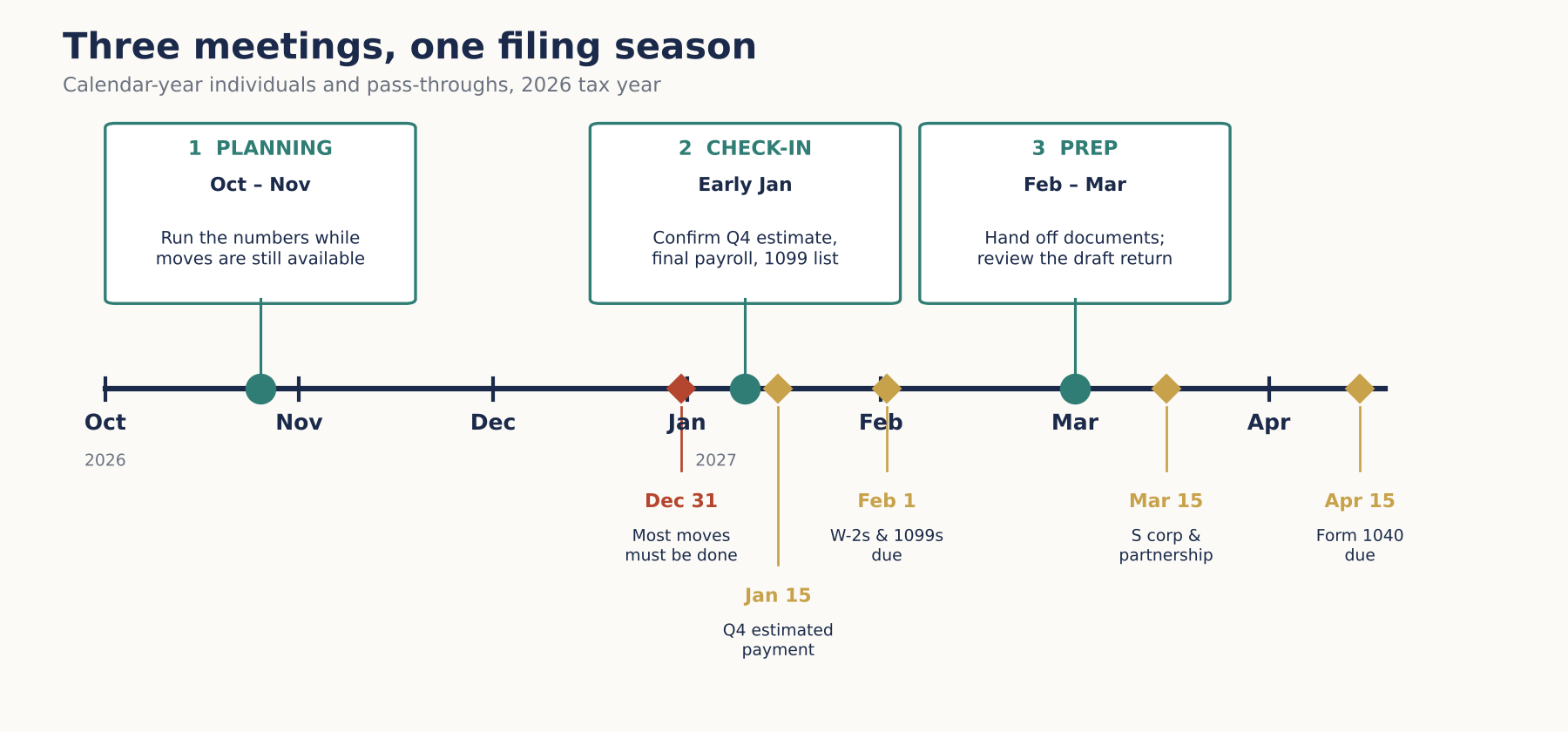
For most business owners and households with any complexity, the filing season works best as three short conversations:
1. The planning meeting (late October through November). This is the one that saves money. Your CPA looks at year-to-date numbers, projects the full year, and tells you what's still adjustable before the calendar runs out.
2. The January check-in. A quick call in the first week or two of January to confirm the fourth-quarter estimated payment (due January 15, 2027), close out payroll, and make sure W-2s and 1099s go out by February 1 — the usual January 31 deadline lands on a Sunday.
3. The prep meeting (February through March). Documents go over, questions get answered, and you review a draft before anything is signed. S corporation and partnership returns are due March 15, and individual returns are due Thursday, April 15, 2027.
The IRS typically opens e-filing in late January. Nothing about your 2026 tax gets better by waiting for it.
Why the October meeting is the one that counts
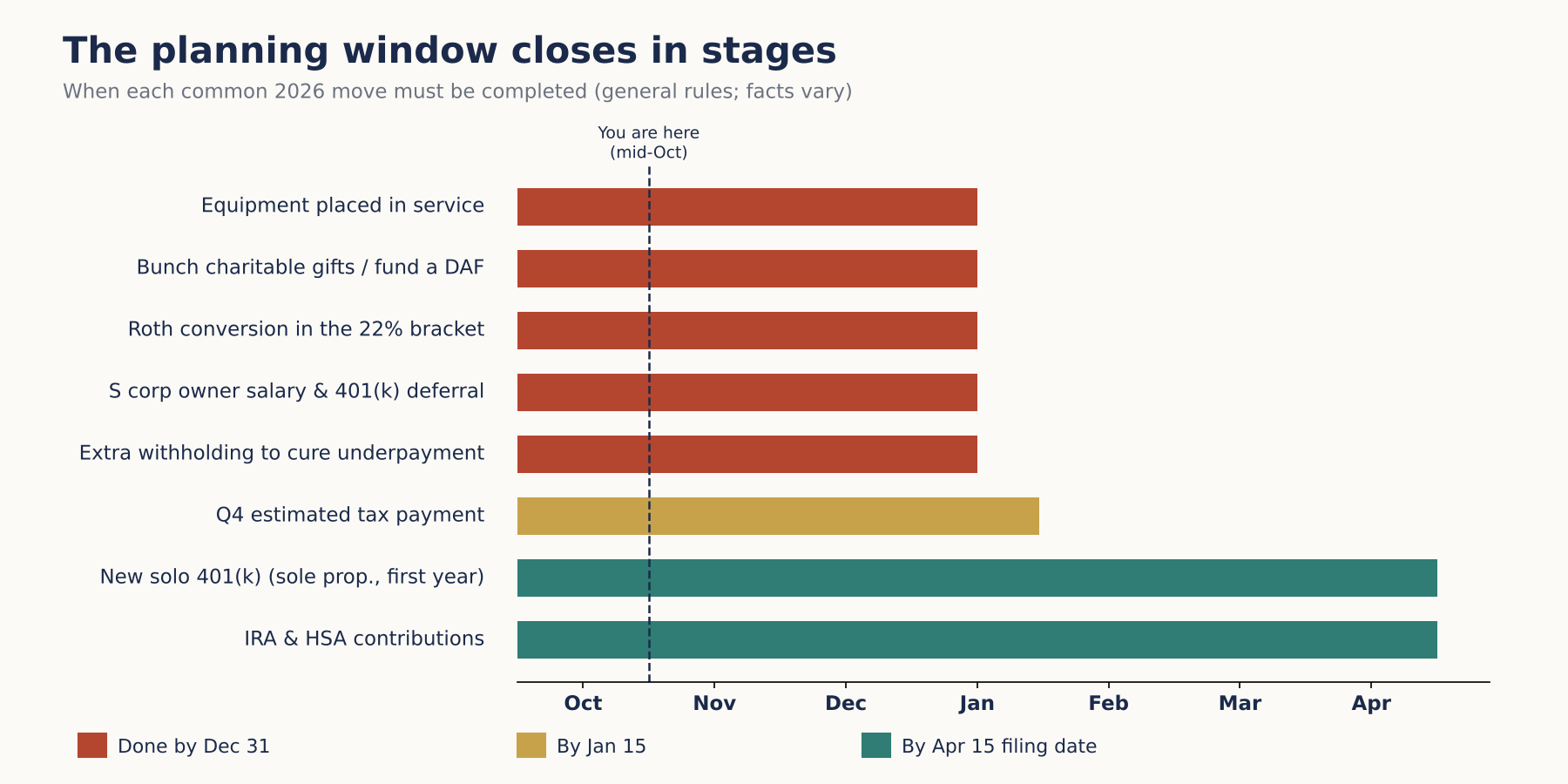
The planning window doesn't close all at once — it closes in stages, and the biggest levers close first. Equipment has to be placed in service by December 31 to be deducted this year. Charitable gifts, including a donor-advised fund contribution for a bunching year, have to be made by December 31. A Roth conversion that fills the rest of your current bracket has to be done by December 31. S corporation owner salary and 401(k) deferrals run through payroll, which means they have to happen by the last pay date of the year.
A few things do survive into the new year: IRA and HSA contributions can be made up to the April filing deadline, and since SECURE 2.0, a sole proprietor can even open a brand-new solo 401(k) for 2026 and fund it — deferrals included — as late as April 15, 2027. But those are the exceptions. Most of the moves I wrote about in The Best 2026 Tax Move Is the One Nobody Brags About, Standard Deduction or Itemize?, and S Corp or C Corp? are decisions with a December 31 deadline, and every one of them depends on knowing what kind of year you're having.
The estimated tax check — while it's still cheap to fix
One item belongs at the top of every fall agenda: are you on track to avoid an underpayment penalty?
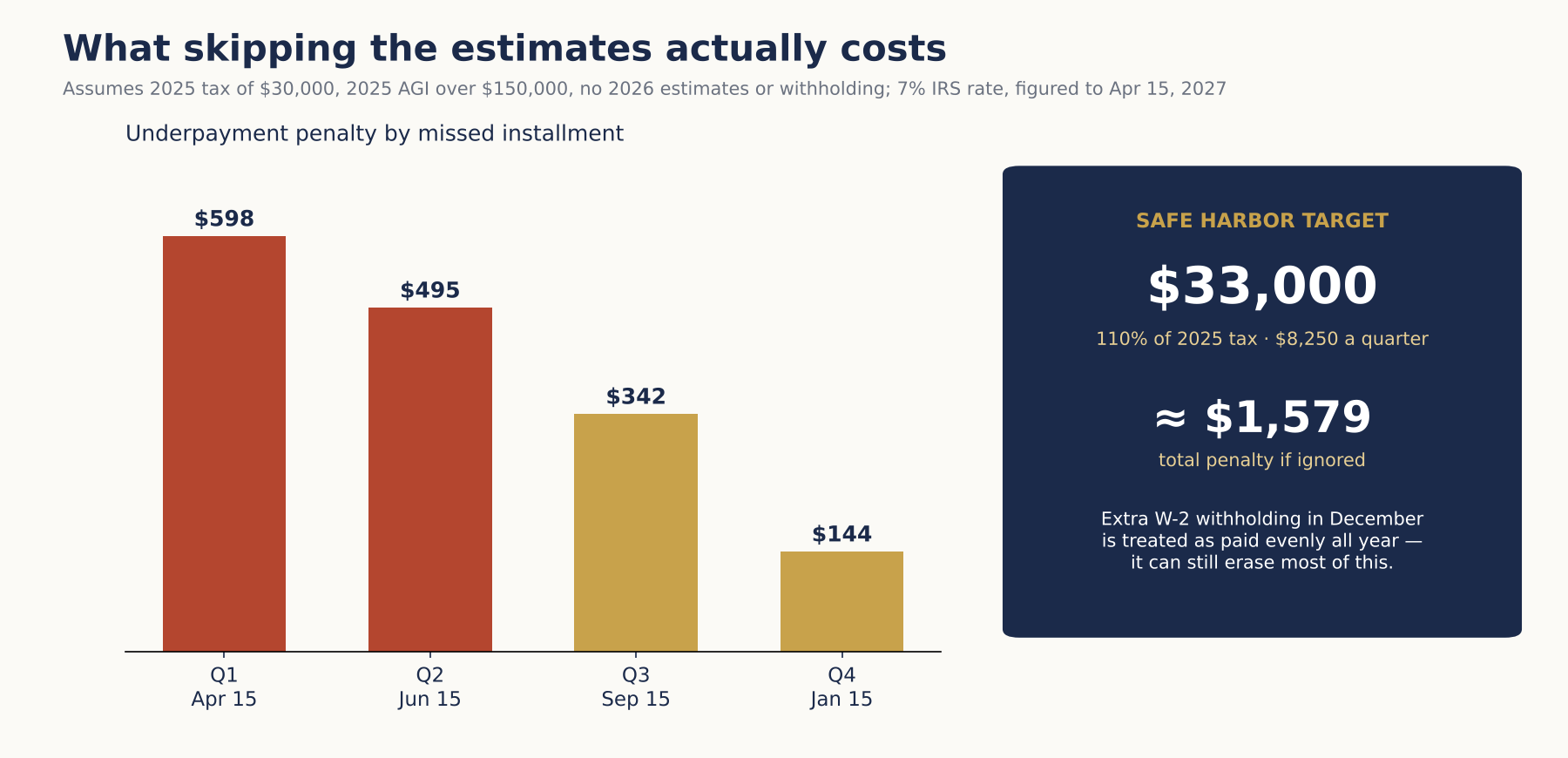
The rule is a safe harbor. You avoid the penalty if your withholding and timely estimates cover 90% of this year's tax, or 100% of last year's — 110% if last year's AGI was over $150,000. The IRS charges 7% a year, compounded daily, on each quarter's shortfall.
Take an owner whose 2025 tax was $30,000 on more than $150,000 of AGI. The safe harbor is $33,000, or $8,250 a quarter. If nothing was paid in through the year, the penalty by April 15 comes to roughly $1,579 — and about $1,435 of that comes from the three installments that were already past due by the time a typical owner sits down in October.
Here's the part worth a meeting: federal income tax withholding is treated as paid evenly through the year, no matter when it actually comes out. A household with W-2 income — including an S corporation owner's own paycheck — can raise withholding in November and December and wipe out most of that penalty retroactively. A late estimated payment can't do that. It's a fix that exists only until the last payroll of the year.
New for 2026: what to put on the list
The 2026 return is the first full year under the One Big Beautiful Bill Act, and several changes are worth raising specifically:
The 1099 threshold rose to $2,000. For payments made in 2026, you generally don't issue a 1099-NEC or most 1099-MISC forms to a contractor paid less than $2,000 — up from $600. Make sure your vendor list and W-9s are current anyway; the forms you do owe are still due February 1.
Tips and overtime show up on W-2s. Employers must now report qualified tips and overtime separately. If you run payroll, confirm your provider is ready. If you earn them, the deduction is up to $25,000 for tips and $12,500 for overtime ($25,000 joint).
The deduction rules moved. The SALT cap is $40,400, itemized charitable gifts face a 0.5% AGI floor, non-itemizers get a new cash-gift deduction, and PMI is deductible again. That's exactly why the standard-versus-itemize call deserves a fresh look before December, not after.
Bigger ceilings, same prerequisite. 100% bonus depreciation, a $2,560,000 §179 limit, and a permanent QBI deduction are all generous — and all useless without current books.
What to bring, and what to ask
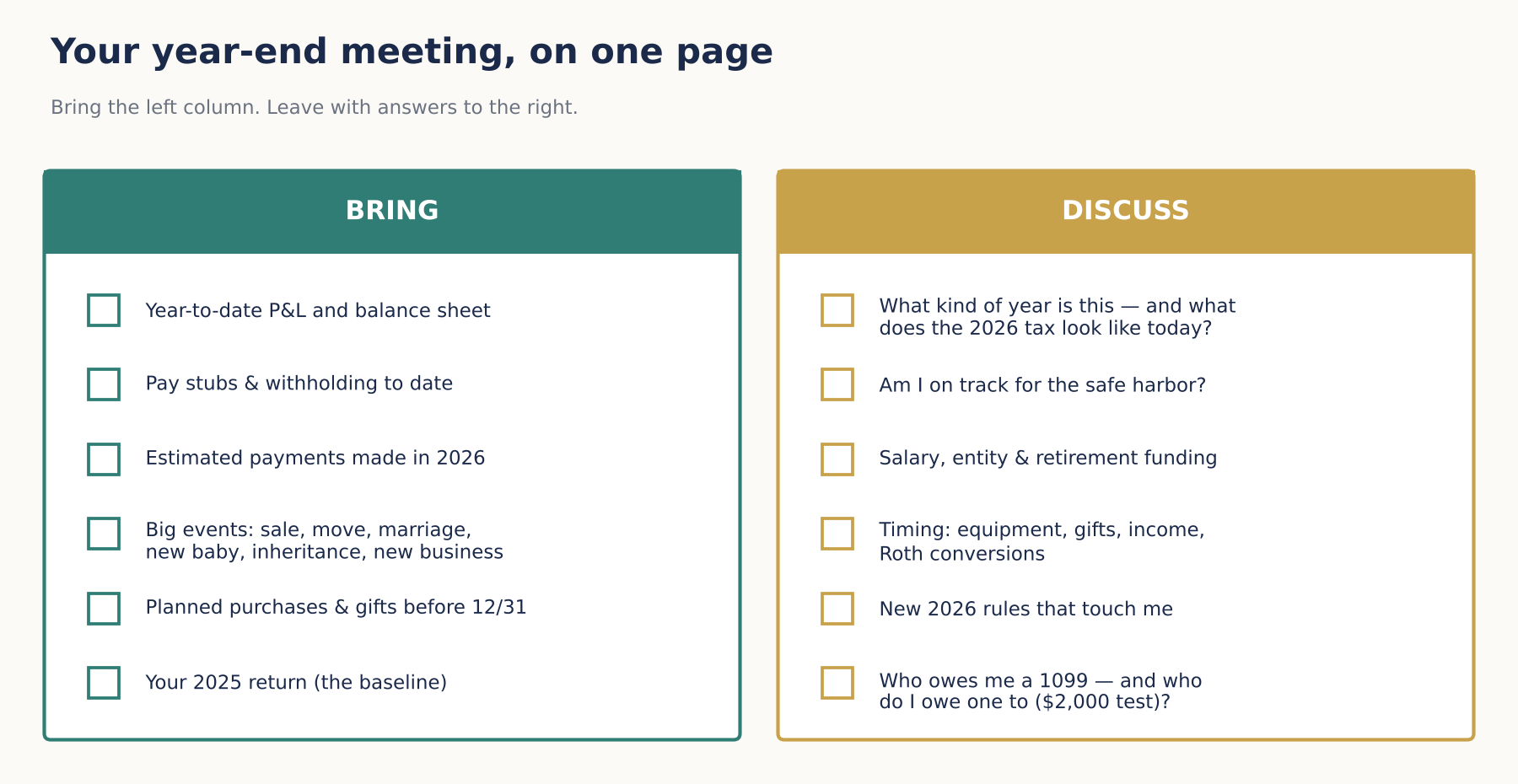
You don't need a binder. You need enough for your CPA to project the year:
A year-to-date profit and loss and balance sheet, as current as you can get them
Your most recent pay stub and a list of estimated payments made in 2026
Your 2025 return, which sets the safe harbor and the baseline
Anything big that happened or is about to: a sale, a move, a marriage, a new child, an inheritance, a new business, a large purchase
And leave with answers to four questions: What does my 2026 tax look like today? Am I covered on estimates? What should I do before December 31? What should I not do? That last one matters — a well-timed "don't buy that truck just for the deduction" is often worth as much as any strategy.
The bottom line
The return gets filed in the spring, but most of what goes on it gets decided in the fall. A 30- to 60-minute planning meeting in late October or November, a short check-in in January, and a clean handoff in February is the rhythm that turns your CPA from a historian into a planner.
If you haven't had that first conversation yet, now is the right time. The year has enough of a shape to project, and there's still enough of it left to change.
This article is provided for general educational purposes and is not tax, legal, or investment advice. Rules, rates, and deadlines change, and the right answer depends on your specific facts. Please reach out before acting on anything here.
Sources: IRS IR-2026-98 and Rev. Rul. 2026-15 (fourth-quarter 2026 interest rates); IRC §6654 and Form 2210 instructions (estimated tax safe harbors and treatment of withholding); IRS Form 1040-ES (2026 due dates); One Big Beautiful Bill Act, P.L. 119-21, §§70432–70433 (1099-K and 1099-NEC/MISC thresholds) and tip and overtime deduction provisions; SECURE 2.0 Act §317 (retroactive first-year solo 401(k) deferrals); IRS Rev. Proc. 2025-32 (2026 inflation adjustments).
