Florida Amendment 3, Explained: What Would Change on Your Property Tax Bill
Few things on this year's ballot generate more questions in my office than Amendment 3. Most of them aren't about whether to vote for it. They're about what it actually does — because the headlines tend to stop at "$250,000 exemption," and the details are where the real effects live.
This article is just the mechanics. No recommendation either way. The goal is that by the end, you can look at your own TRIM notice and estimate what would change.
Amendment 3 was placed on the ballot by the Florida Legislature (as HJR 1F), needs 60% of the vote to pass, and would take effect January 1, 2027 if approved. You may have seen it under its original title, "Save Our Homes from Excessive Property Taxes." The ballot now uses a revised title and summary — "Increased Homestead Exemption; Lower Cap on Increases in Non-Homestead Property Assessments" — but the amendment's text itself did not change.
The four things it does
The amendment makes four changes to the Florida Constitution:
A larger homestead exemption for non-school taxes. $150,000 in 2027 and $250,000 in 2028, adjusted for inflation starting in 2029.
A lower assessment cap for non-homestead property. Second homes, rentals, and commercial property could see their assessed value rise no more than 5% a year instead of 10%.
A waiting period for new residents. People who aren't Florida residents by December 31, 2026 would start with the existing exemption and receive the larger one beginning in their fifth year of homestead exemption.
A list of permitted uses for property tax revenue. Counties and cities would be directed to use property taxes for public safety, education and schools, infrastructure, natural resources, bond debt service, employee retirement benefits, and operations and administration. Other expenditures could still be approved by county officers or local governing bodies unless prohibited by general law.
It also directs the Legislature to create a uniform process that would let counties and cities raise the exemption further for their own levies — up to a home's full assessed value — and lets special districts do the same with voter approval.
How the homestead exemption would change
Today a Florida homestead gets two exemptions. The first $25,000 of assessed value is exempt from all property taxes, including school taxes. A second, inflation-indexed exemption — $26,411 for 2026 — applies to assessed value above $50,000, but only for non-school taxes. Together, that's a maximum of $51,411 off the non-school portion of the bill.
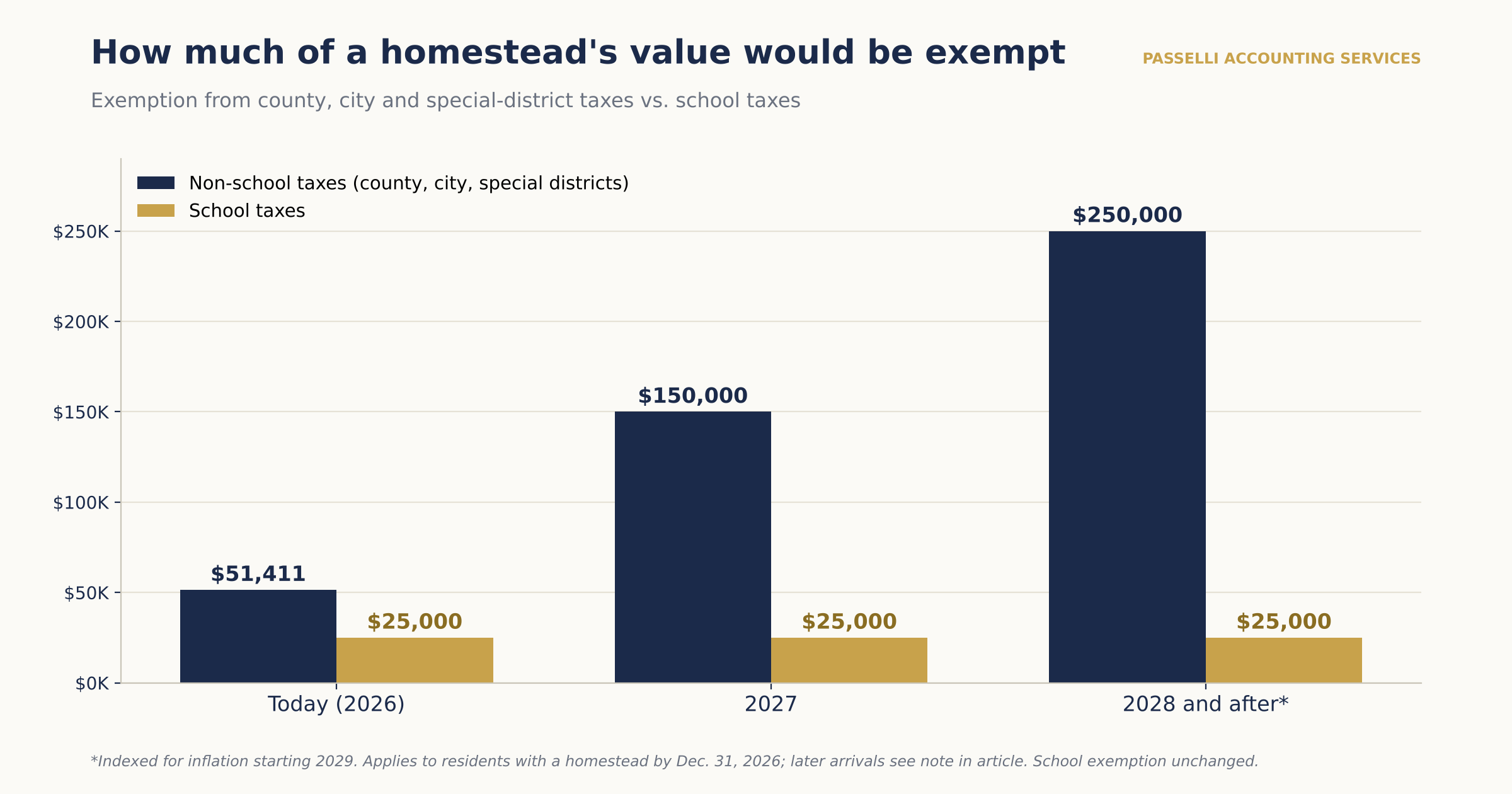
Amendment 3 replaces that non-school figure with $150,000 in 2027 and $250,000 in 2028. The school-tax exemption stays at $25,000. That distinction matters, because school levies are commonly estimated at roughly 40% of a typical Florida tax bill, and that part of the bill doesn't change.
Several things are untouched: the Save Our Homes cap (the lesser of 3% or inflation on a homestead's assessed value), portability, the existing senior, veteran, widow/widower, and disability exemptions, and non-ad valorem assessments like fire fees or solid waste charges that appear on the same bill.
What it looks like on a real bill
Here's the math for three existing homesteads, using the statewide average non-school rate of about 10.5 mills ($10.50 per $1,000 of taxable value) and assuming tax rates stay the same.
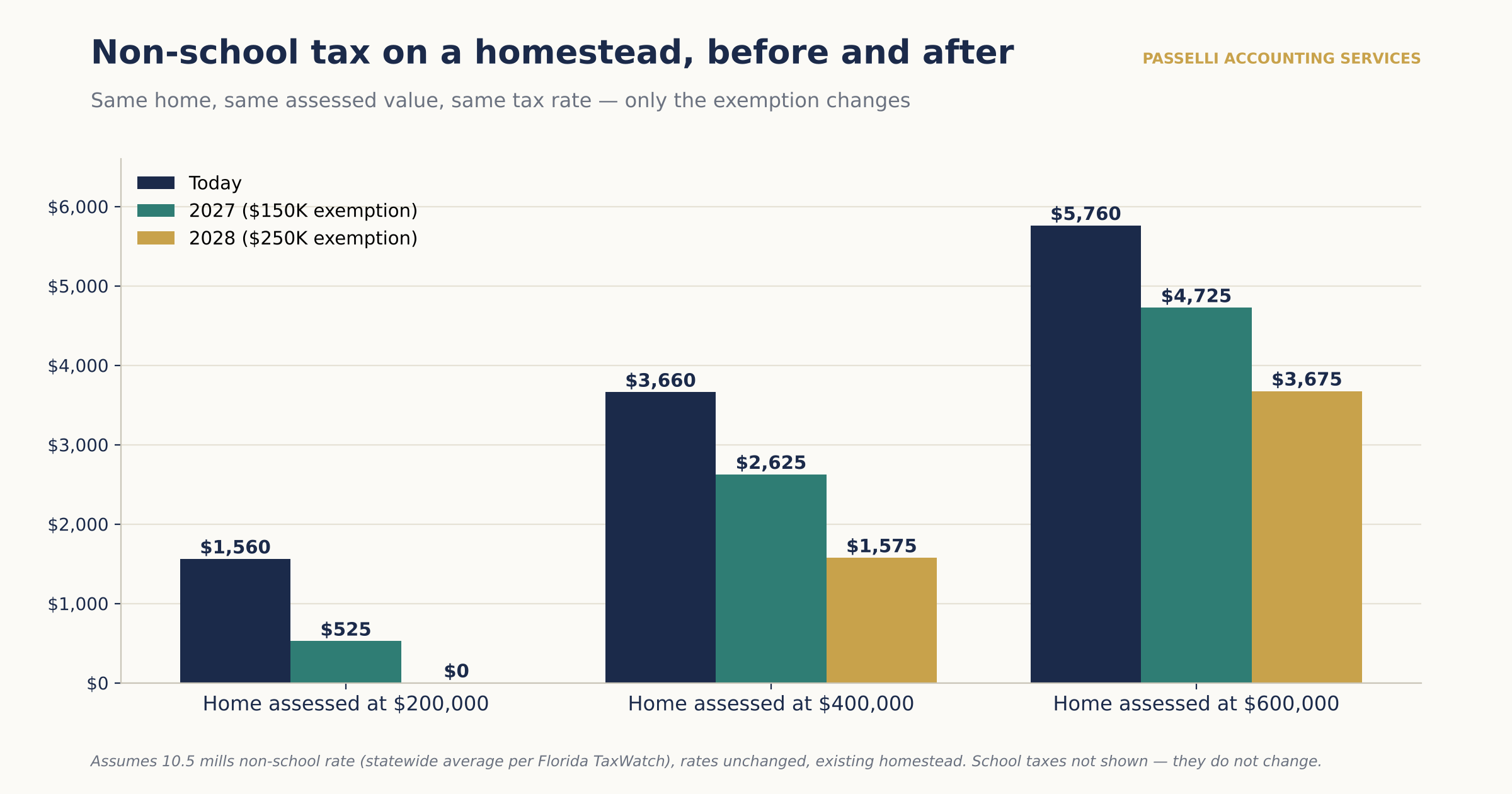
Assessed at $400,000. Today's non-school taxable value is $348,589, for about $3,660 in non-school tax. In 2027 that drops to about $2,625, and in 2028 to about $1,575 — a difference of roughly $2,085 a year.
Assessed at $200,000. Today's non-school tax is about $1,560. In 2028 the exemption covers the entire assessed value, so the non-school portion would be $0. School taxes would still be owed.
Assessed at $600,000. The dollar savings are the same as the $400,000 home — about $2,085 in 2028 — because the exemption removes a fixed amount of value, not a percentage.
That last point is worth noting: once a home's assessed value is above $250,000, the savings are a flat number that depends on the local tax rate, not the home's value. Your own figure will differ with your county, city, and special-district millage.
New residents and the five-year wait
Someone who moves to Florida and establishes a homestead after 2026 would start with the current exemption structure. Using the same $400,000 example, that owner would pay about $3,660 in non-school tax in each of their first four years of exemption, while a neighbor with an identical, longtime homestead pays about $1,575. Beginning in the fifth year of exemption, both would receive the larger exemption. The amendment applies this rule "to the extent permitted by the U.S. Constitution."
Floridians who already have a homestead and move within the state keep their eligibility for the larger exemption on the next home, and portability works as it does today.
Rentals, second homes, and commercial property
Non-homestead property doesn't get the larger exemption. What changes is the cap on how fast its assessed value can rise for non-school taxes: 5% a year instead of 10%.
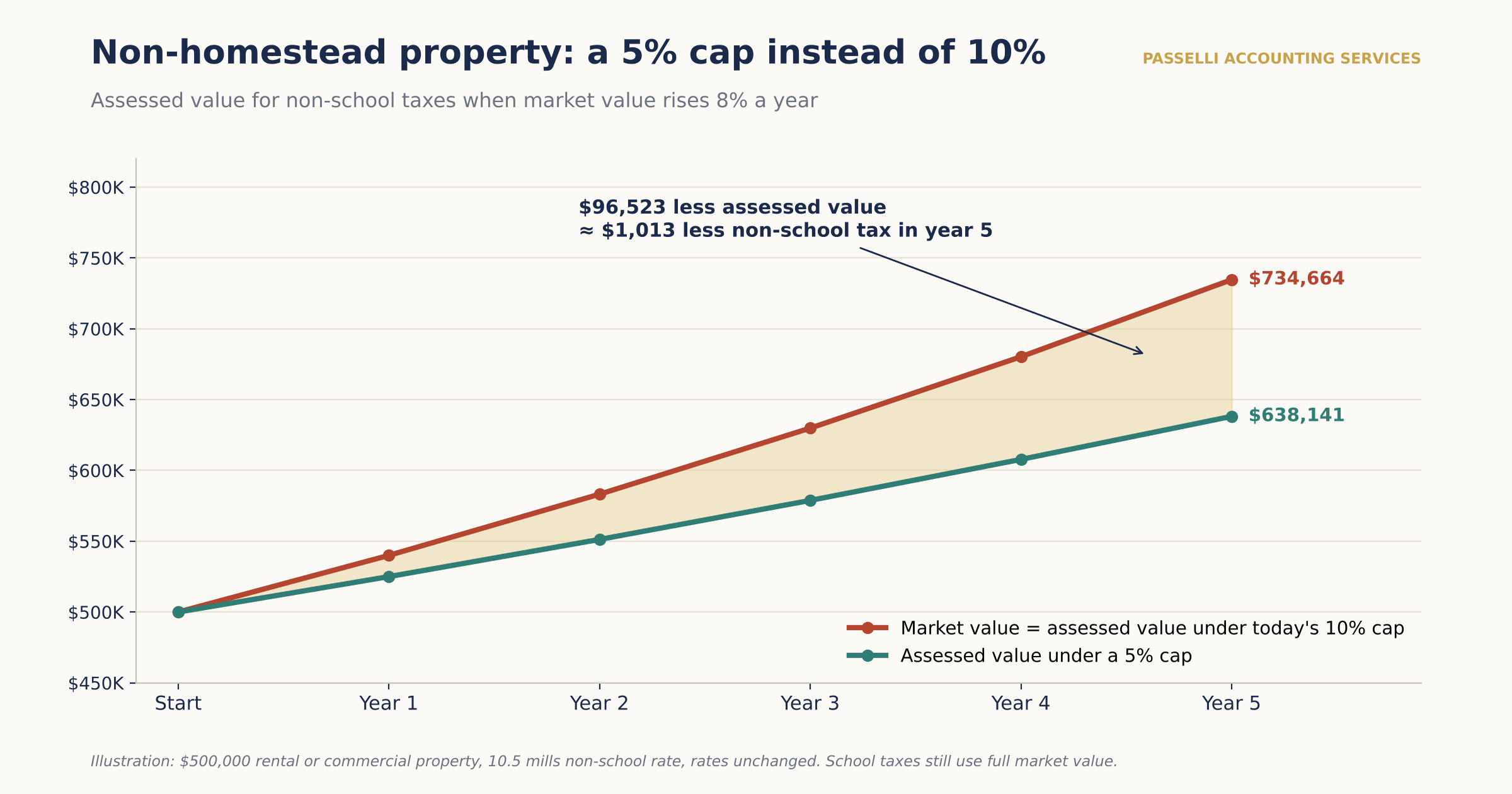
Take a $500,000 rental or commercial building whose market value rises 8% a year. Under today's 10% cap, its assessed value tracks the market and reaches about $734,664 in five years. Under a 5% cap, it would be assessed at about $638,141 — roughly $96,500 less, or about $1,013 less in non-school tax in year five at 10.5 mills.
Three caveats. The cap only matters when values rise faster than 5%; in a flat or falling market it does nothing. School taxes on non-homestead property continue to use full market value. And as under current law, the capped value generally resets to market value when a property sells.
Effects on local government revenue
Because a larger portion of homestead value would be exempt, the same tax rates would raise less money. The state's Revenue Estimating Conference projects the statewide reduction at about $4.96 billion in fiscal year 2027-28, growing to roughly $11.86 billion a year once fully phased in.
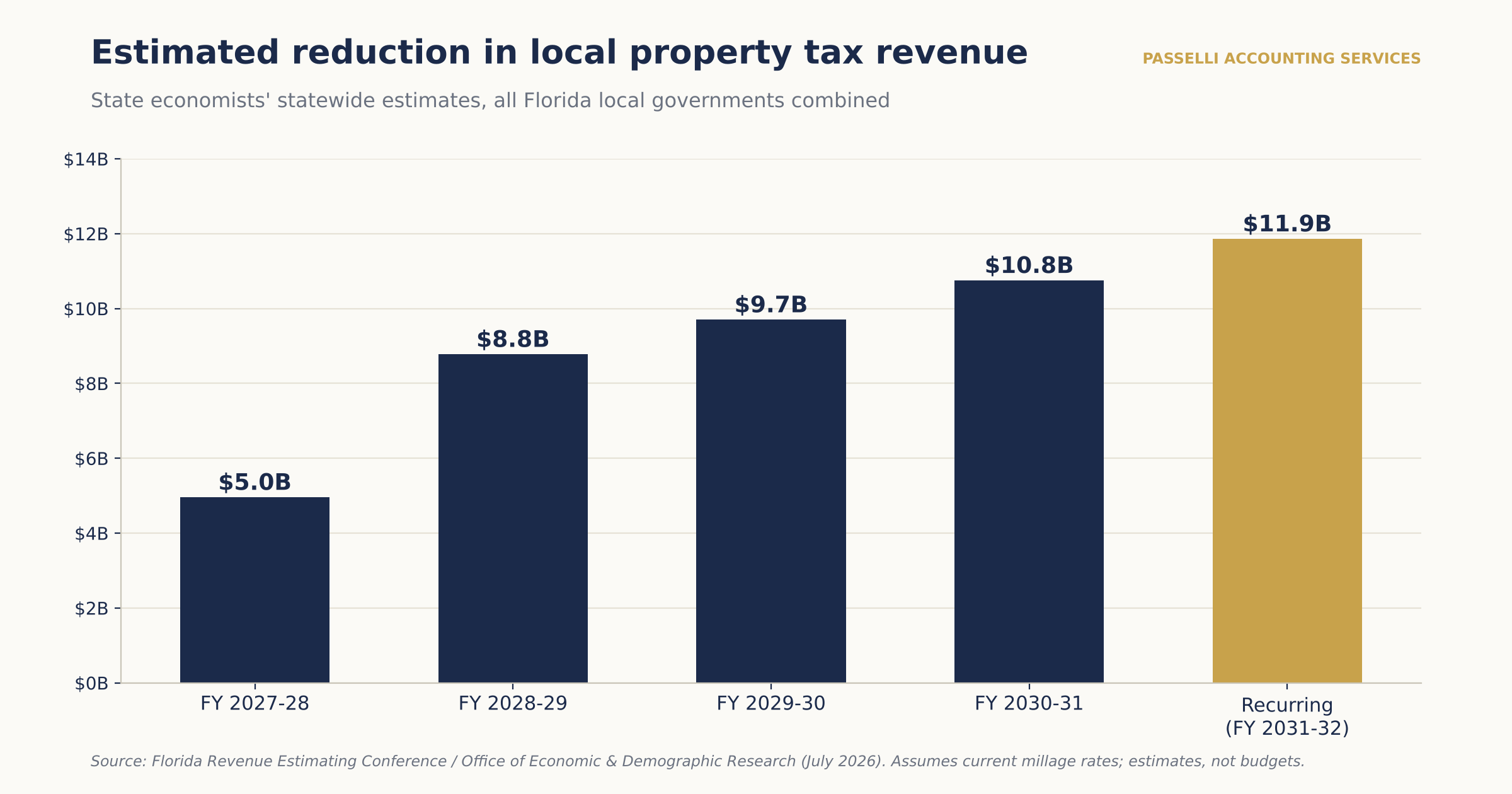
These are estimates that assume current millage rates. How each county, city, and special district would respond — adjusting budgets, adjusting millage rates within existing legal limits, finding other revenue, or some combination — would be local decisions made after the fact. Those choices would also affect the final net change for every type of property owner, including those who don't receive the larger exemption. County-by-county estimates are published by the Florida Office of Economic and Demographic Research and by several independent organizations if you want to see your area's figures.
The bottom line
Amendment 3 makes four structural changes: a much larger homestead exemption for non-school taxes, a tighter 5% cap for non-homestead property, a five-year phase-in for new residents, and a constitutional list of uses for county and city property tax revenue. School taxes, Save Our Homes, and portability stay as they are.
If you want to estimate your own effect, find the non-school millage on your TRIM notice and multiply it by about $98.59 for 2027 or $198.59 for 2028 (for a homestead assessed above $250,000). That's the starting point; actual results will depend on what local governments do with their rates. If you'd like help reading your notice or thinking through how this interacts with a planned home purchase or rental property, that's a short conversation.
This article is provided for general educational purposes and is not tax, legal, or investment advice. It does not advocate for or against any ballot measure. Rules, rates, and estimates change, and the right answer depends on your specific facts. Please reach out before acting on anything here.
Sources: Florida Department of State, Division of Elections — Amendment 3 ballot title, summary, and full text (HJR 1F, 2026F special session); Florida Revenue Estimating Conference / Office of Economic and Demographic Research (July 2026 impact estimates); Florida Department of Revenue (2026 homestead exemption amounts); Florida TaxWatch Property Tax Resource Center; Tax Foundation, Amendment 3: A Restructuring of Florida's Local Tax Base; Florida Chamber of Commerce Amendment 3 resource center.
