S Corp or C Corp? The Answer Depends on Where the Money Is Going
A 21% corporate rate sounds like a bargain until the money comes out. Here’s how to tell which system actually costs you less — and when the “expensive” one wins anyway.
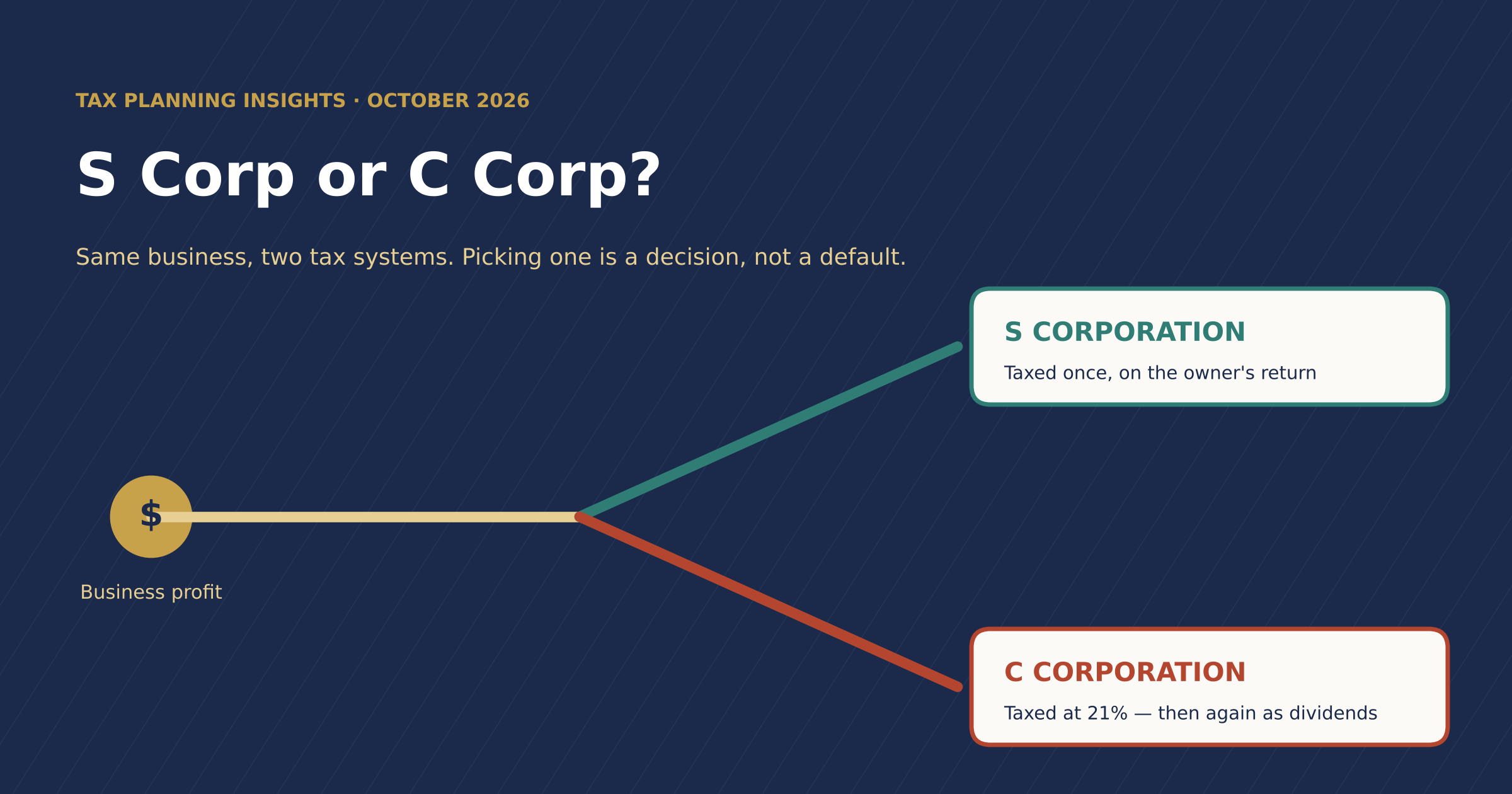
Few questions come up in my office more often than this one, and few get answered worse on the internet. One side says the 21% corporate rate makes a C corporation the obvious choice. The other side says double taxation makes it a trap. Both are half right, which is the most dangerous kind of right.
The truth is that an S corporation and a C corporation are not better or worse tax structures. They are two different tax systems, and each one is cheap for a particular kind of business and expensive for the others. The way to choose is to stop asking "which rate is lower?" and start asking "where is the profit going?"
Two systems, one business
A C corporation is its own taxpayer. It files Form 1120 and pays a flat 21% federal rate on its profit. Here in Florida, it also pays the state's 5.5% corporate income tax on income above a $50,000 exemption. When the after-tax profit is later paid to the owners as dividends, they pay tax again — 0%, 15%, or 20%, plus the 3.8% net investment income tax once joint income passes $250,000.
An S corporation generally pays no income tax of its own. Its profit flows through to the owners' personal returns, where it's taxed once at their individual rates. Florida doesn't impose its corporate income tax on S corporations in the ordinary case. And S corporation owners can claim the 20% qualified business income (QBI) deduction, which the One Big Beautiful Bill Act made permanent. C corporation shareholders get no QBI deduction at all.
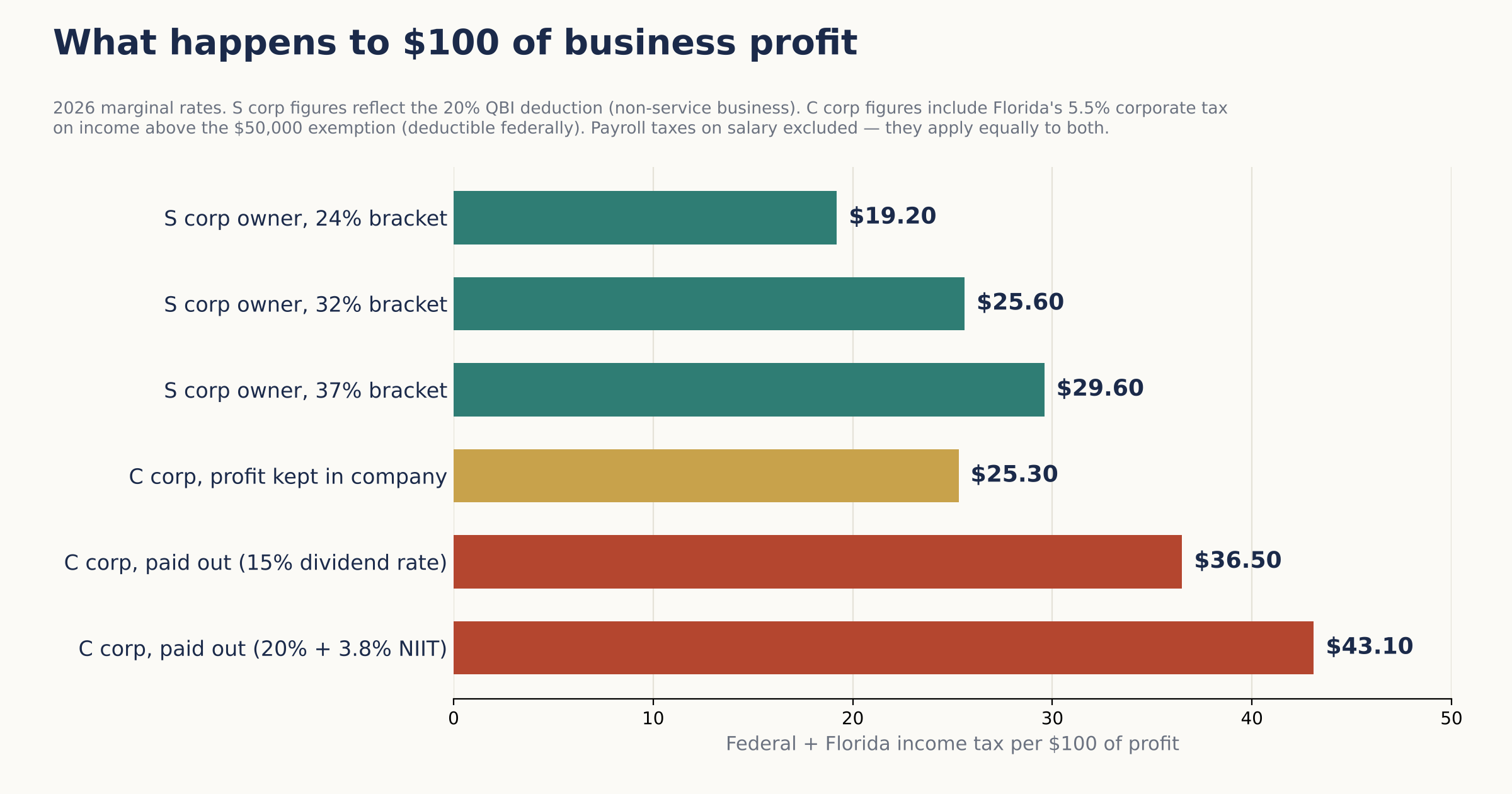
Put those rules side by side and the picture is clear. An S corporation owner in the 24% bracket keeps the tax on $100 of profit to about $19.20. A Florida C corporation pays about $25.30 before a dollar leaves the company — and once that profit is paid out as a dividend, the total climbs to $36.50, or as much as $43.10 at the top rates.
A $300,000 example, three ways
Take a Florida business earning $300,000 before the owner's pay. The owner is married, files jointly, has no other income, and takes a $120,000 reasonable salary either way. The payroll tax on that salary is identical under both structures. Everything else is not.
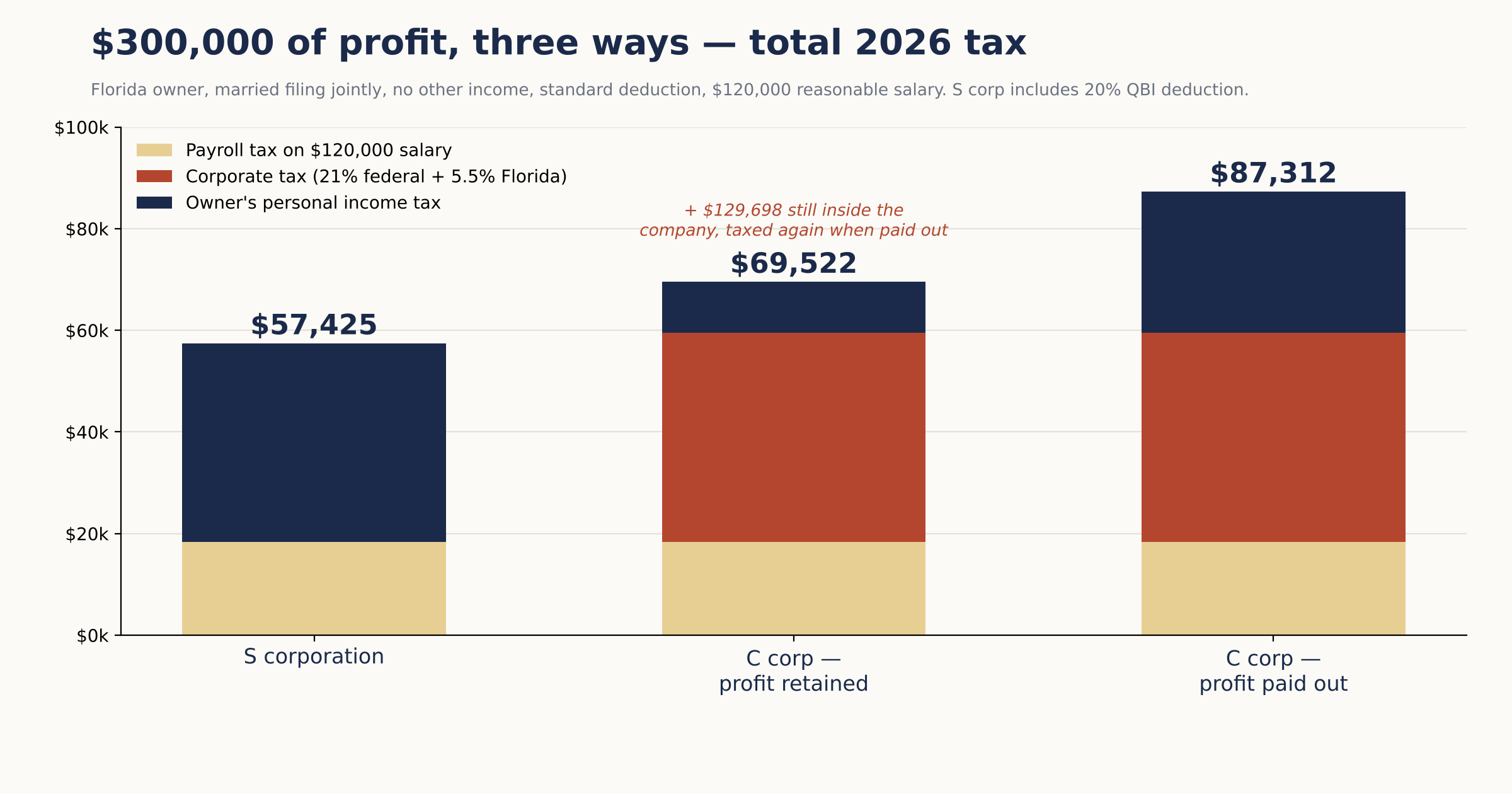
As an S corporation, the remaining profit flows to the owner's return, the QBI deduction applies, and total 2026 tax comes to about $57,425.
As a C corporation that pays out its profit, the company owes about $41,100 in federal and Florida corporate tax, then the owner pays tax on the dividend. Total: about $87,312 — roughly $29,900 more for the same business.
As a C corporation that keeps its profit, this year's tax is about $69,522. That's still about $12,100 more than the S corporation, and $129,698 of after-tax profit is now sitting inside the company, waiting to be taxed a second time whenever it comes out.
For an owner who lives on what the business earns, that isn't close. The S corporation wins, and it usually wins by a lot. It's the same logic I walked through in The Best 2026 Tax Move Is the One Nobody Brags About, where electing S treatment on a $120,000 Schedule C saved about $7,650 in self-employment tax.
When the C corporation earns its keep
The C corporation's advantages are real — they just don't show up in a single year's return.
Reinvestment. A business that plows its profit back into inventory, equipment, or hiring never pays the second layer of tax on that money until it's distributed. For an owner already in the 35% or 37% bracket, a 21% federal rate on retained earnings can be meaningfully cheaper than the flow-through rate. (The accumulated earnings tax exists to stop companies from hoarding cash with no business purpose, so the reinvestment has to be genuine.)
The exit. This is where the C corporation can be extraordinary. Under Section 1202, gain on qualified small business stock can be excluded from federal tax. For stock issued after July 4, 2025, the OBBBA added a tiered schedule — 50% excluded after three years, 75% after four, 100% after five — and raised the per-company cap to $15 million (or 10 times basis), with a $75 million gross-asset ceiling for the company.
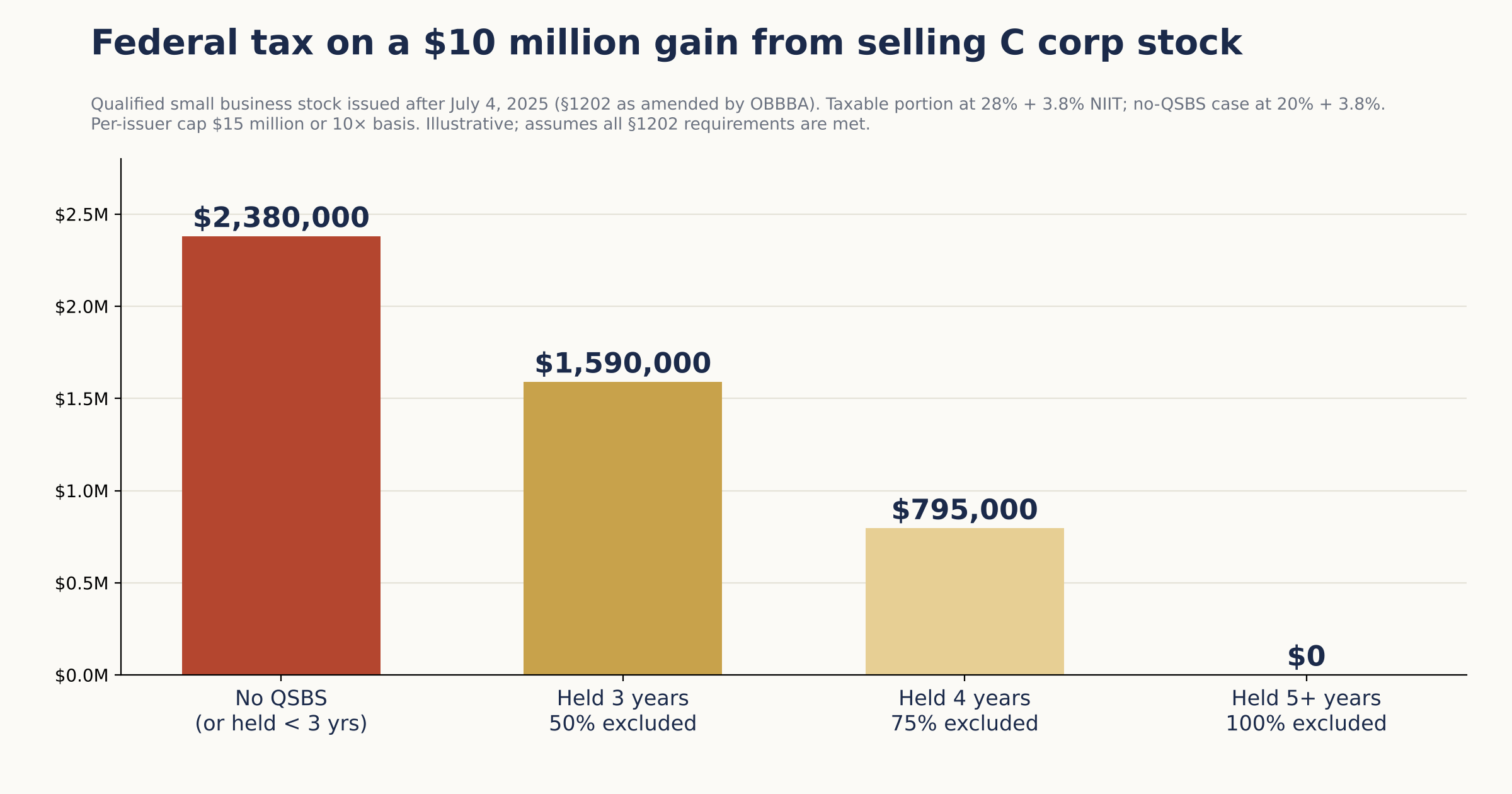
On a $10 million gain, that's the difference between roughly $2.38 million of federal tax and zero. S corporation stock never qualifies. That said, plenty of businesses can't qualify regardless of entity. Health, law, accounting, consulting, financial services, and other businesses that rely on the owner's skill or reputation are excluded.
Outside money and flexibility. S corporations are limited to 100 shareholders, generally U.S. individuals and certain trusts, and only one class of stock. Venture funds, foreign investors, preferred stock, and most option plans don't fit inside those rules. A C corporation has no such limits.
The details that change the answer
Reasonable salary is not optional. An S corporation that pays its owner too little invites the IRS to reclassify distributions as wages. The savings come from the profit above a defensible salary, not from skipping payroll.
Losses behave differently. S corporation losses can flow to your personal return (subject to basis and other limits). C corporation losses stay locked inside the company until it has profit to offset.
Switching has a price. Revoke an S election and you generally can't re-elect for five years. Convert a C corporation to an S corporation and a five-year built-in gains tax can apply to appreciation that existed at conversion.
Your marginal rate decides the math. As I explained in Your Tax Bracket Isn't Your Tax Rate, the comparison only works using the rate on your next dollar, including QBI and payroll effects.
The bottom line
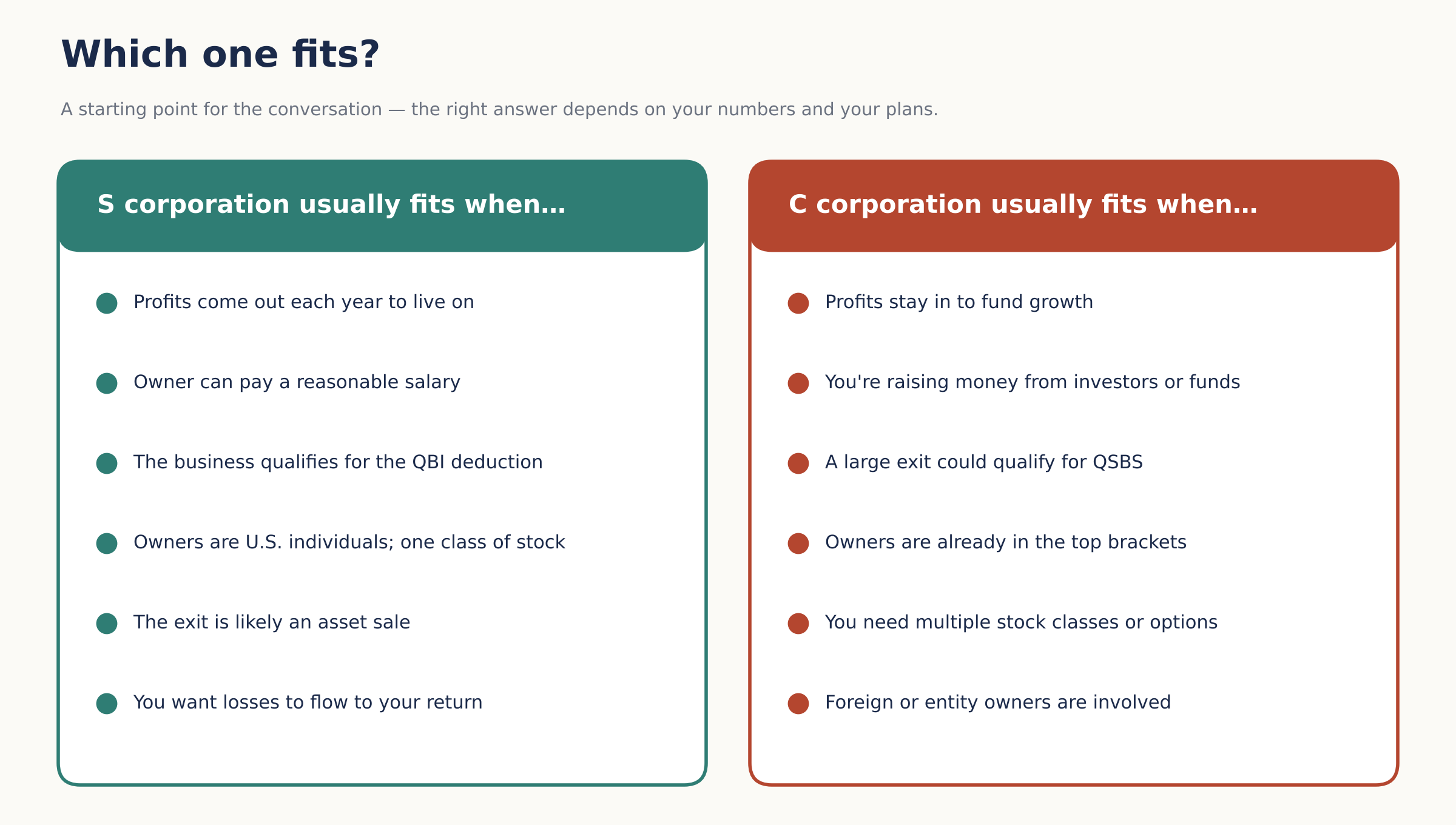
If the business's profit comes out every year to support your household, an S corporation is almost always the cheaper system — in our example, by about $30,000 a year. If the profit stays in to fund growth, outside investors are on the horizon, or a qualifying sale could unlock a Section 1202 exclusion, a C corporation can be worth the second layer of tax many times over.
Either way, it's a decision that should be made deliberately, with your own numbers, and ideally before the year closes. With 2026 winding down, now is a good time to look at what kind of year you're having and where the money is headed. If you're unsure which side of that line you're on, that's a short and worthwhile conversation.
This article is provided for general educational purposes and is not tax, legal, or investment advice. Rules, rates, and thresholds change, and the right answer depends on your specific facts. Please reach out before acting on anything here.
Sources: IRC §11 (21% corporate rate); IRC §§1361–1362 (S corporation eligibility, election, and revocation); IRC §1374 (built-in gains); IRC §199A as amended by the One Big Beautiful Bill Act, P.L. 119-21; IRC §1202 as amended by OBBBA (qualified small business stock); IRS Rev. Proc. 2025-32 (2026 brackets and capital gains thresholds); IRC §1411 (net investment income tax); Florida Department of Revenue, corporate income tax (Ch. 220, F.S.).
