Your Tax Bracket Isn’t Your Tax Rate — and Planning Depends on Knowing Both
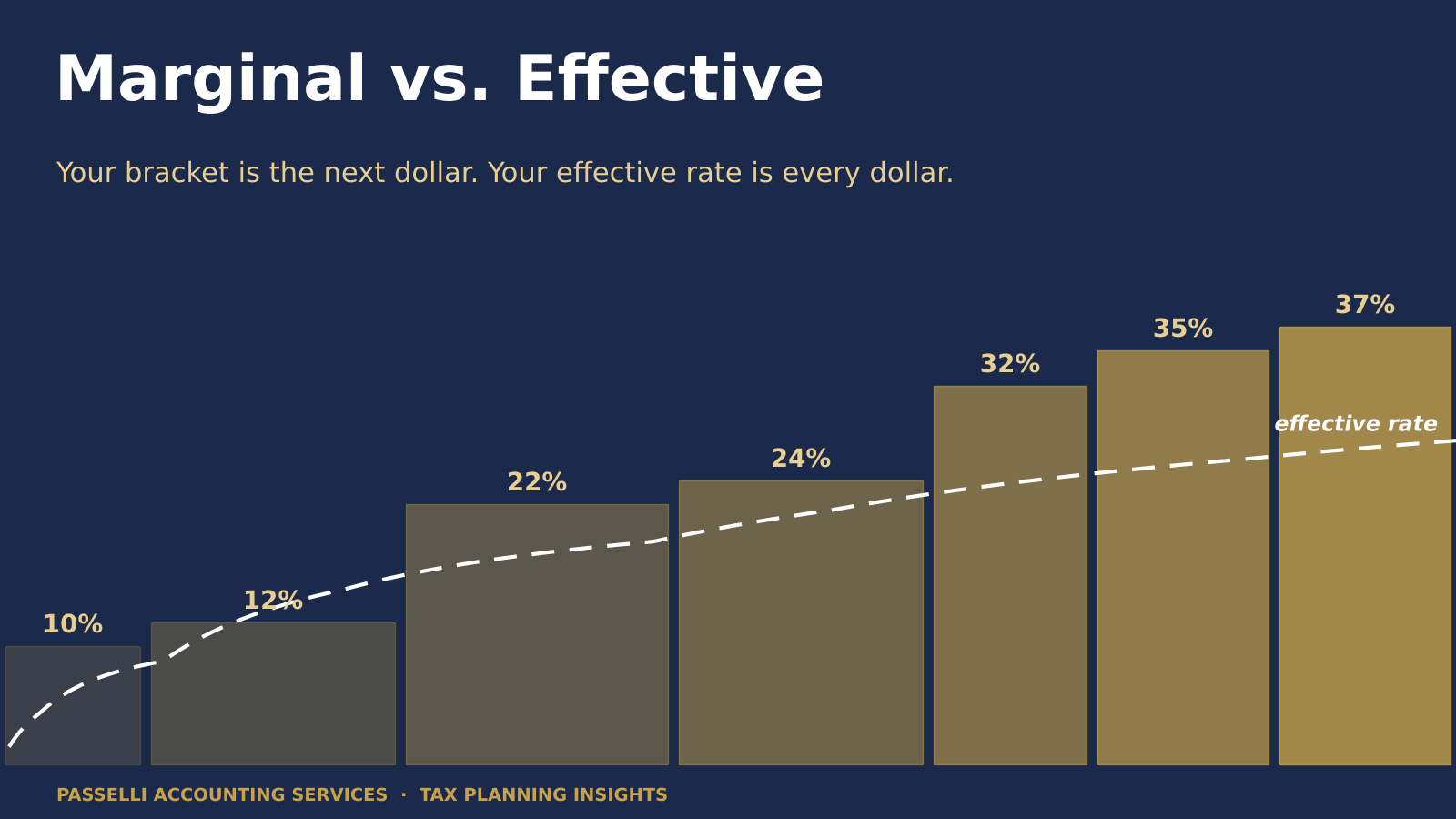
Ask a room of business owners what tax rate they pay and you'll hear "22%," "24%," maybe "I'm in the 32% bracket." Almost all of those answers are true and almost none of them describe what actually left their bank account.
That's not a trivia problem. Your tax return has two different rates on it, and each one answers a different question. The effective rate tells you what you paid. The marginal rate tells you what your next decision will cost or save. Planning lives almost entirely on the second one — and people who use the first one by mistake routinely undervalue deductions, overvalue raises, and pass on moves that would have paid for themselves.
Two rates, one return
Federal income tax is a staircase. For 2026, a married couple filing jointly pays 10% on the first $24,800 of taxable income, 12% up to $100,800, 22% up to $211,400, and so on up to 37% above $768,700. Each rate applies only to the dollars that land on its step.
Take a couple earning $180,000 with no other deductions. The $32,200 standard deduction brings taxable income to $147,800. Their tax:
10% of $24,800 = $2,480
12% of the next $76,000 = $9,120
22% of the last $47,000 = $10,340
Total federal income tax: $21,940.
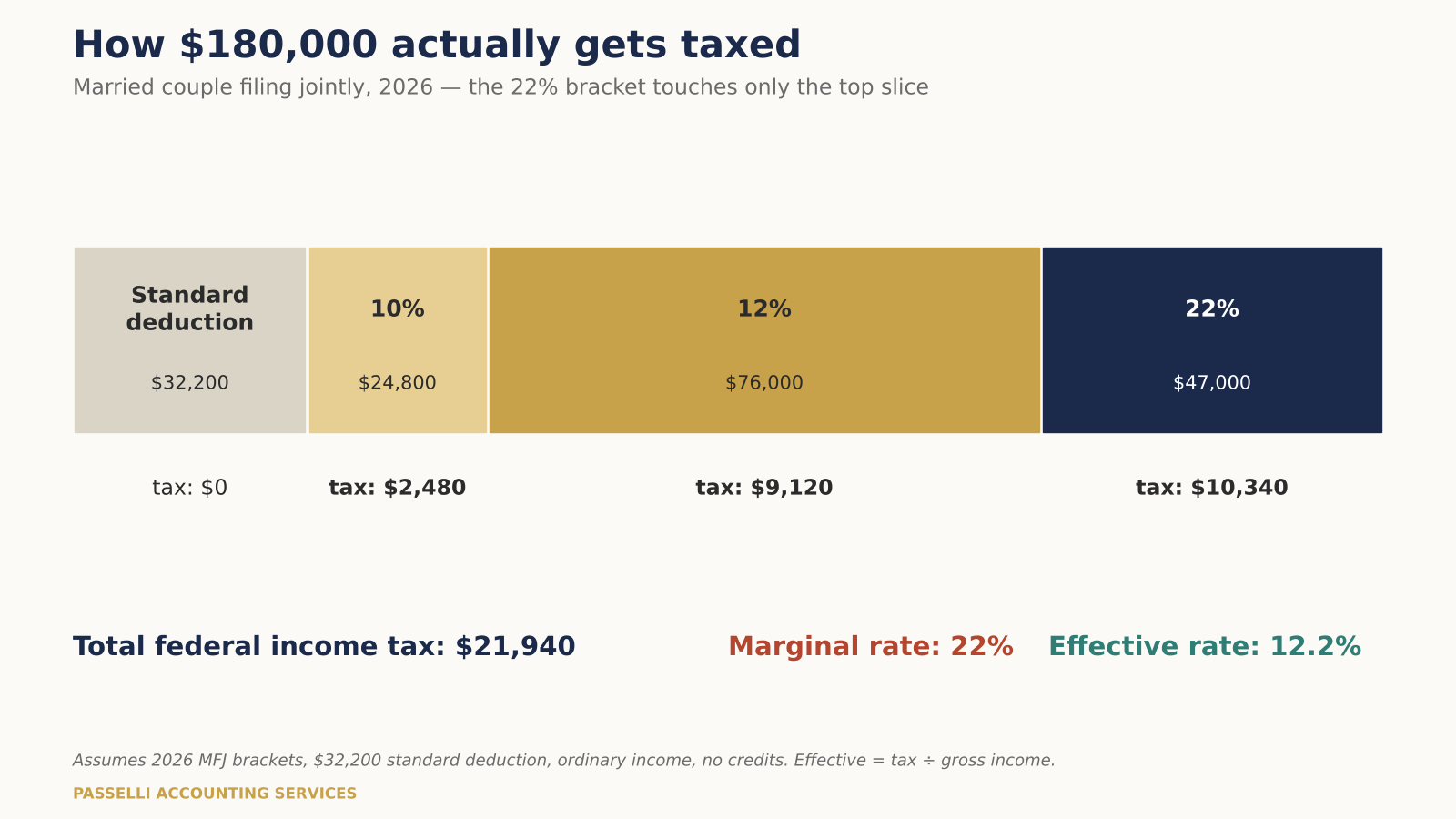
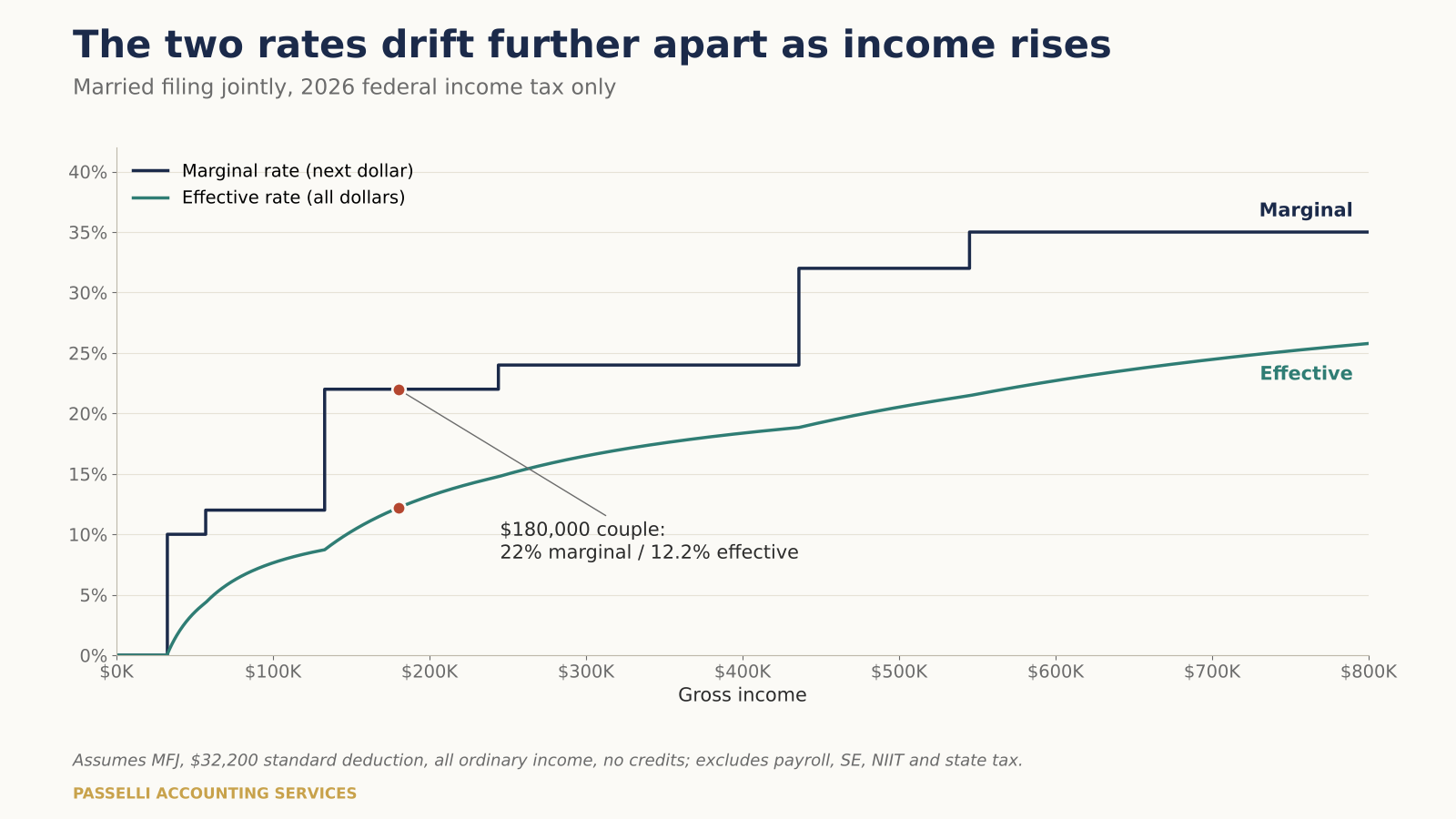
Their marginal rate is 22% — the rate on their next dollar. Their effective rate is 12.2% — total tax divided by total income. Same return, two very different numbers, and the gap only widens as income rises.
The raise myth
The most common confusion runs in one direction: "If I take that raise, it'll push me into a higher bracket and I'll take home less."
It won't. Crossing into the 24% bracket means the dollars above the line are taxed at 24%. Every dollar below it is taxed exactly as before. A $10,000 raise for our couple costs $2,200 in federal income tax and leaves $7,800 in their pocket. Under the regular brackets, more income never means less take-home.
(There are a handful of real cliffs elsewhere in the code — some credits and subsidies switch off at a fixed income — but the brackets themselves aren't one of them.)
A deduction is worth your marginal rate, not your effective rate
This is where the mix-up costs money. If our couple thinks of themselves as "paying about 12%," a $10,000 deductible 401(k) contribution looks like it saves $1,220. It actually saves $2,200, because that $10,000 comes off the top of their income — out of the 22% step, not out of the average.
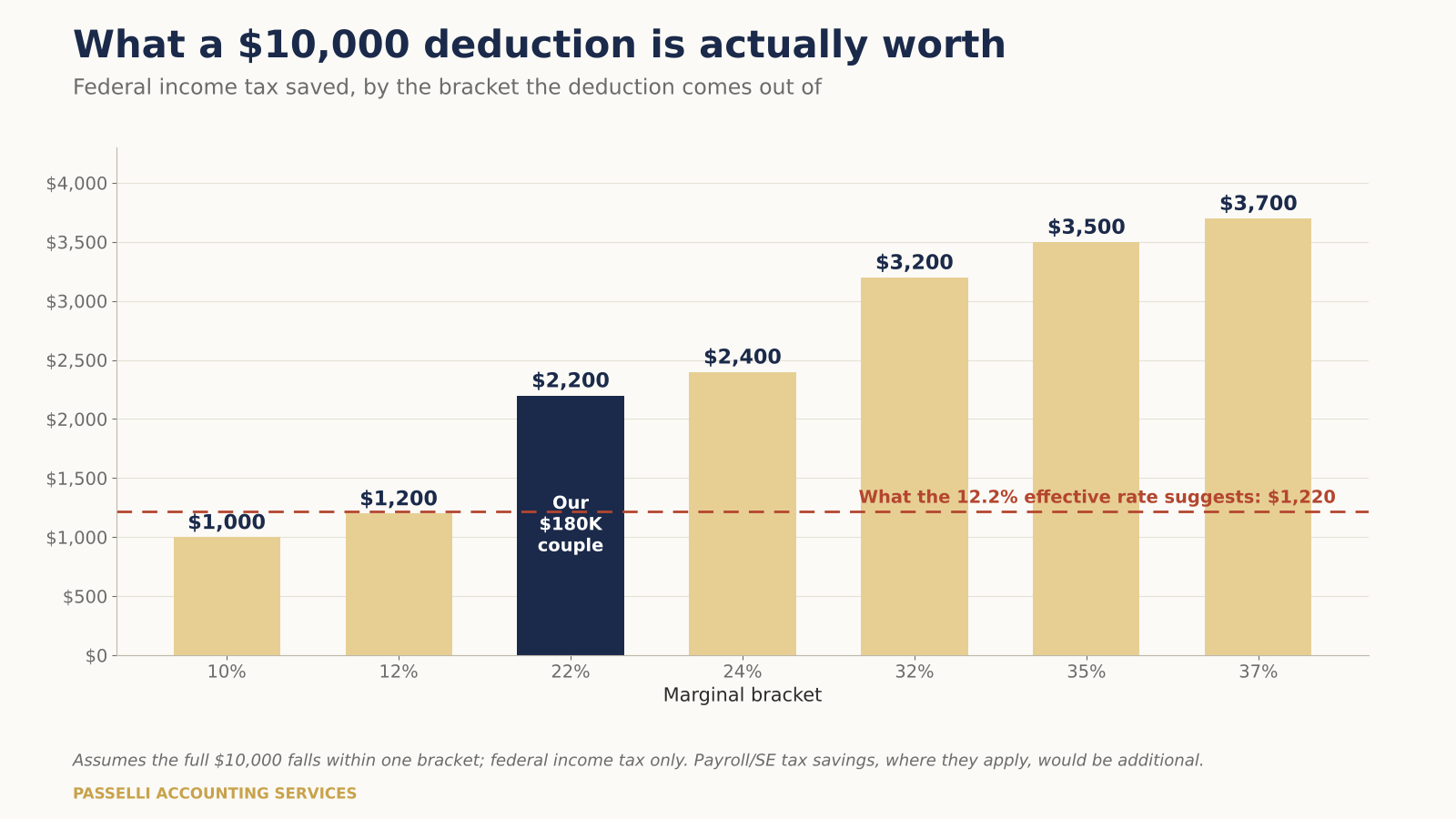
Every planning decision works this way. A retirement contribution, a business expense you documented, an equipment purchase timed into the right year — each one is valued at the rate on the dollars it removes. When I wrote in Standard Deduction or Itemize? that a $400 itemizing edge was worth "about $88 at a 22% bracket," that's the marginal rate at work. The effective rate would have told you $49, and it would have been wrong.
Your real marginal rate is often higher than your bracket
The bracket is only the starting point. Other taxes and phase-ins ride along on the same next dollar, and they can push the true cost well past the number people quote.
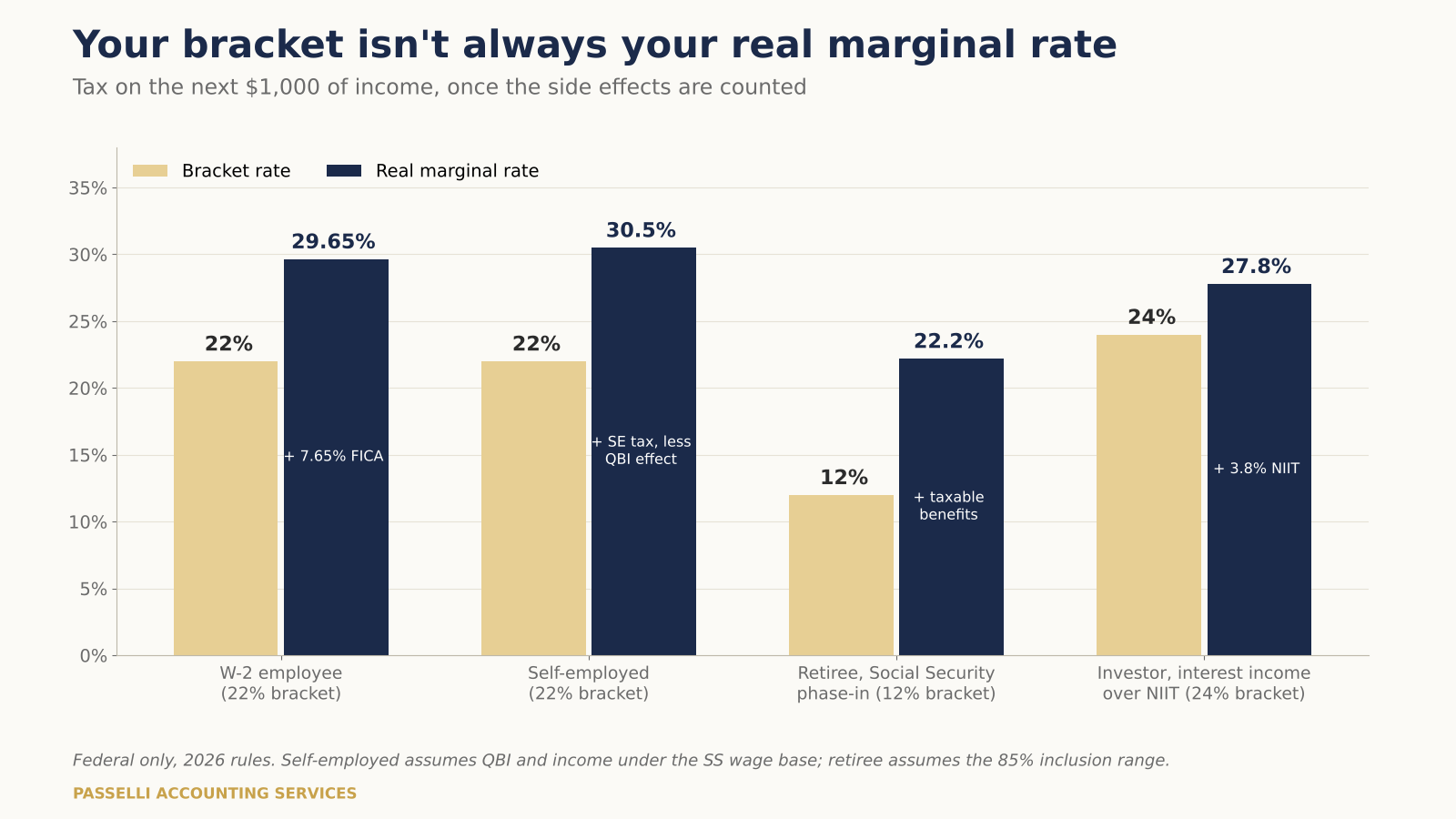
W-2 employees in the 22% bracket also pay 7.65% Social Security and Medicare on wages, for a real rate near 29.65%.
Self-employed owners pay self-employment tax, partly offset by the QBI deduction. As I laid out in The Best 2026 Tax Move Is the One Nobody Brags About, that nets to roughly 30.5 cents on each additional dollar of Schedule C profit in the 22% bracket — which is exactly why each documented business dollar saves about 30 cents.
Retirees collecting Social Security can land in a zone where each extra $1,000 of IRA withdrawal makes up to $850 of benefits taxable too. In the 12% bracket, that's a real marginal rate of about 22.2% — nearly double the bracket.
Investors above $250,000 of joint income add the 3.8% net investment income tax on interest, dividends, and gains. That threshold isn't indexed for inflation, so it catches more households every year.
Here in Florida, there's no state income tax to stack on top — a real advantage. But the federal layers alone can move your planning rate by eight or ten points.
Where the effective rate earns its keep
The effective rate isn't useless. It's the right tool for different jobs: budgeting cash flow, comparing your overall burden from year to year, sanity-checking withholding and estimated payments, and — importantly — thinking about retirement withdrawals.
That last one is the classic Roth-versus-traditional question. A traditional contribution saves tax at today's marginal rate. The money comes out later spread across the lower steps of the staircase, so in retirement it often faces something closer to an effective rate. Someone saving at 24% today who expects to draw down income in the 12% bracket later should usually favor traditional. Someone in the 12% bracket now — a young professional, or an owner having a lean year — may be better off paying the tax today with a Roth.
Using it before December 31
With three months left in 2026, the marginal rate is the number to watch, and the question is simple: how much room is left on your current step?
Our $180,000 couple has $63,600 of room left in the 22% bracket before they hit 24%. That room can be used deliberately — a partial Roth conversion at 22% that would cost 24% or more later, a bonus taken this year instead of next, or a capital gain realized now. In the other direction, a household near the top of a step can push income into January or accelerate deductions into December to keep dollars from spilling onto the next one.
Lower-income years have their own opportunity: for 2026, long-term capital gains are taxed at 0% as long as joint taxable income stays at or below $98,900 ($49,450 single). A retiree or an owner in a down year can sometimes harvest gains completely tax-free — but only if someone knows where the line sits.
The bottom line
Your effective rate tells you how the year went. Your marginal rate tells you what to do next. Use the effective rate to understand your overall tax burden; use the marginal rate — the real one, with payroll tax, SE tax, and phase-ins counted — to price every deduction, contribution, conversion, and timing decision.
If you've been calculating what a strategy is worth using the rate you "pay," there's a good chance you've been underestimating it. That's worth a short conversation before December 31, while the room on your current step is still there to use.
This article is provided for general educational purposes and is not tax, legal, or investment advice. Rules, rates, and thresholds change, and the right answer depends on your specific facts. Please reach out before acting on anything here.
Sources: IRS Rev. Proc. 2025-32 (2026 tax brackets, standard deduction, and capital gains thresholds); IRC §1411 and IRS Topic 559 (net investment income tax); IRS Publication 915 (taxation of Social Security benefits); IRC §1401 and §199A (self-employment tax and QBI deduction); IRS Publication 590-A/B (traditional and Roth IRAs).
