Standard Deduction or Itemize? The 2026 Math Changed — Make Sure You Pick the Right Side
A bigger SALT cap, a new charitable floor, and a new senior deduction mean last year's answer may not be this year's. The difference is real money, and nobody tells you when you've picked wrong.
Every return makes the same choice on line 12 of Form 1040: take the standard deduction, or itemize on Schedule A. You get whichever is larger — but only if someone actually runs both sides. Software defaults and last year's habits make that choice for a lot of people, and the IRS will never send a letter saying you left money on the table.
For most of the last eight years the answer was easy. The standard deduction was big, the $10,000 cap on state and local taxes was tight, and roughly nine in ten filers took the standard deduction without a second thought.
The One Big Beautiful Bill Act changed enough moving parts that 2026 deserves a fresh look. Some households who haven't itemized since 2017 will now come out ahead doing it. Others who itemize out of habit will find the new floors quietly eat their margin. And a few rules punish the wrong choice in ways that aren't obvious.
The number to beat
For 2026 the standard deduction is $16,100 single, $24,150 head of household, and $32,200 married filing jointly. If you're 65 or older (or blind), you add $2,050 as a single filer or $1,650 per qualifying spouse on a joint return. A married couple who are both over 65 starts at $35,500.
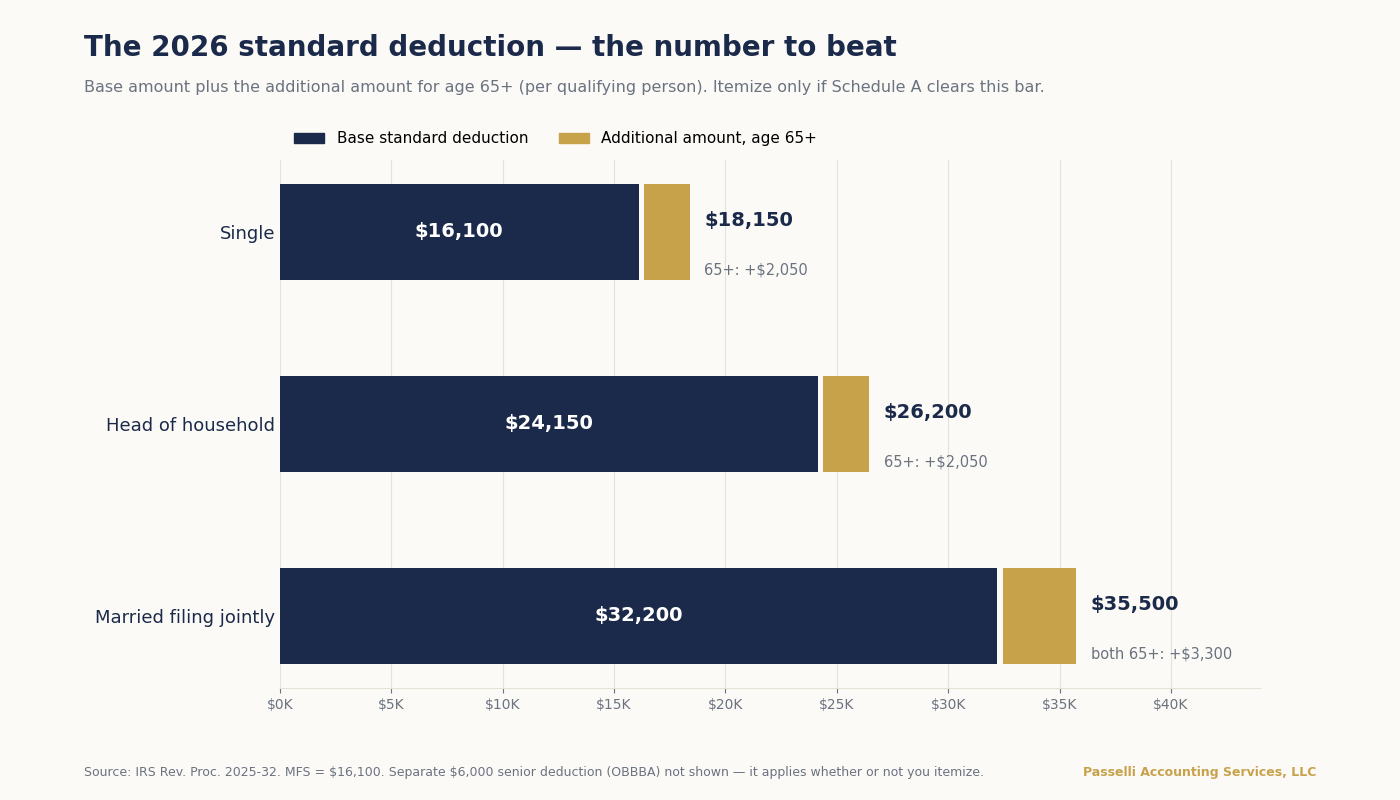
That add-on matters more than people realize, because it disappears the moment you itemize. A 67-year-old single filer isn't comparing Schedule A to $16,100 — the real bar is $18,150.
The new $6,000 senior deduction under OBBBA ($12,000 for a couple who both qualify) is different. It applies whether you itemize or not, so it shouldn't sway the decision either way. It does phase out above $75,000 of modified AGI ($150,000 joint), so it's worth confirming you're getting it at all.
What goes on Schedule A in 2026
The big pieces of Schedule A are the same as always, but several rules changed:
State and local taxes. The cap rose from $10,000 to $40,400 for 2026. It phases down by 30 cents for every dollar of MAGI over $505,000, and bottoms out at $10,000.
Mortgage interest. Still limited to interest on $750,000 of acquisition debt, and that limit is now permanent. Mortgage insurance premiums (PMI, FHA, VA, and USDA fees) are deductible again starting in 2026, but that phases out between $100,000 and $110,000 of AGI.
Charitable gifts. Itemizers now lose the first 0.5% of AGI in giving. At $200,000 of AGI, the first $1,000 you give deducts nothing.
Medical expenses. Only the portion above 7.5% of AGI counts, same as before.
Top-bracket haircut. Filers in the 37% bracket get about 35 cents of benefit per itemized dollar instead of 37.
For most of my clients here in Palm Beach County, the SALT change matters less than the headlines suggest. Florida has no state income tax, so our "SALT" is property tax plus sales tax. Few households get anywhere near $40,400 that way. The bigger levers here tend to be mortgage interest, PMI, and how you time your giving.
A close call, run both ways
Take a married couple in Wellington with $180,000 of AGI. They paid $8,500 in property tax and claim $2,400 of sales tax from the IRS tables. They also paid $17,600 in mortgage interest and gave $5,000 to charity, which is $4,100 after the 0.5% floor.
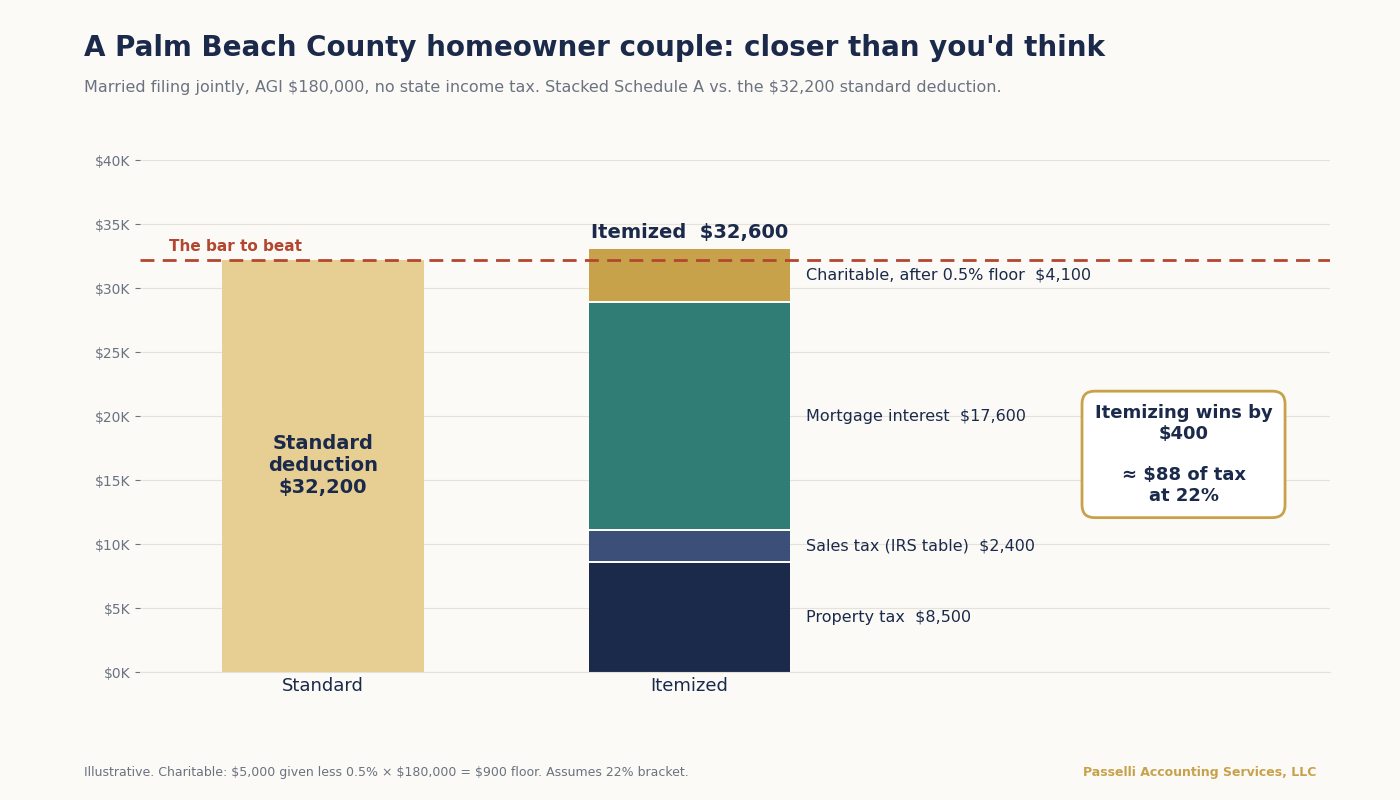
Their Schedule A comes to $32,600. That beats the standard deduction by $400, which is worth about $88 at a 22% bracket. It's not dramatic. But notice how thin the margin is: if they forget the sales-tax table or miscount their gifts, the answer flips. If they bought a car this year, the sales tax on it can be added to the table amount and could widen the margin a lot. Neither answer is obvious until someone actually runs both sides.
Bunching: the same giving, more deduction
When you're hovering near the line, when you pay deductible expenses can matter as much as how much you pay. The classic move is bunching, which means putting two years of charitable giving into one year. You itemize big in that year and take the standard deduction in the other.
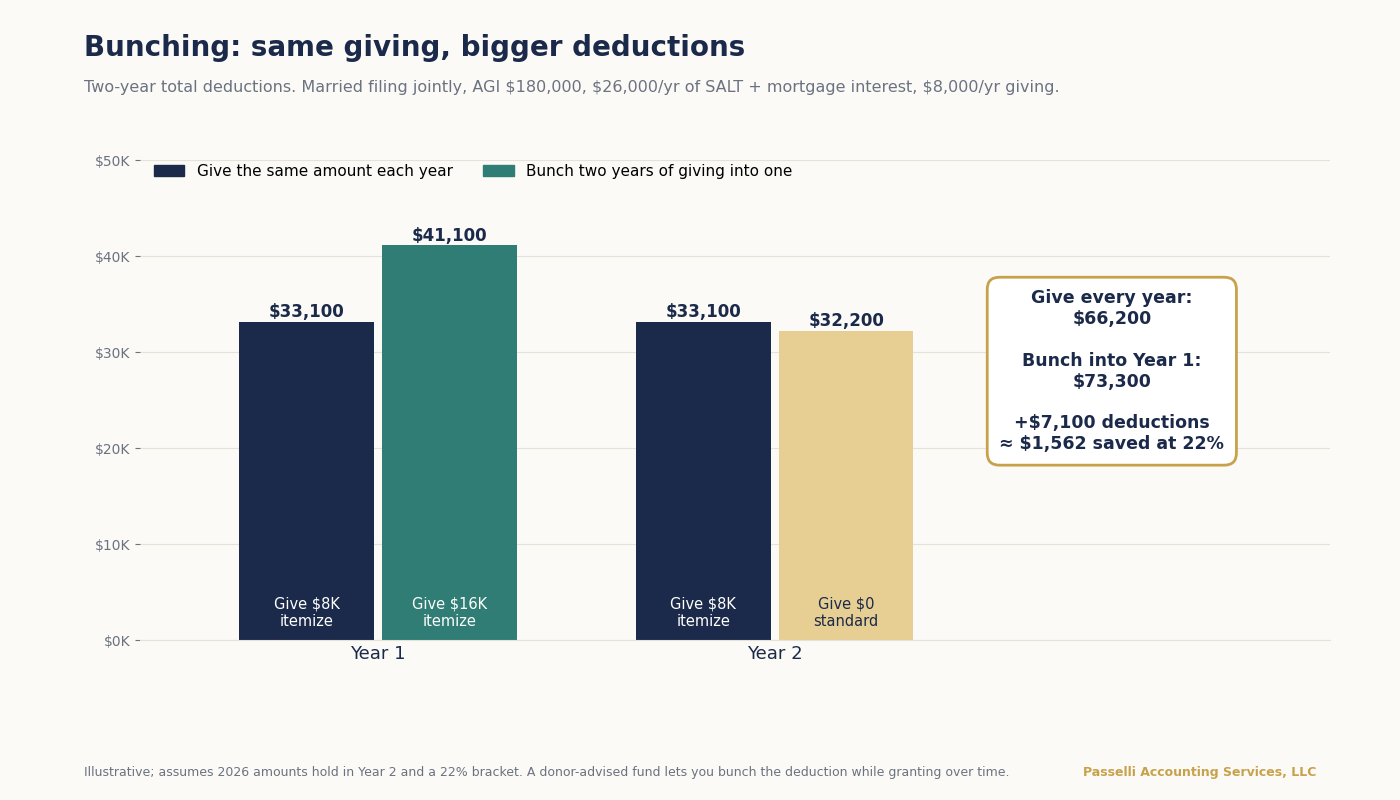
Now take a couple with $26,000 a year of property tax, sales tax, and mortgage interest who give $8,000 a year. If they give evenly, they itemize $33,100 each year, or $66,200 over two years. If they put both years of giving into year one, they itemize $41,100 that year and take the $32,200 standard deduction the next, for $73,300 total. That's $7,100 more in deductions for the exact same giving, or about $1,560 of tax at 22%.
A donor-advised fund makes this painless. You fund it in the bunching year and take the deduction then, and you can still send grants to your charities on your normal schedule. The new 0.5% floor makes bunching a little more valuable than before, because you absorb the floor once every two years instead of every year.
Standard-deduction years aren't a total loss for givers, either. Starting in 2026, non-itemizers can deduct up to $1,000 of cash gifts ($2,000 joint) to qualifying charities. Gifts to donor-advised funds don't count toward this, so the off-year gifts should go straight to the charity.
Six ways people get it wrong
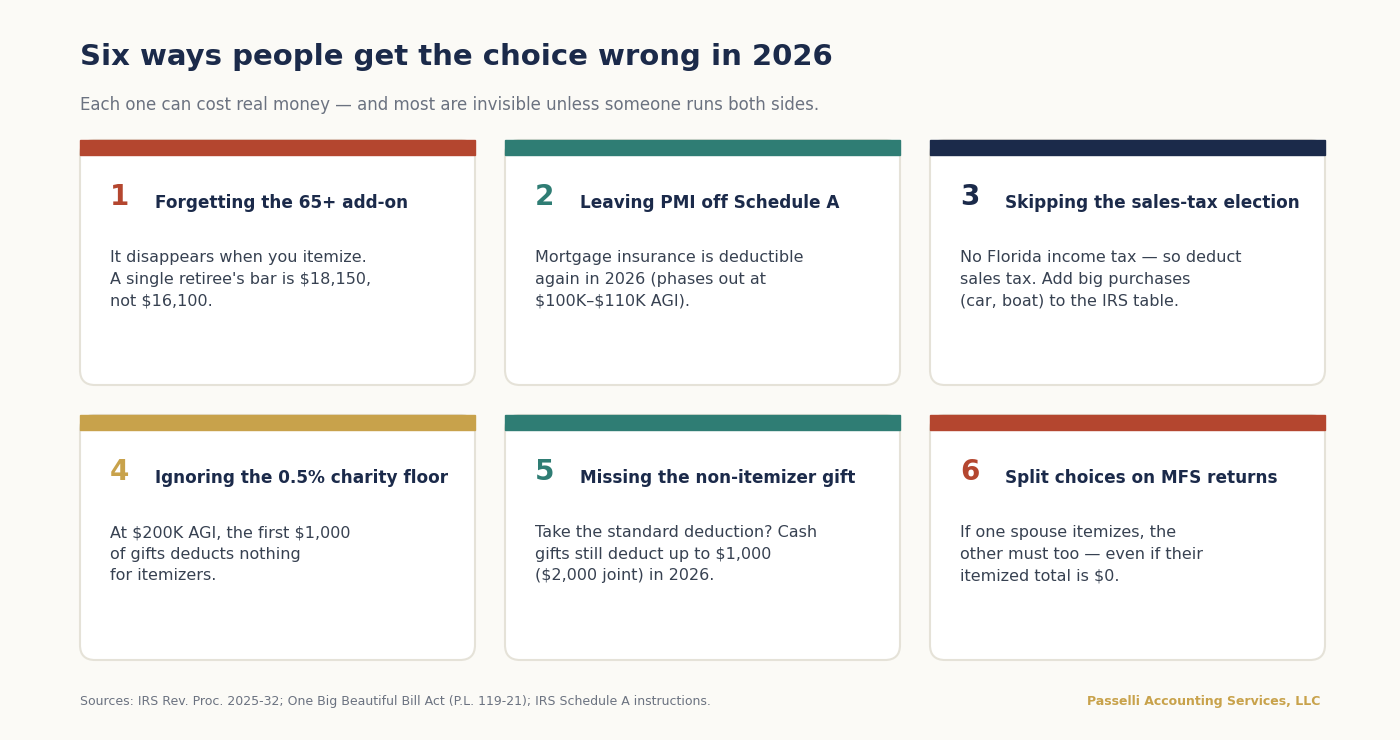
Most of these errors don't trigger a notice. They just cost you money, quietly, every year:
Forgetting the 65+ add-on when comparing, which makes itemizing look better than it is.
Leaving mortgage insurance off Schedule A now that it's deductible again.
Skipping the sales-tax election. In a state with no income tax, it's the only SALT deduction besides property tax. Big-ticket purchases like a car, boat, or RV can be added to the table amount.
Ignoring the 0.5% charitable floor, which can turn a small itemizing edge into a loss.
Missing the new non-itemizer charitable deduction in standard-deduction years.
Mismatched choices on separate returns. If spouses file separately and one itemizes, the other must itemize too, even if their own Schedule A is close to zero.
The bottom line
The standard-versus-itemized choice looks like a checkbox, but it's really a calculation. The inputs changed a lot in 2026: a higher SALT cap, the return of the PMI deduction, a new charitable floor, and a senior deduction that stacks on either path. If your return is on autopilot, now is the time to re-run it.
As I wrote in The Best 2026 Tax Move Is the One Nobody Brags About, you have to know which bucket you're in before you can plan around it. That means keeping the property tax bill, the Form 1098, large purchase receipts, and every charitable acknowledgment letter, even in a year you expect to take the standard deduction.
We're three months from December 31. That's enough time to decide whether 2026 should be a bunching year, whether a December property tax payment helps or doesn't matter, and whether a planned gift belongs in this year or next. If you're near the line, that's a short, worthwhile conversation to have now instead of in April.
This article is provided for general educational purposes and is not tax, legal, or investment advice. Rules, rates, and thresholds change, and the right answer depends on your specific facts. Please reach out before acting on anything here.
Sources: IRS Rev. Proc. 2025-32 (2026 standard deduction and inflation adjustments); One Big Beautiful Bill Act, P.L. 119-21 (§70103 senior deduction; SALT cap under IRC §164(b)(7); mortgage insurance premiums, §70108; charitable floor and non-itemizer deduction); IRS 2026 draft Schedule A and instructions; IRS Publication 936; IRS Publication 501.
