The Best 2026 Tax Move Is the One Nobody Brags About
Clean books, tracked expenses, and a working grasp of the basics beat every clever strategy — mostly because the clever strategies don’t work without them.

Every year around this time I get some version of the same phone call. It is September, three-quarters of the year is gone, and a business owner wants to know the one move that will change their tax bill.
Sometimes there is one. More often the move they’re asking about — the S corporation election, the equipment purchase, the retirement plan — is available in theory and unusable in practice, because nobody can say what the business has actually earned this year. We are fourteen weeks from December 31 and the answer to “what’s your net profit?” is a shrug and a folder of receipts.
That’s the real 2026 planning story. The headline strategies are fine, and I’ll keep recommending them. But the return on the unglamorous work — reconciling a bank account every month, logging a mile, knowing which line of the return a number lands on — is larger, more reliable, and available to everyone, including the people the headline strategies don’t fit.
A deduction you can’t prove is not a deduction
Start with the rule most people never hear until it is too late.
Ordinary business expenses live under a general recordkeeping standard, and when records are imperfect a court has some latitude. That latitude comes from Cohan v. Commissioner, a 1930 case that permits a court to “make as close an approximation as it can” rather than disallow a deduction outright.
Then there is §274(d), which carves a specific list out of that mercy. Travel, meals, vehicle use, and listed property require strict substantiation — the amount, the time, the place, and the business purpose of each expenditure. The Cohan rule does not apply. If the records aren’t there, the deduction isn’t there. No estimate, no approximation, no credit for the obvious fact that the driving happened.
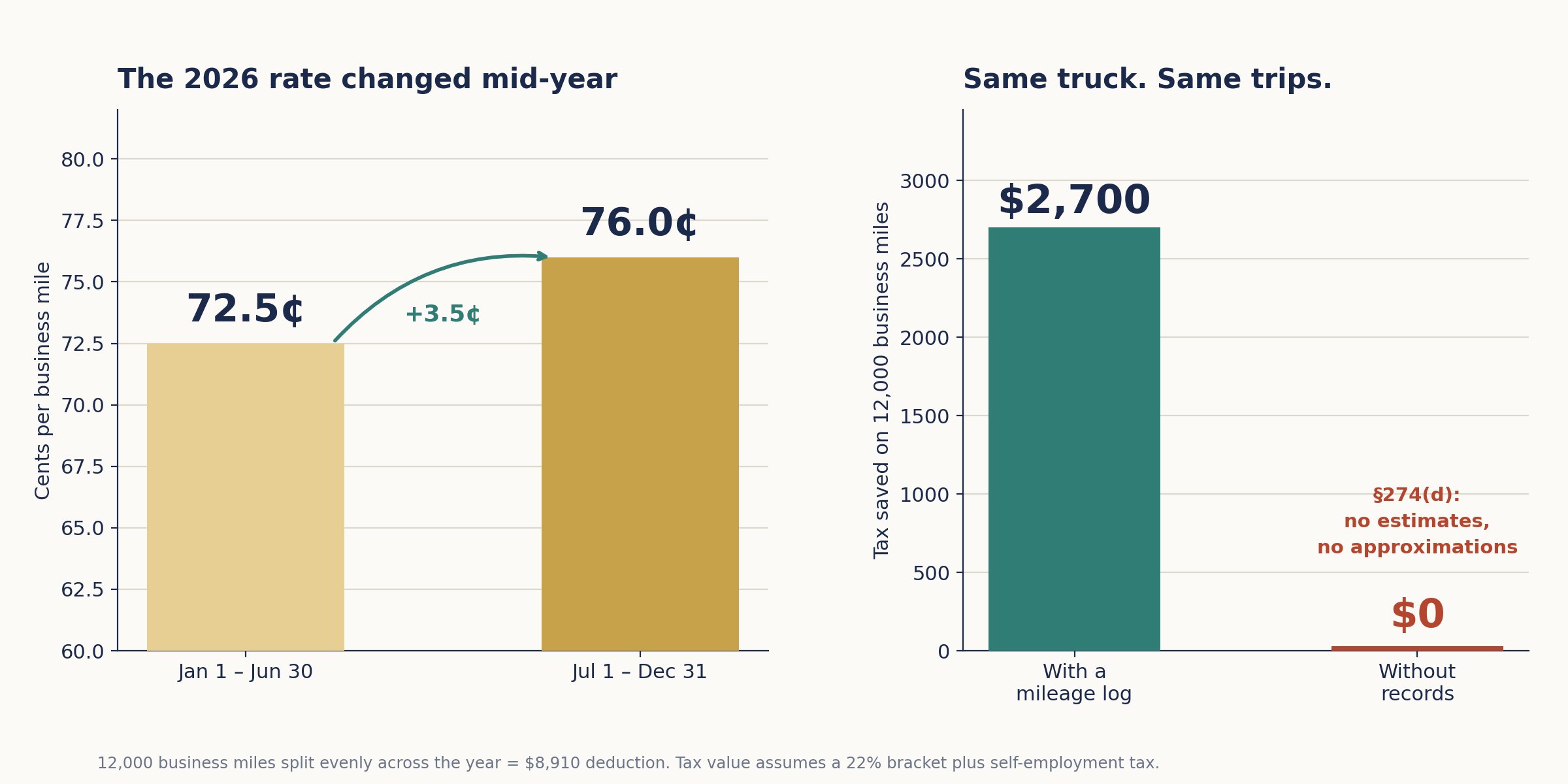
Consider a contractor who drives 12,000 business miles in 2026. The rate changed mid-year: 72.5 cents a mile through June 30 and 76 cents from July 1 forward. Split evenly, that is an $8,910 deduction — worth roughly $2,700 in combined federal income and self-employment tax at a 22% bracket.
With a mileage log, it’s $2,700. Without one, it’s zero. Same truck, same trips, same year.
What one documented dollar is actually worth
People underestimate the value of a business deduction because they think in terms of their tax bracket. For a self-employed owner, the bracket is only part of it.
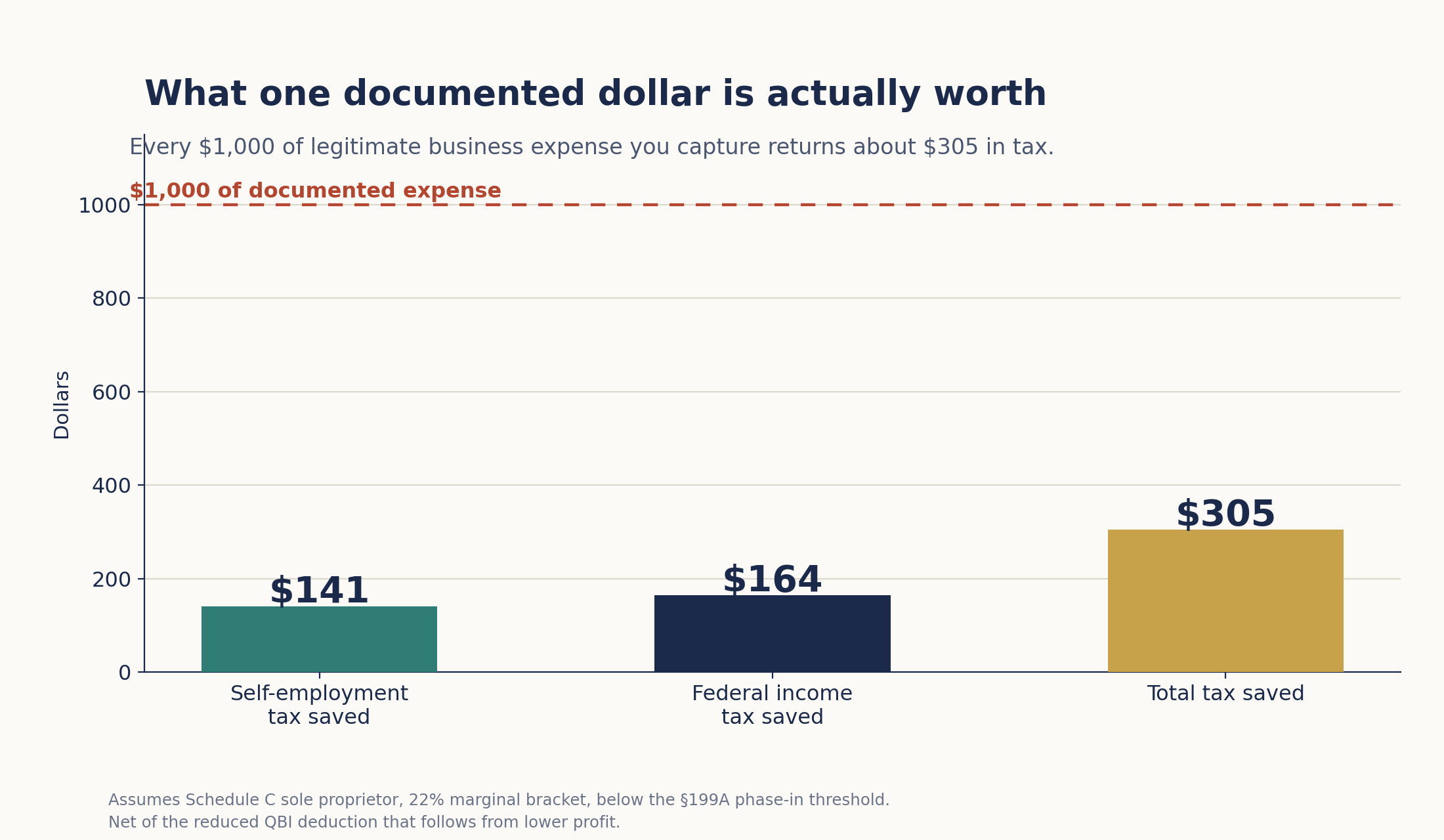
Run $1,000 of legitimate, documented expense through a Schedule C at a 22% marginal rate: self-employment tax falls by about $141, and income tax falls by about $164 — after accounting for the fact that lower profit also means a slightly smaller qualified business income deduction. Net: roughly $305 back on every $1,000, or about 30 cents on the dollar.
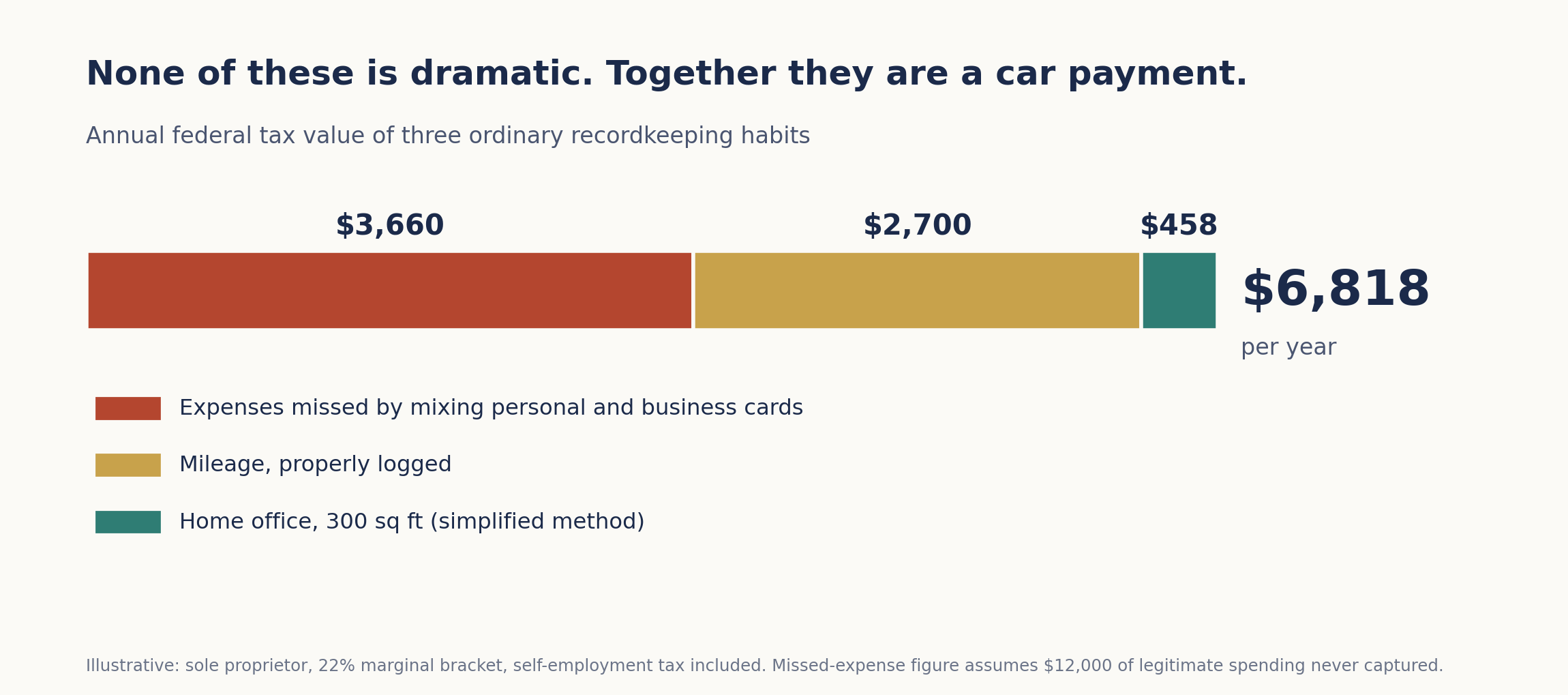
Now scale it. An owner running business purchases through a personal card and reconstructing them from memory in March typically misses somewhere between 10% and 20% of what they spent. Call it $12,000 of legitimate expense that never makes it onto the return. That is about $3,660 in tax, paid voluntarily, every year, for the sake of not spending twenty minutes a week on categorization.
Add a home office. A 300-square-foot space under the simplified method is a $1,500 deduction — about $458 — and the actual-expense method is frequently two to three times that for owners who keep utility and mortgage interest records. None of these numbers is dramatic on its own. Together they are a car payment.
The big moves are downstream of the small ones
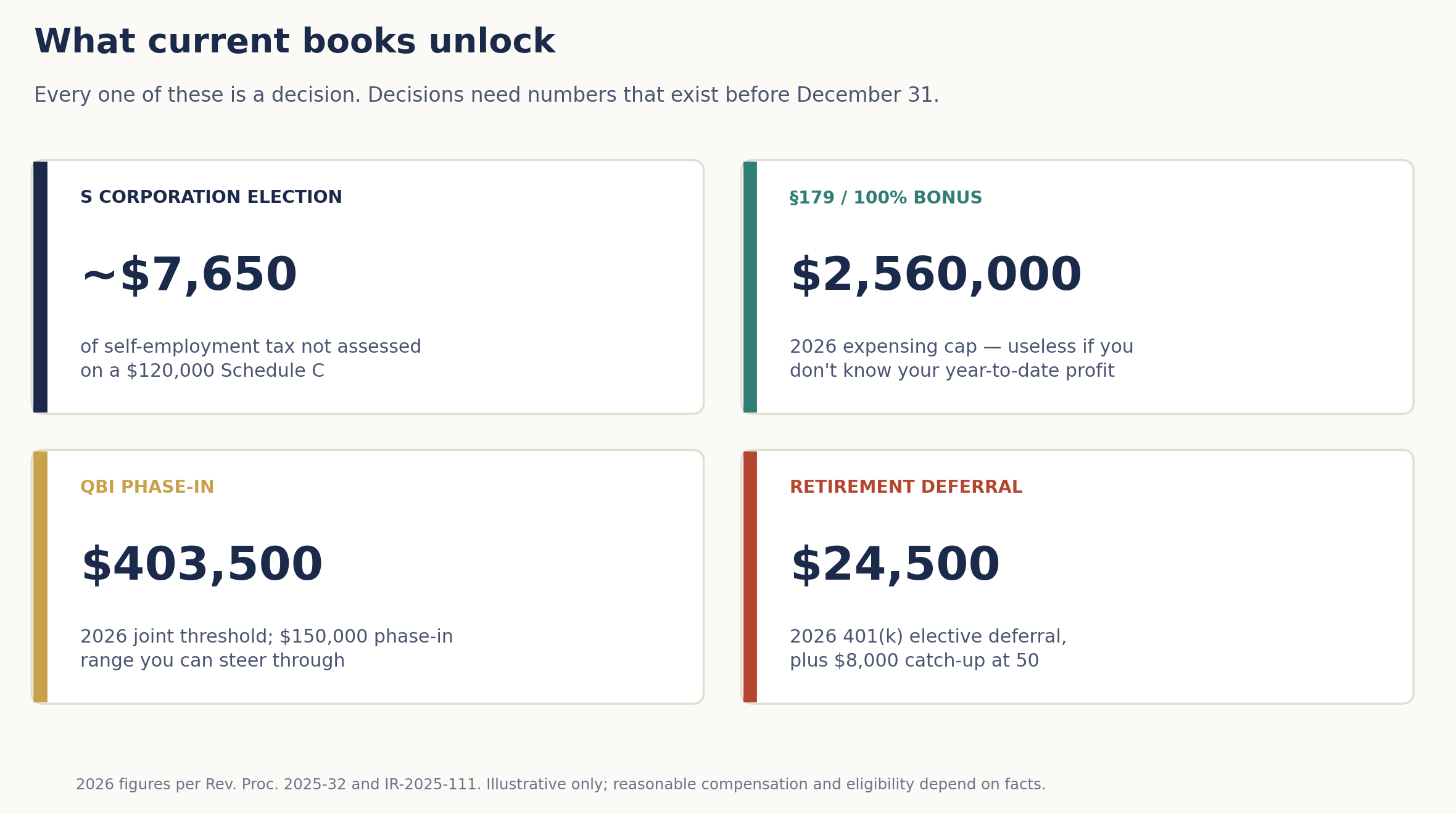
Here is the part that costs the most and gets discussed the least: the strategies worth real money are decisions, and decisions require current numbers.
The S corporation election. I’ve written before about the Schedule C netting $120,000 where electing S treatment and paying a defensible $70,000 salary keeps roughly $7,650 of self-employment tax from being assessed. That analysis depends entirely on knowing what the business earns and what a reasonable salary looks like against it. An owner who closes their books monthly knows by August whether the election makes sense. An owner who reconciles in March finds out after the year has closed.
Fixed asset timing. The One Big Beautiful Bill Act restored 100% bonus depreciation permanently, and §179 expensing sits at $2,560,000 for 2026 with a phase-out beginning at $4,090,000. Enormous ceilings — and almost entirely useless as a planning tool if you don’t know in November whether you’re having a $90,000 year or a $190,000 year. Buying equipment you don’t need to chase a deduction is a bad trade; buying equipment you do need in the right year is free money. Only one of those is available to someone flying blind.
The QBI deduction. For 2026 the §199A threshold is $201,750 single and $403,500 joint, and OBBBA widened the phase-in range to $75,000 and $150,000 respectively. If you’re inside that range, every dollar of taxable income you move — through a retirement contribution, a timing decision, an expense you actually captured — changes the size of the deduction. That’s a dial you can only turn if you know where you’re standing. There’s also now a $400 minimum deduction for active business owners with at least $1,000 of qualified business income, which is small, real, and routinely missed.
Retirement contributions. The 2026 limits are $24,500 of 401(k) elective deferral (plus $8,000 catch-up at 50, or $11,250 at ages 60–63), $7,500 for an IRA, and $4,400 self-only or $8,750 family for an HSA. A solo 401(k) deferral alone is worth about $5,390 at a 22% bracket — but you have to establish the plan and fund it on a schedule, which means knowing before year-end that the cash is there.
2026 quietly raised the price of sloppy records
A few changes this year specifically punish the approximate.
The mileage rate changed mid-year, so a single annual estimate is now wrong by construction — you need the split. The charitable deduction gained a 0.5% AGI floor for itemizers, meaning a household at $200,000 of AGI who gives $2,000 deducts $1,000; the first $1,000 is gone. Non-itemizers, on the other hand, got a new above-the-line deduction of up to $1,000 ($2,000 joint) for cash gifts — the first time in years that standard-deduction filers get anything at all for giving, and a reason to keep acknowledgment letters you would previously have thrown away.
And with the 2026 standard deduction at $32,200 joint and $16,100 single, more households than ever won’t itemize at all — which is a reason to know which bucket you’re in, not a reason to stop tracking.
What “good enough” actually looks like
Nobody needs a controller. The bar is lower than people assume:
A dedicated business bank account and card. One decision that eliminates most of the reconstruction problem permanently.
Monthly reconciliation. Not quarterly, not annually. Thirty to sixty minutes while you still remember what the charges were.
A mileage app. They cost about $60 a year and produce exactly the four elements §274(d) requires.
Receipts for anything over $75, and all lodging. Digital is fine. A photo in a dated folder is fine.
A quarterly look at the profit and loss — not to file anything, but so that in November you can answer the question that every planning decision starts with: what kind of year is this?
That’s it. Four habits and a quarterly glance.
The bottom line
The best tax planning ideas for 2026 are not secrets. They’re the same ones as last year: pick the right entity, fund the right retirement plan, time the right purchases, capture the deductions you’ve already earned. What separates the owners who get them from the owners who read about them is not sophistication. It’s whether the numbers exist in time to act on.
Clean books don’t just save you the $3,000 in missed deductions. They convert every other strategy from a thing you discuss in March into a thing you execute in October. That’s the whole game.
If you’re not sure what kind of year you’re having, that’s a fine reason to call. It’s also, right now, the most valuable question on the list.
This article is provided for general educational purposes and is not tax, legal, or investment advice. Rules, rates, and thresholds change, and the right answer depends on your specific facts. Please reach out before acting on anything here.
Sources: IRS Rev. Proc. 2025-32 (2026 inflation adjustments); IRS IR-2025-111 (2026 retirement plan limits); IRS 2026 standard mileage rates; IRC §274(d) and Treas. Reg. §1.274-5T substantiation requirements; Cohan v. Commissioner, 39 F.2d 540 (2d Cir. 1930); One Big Beautiful Bill Act §70105 and depreciation provisions; IRS guidance on 2026 charitable contribution rules.
