Tax Planning for 2026: Why September Is When the Real Work Starts
Your third estimated payment for 2026 is due this week. That’s not a coincidence — it’s the best reminder of the year that December is too late to start.

Every fall I have some version of the same conversation. A client calls in November, sometimes December, wanting to know what they can still do to lower this year’s bill. Some years the honest answer is “not much” — the moves that actually move the needle need lead time: a purchase that has to be placed in service, a retirement plan that has to be adopted, a withholding change that has to run through a few pay periods before it matters.
September is different. You have real numbers for three quarters of the year, real time left to act on them, and — this year in particular — a set of rules that finally stopped changing. The One Big Beautiful Bill Act locked several major provisions into place permanently starting in 2026, which means for the first time in a few years you can plan around the rule instead of guessing whether it survives to December 31.
What actually changed for 2026
Three things that used to come with an expiration date no longer do.
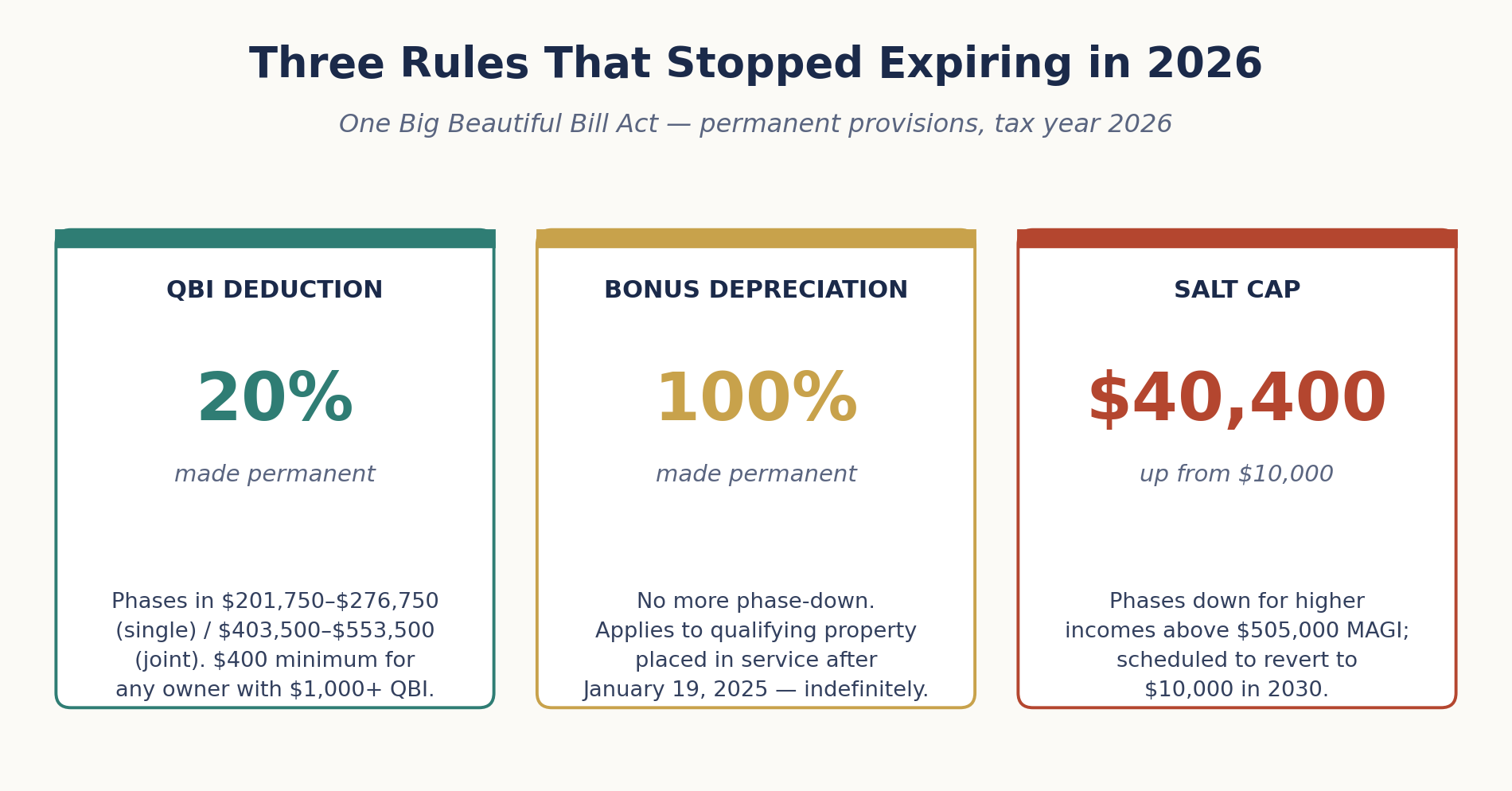
The 20% qualified business income deduction is now permanent. For owners of S corporations, partnerships, and sole proprietorships, that deduction phases in between $201,750–$276,750 of taxable income for single filers and $403,500–$553,500 for joint filers in 2026, and it now carries a $400 minimum deduction for anyone with at least $1,000 of qualifying business income — a small floor, but a real one for very small operations.
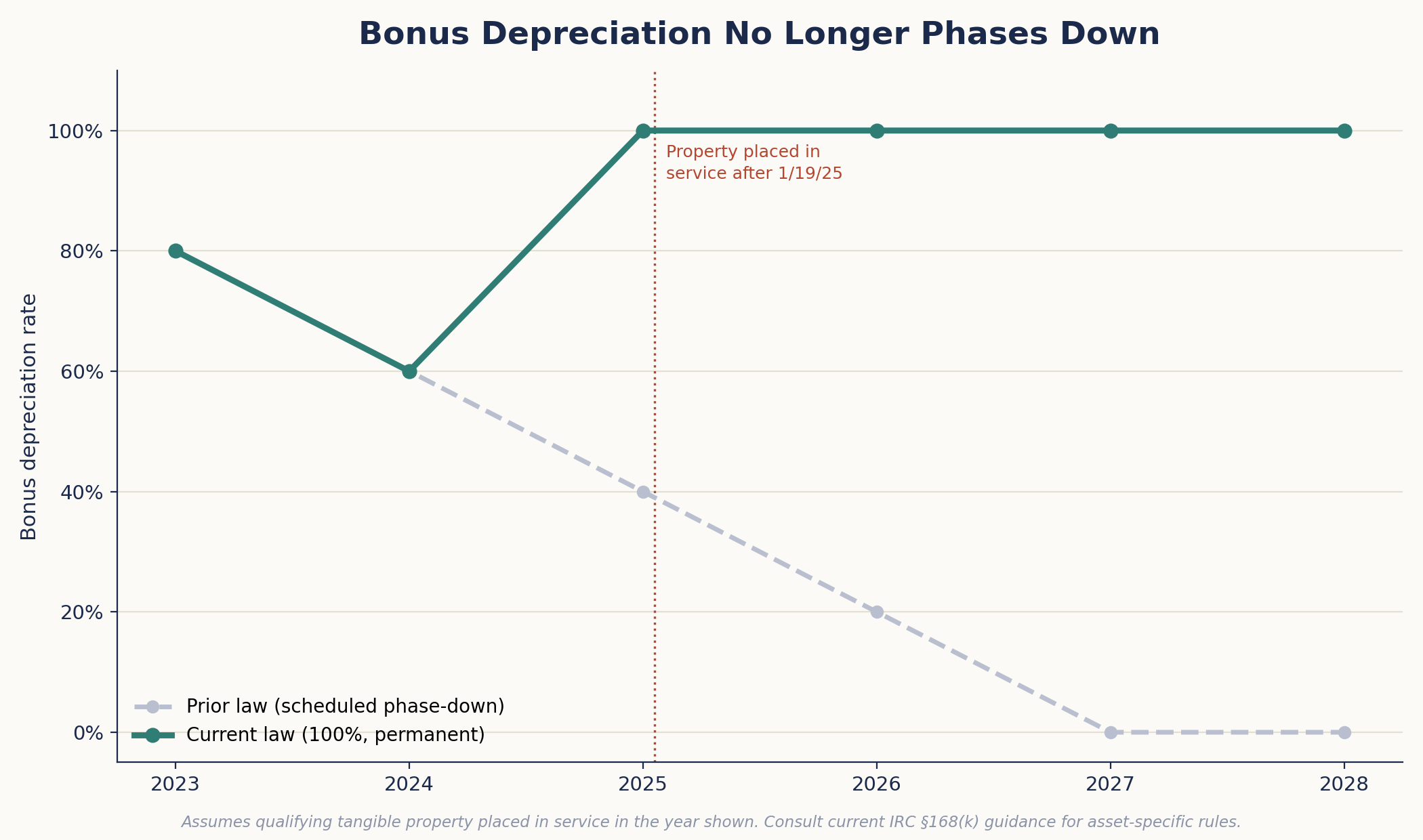
Bonus depreciation is back to 100% — permanently. Under prior law, bonus depreciation was on a phase-down schedule toward zero. That schedule is gone for property placed in service after January 19, 2025. Section 179 expensing also rose to a $2.56 million annual limit for 2026, phasing out above $4.09 million of qualifying purchases.
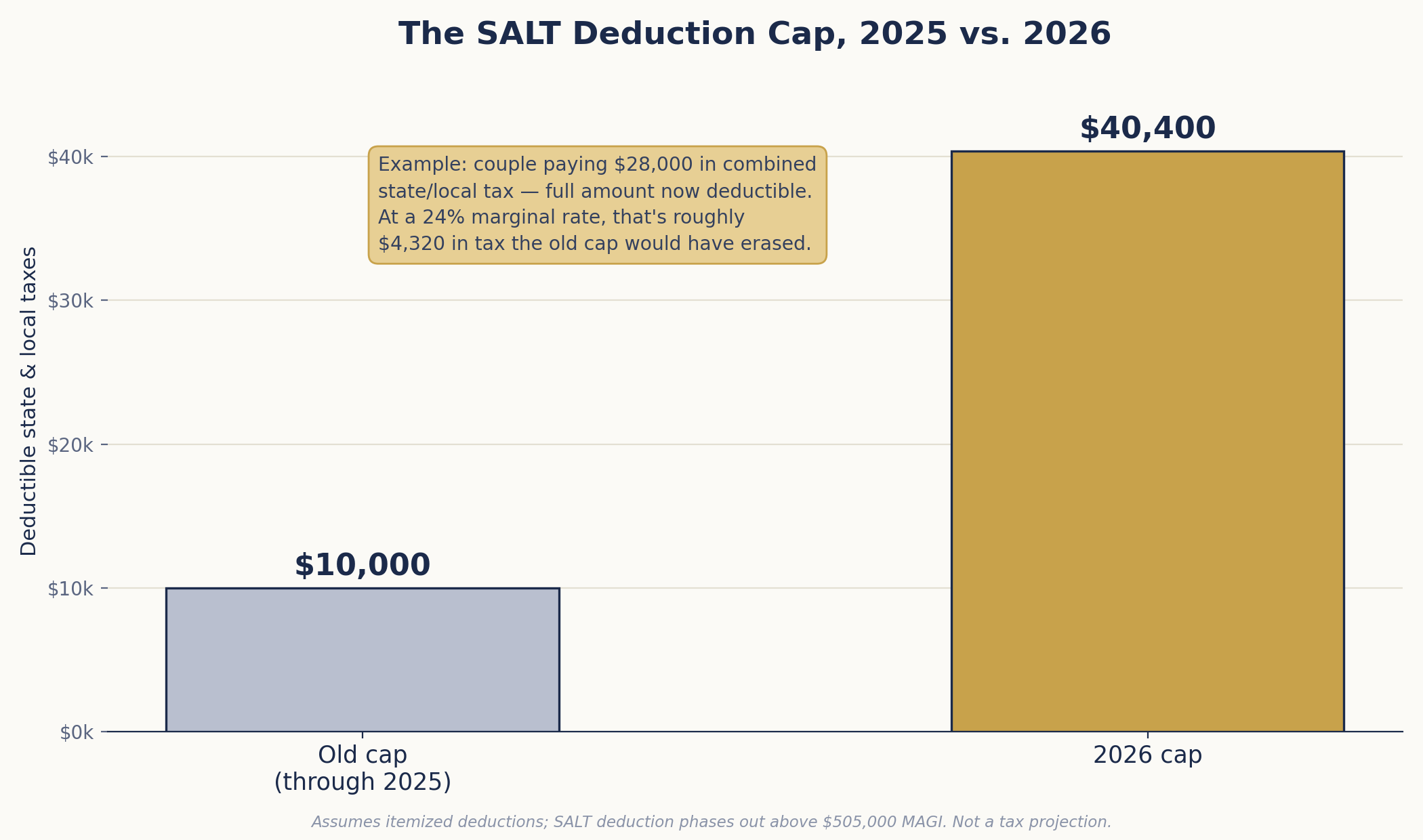
The SALT cap roughly quadrupled. The $10,000 cap on deducting state and local taxes — a sore point for a lot of Florida transplants who still owe tax where they came from, and for anyone paying meaningful property tax here — is now $40,400 for 2026, with a phase-down for higher earners and a scheduled reversion to $10,000 in 2030.
The SALT cap change is worth a real look
If you itemize and your state and local taxes (property tax plus either income or sales tax) run above $10,000, this one is not academic. Take a couple paying $28,000 a year in Florida property tax and out-of-state income tax combined — under the old $10,000 cap, $18,000 of that was simply lost. Under the 2026 cap, the full $28,000 is deductible. At a 24% marginal rate, that is roughly $4,320 in tax that a $10,000 cap would have erased and a $40,400 cap does not. The benefit phases out for taxpayers with modified AGI above $505,000, so this is squarely a mid-to-high earner planning item, not a top-bracket one.
Buy equipment on a timeline you control, not the calendar’s
The old bonus depreciation phase-down created a real “use it or lose it” panic every December. That pressure is gone — 100% bonus depreciation isn’t disappearing next year — but the mechanics of the deduction still reward getting property placed in service before your tax year closes.
Example: a client buys $50,000 of qualifying equipment and places it in service by December 31. In the 24% bracket, that purchase shelters $50,000 of income immediately rather than over five or seven years of straight-line depreciation — about $12,000 in tax deferred into the current year instead of trickling out over the life of the asset. Whether accelerating that purchase makes sense depends on cash flow and whether you actually need the equipment, not just the tax math — but now that the rule is permanent, it’s worth running the numbers on a real timeline instead of a rushed one.
Retirement accounts are the other deadline that doesn’t move
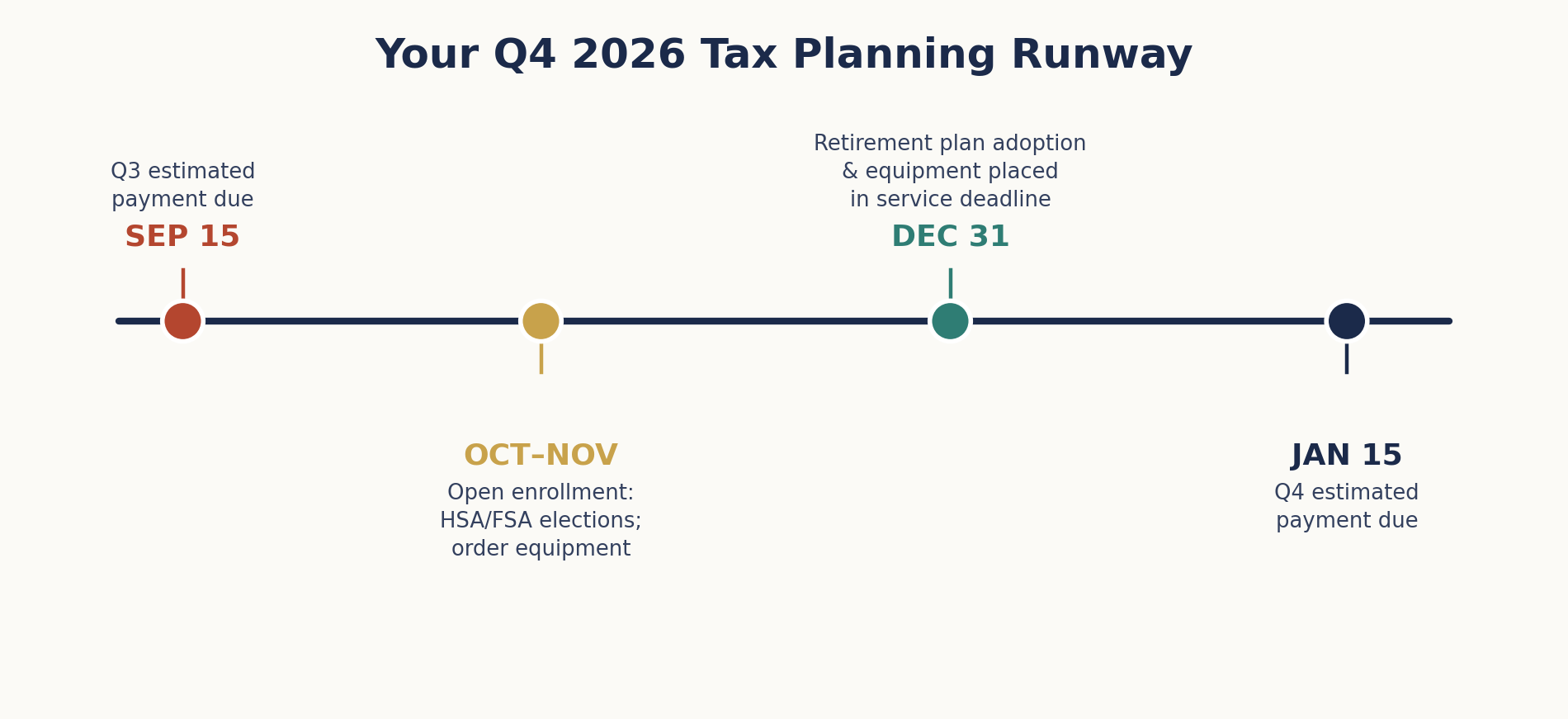
Unlike an IRA, which can be funded up until the following April, a 401(k)-type plan generally has to be adopted by December 31 to shelter current-year income — funding can sometimes follow later, but the plan itself needs to exist first. For 2026, the employee deferral limit is $24,500, with an $8,000 catch-up at 50 and older ($32,500 total), and a larger $11,250 catch-up for anyone turning 60 through 63 this year ($35,750 total). Traditional and Roth IRA limits rose to $7,500, plus a $1,100 catch-up at 50+.
If you’re self-employed and don’t already have a solo 401(k) or SEP in place, September gives you enough runway to get the paperwork done properly instead of racing a January 1 deadline. It’s also a reasonable window to model a Roth conversion, since you now have nine months of real income data instead of a guess.
Four things worth doing before New Year’s Eve
Get your Q3 and Q4 estimates right. The third payment is due this week; the fourth is due January 15. Underpaying either one triggers an IRS penalty computed quarter by quarter — it isn’t forgiven just because you overpay at filing time.
Decide on equipment purchases with real numbers, not panic. You have three months to place property in service instead of three days.
Adopt (or top off) a retirement plan. The deadline to establish a plan for 2026 is the calendar year-end, even though some contributions can follow later.
Revisit charitable giving. If you don’t itemize, OBBBA now lets you deduct up to $1,000 (single) or $2,000 (joint) in cash gifts anyway. If you do itemize, a new 0.5%-of-AGI floor applies before charitable deductions count at all — which is a good reason to bunch a few years of giving into one if you’re close to that line.
The bottom line
None of this is exotic. It’s the same handful of levers that have always mattered — timing income, timing purchases, funding retirement accounts, managing what’s deductible — applied to a rulebook that, for once, isn’t scheduled to change again in eighteen months. The advantage September has over December isn’t more options; it’s more time to use the ones you have. If your third-quarter estimate reminded you of that this week, that’s the system working as intended.
This article is provided for general educational purposes and is not tax, legal, or investment advice. Rules, thresholds, and deadlines change, and the right answer depends on your specific facts. Please reach out before acting on anything here.
Sources: IRS Rev. Proc. 2025-32 (2026 inflation adjustments); IRS “401(k) limit increases to $24,500 for 2026, IRA limit increases to $7,500”; One Big Beautiful Bill Act (H.R. 1, 2025) provisions on Section 199A, bonus depreciation, Section 179, SALT cap, and charitable deduction changes; IRS Form 2553 instructions on S corporation election timing.
