CPA, CFA, CFP: Three Sets of Letters, Three Different Jobs
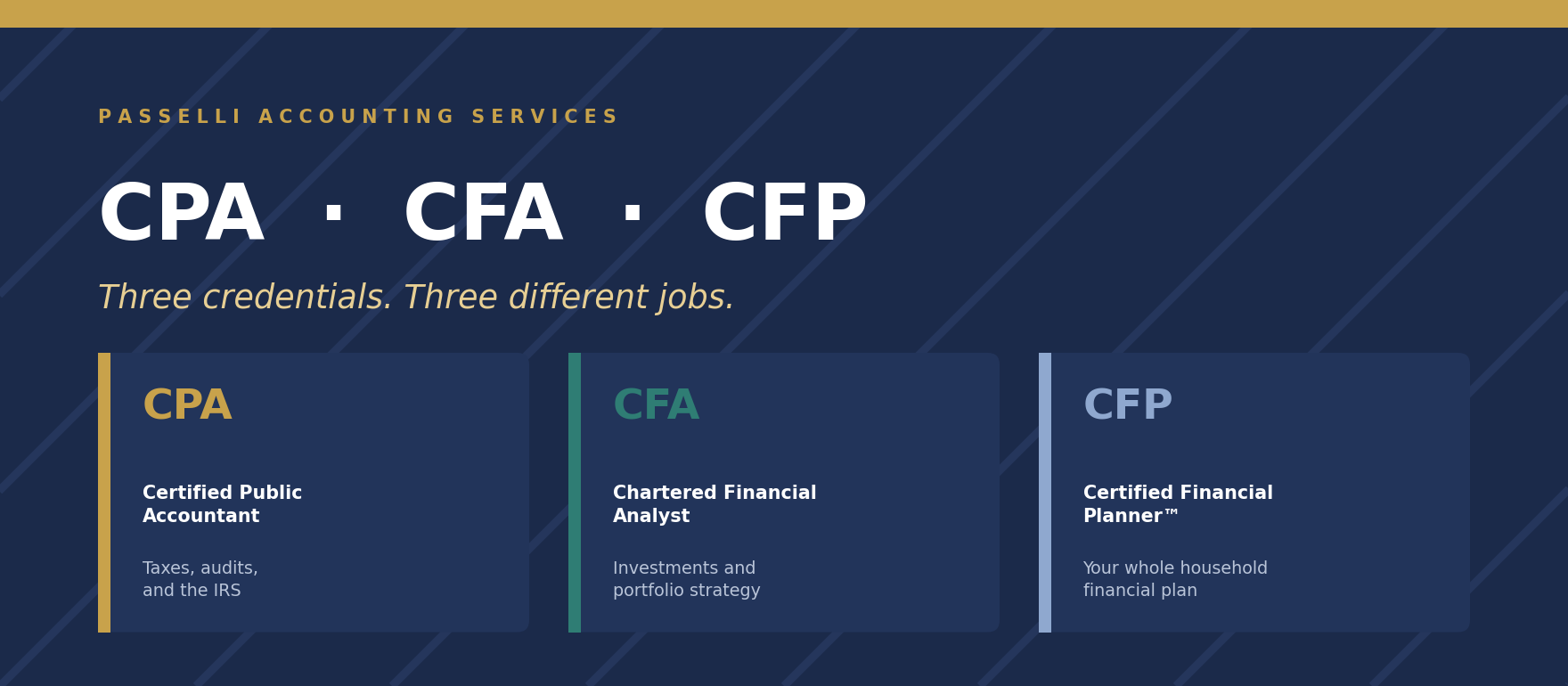
They all sound like “the money person.” Only one of them can stand between you and the IRS.
Every few weeks a client forwards me an email from someone with initials after their name and asks a version of the same question: is this the person I should be talking to?
Fair question. CPA, CFA, and CFP look interchangeable on a business card. They are not. They are three different credentials, earned in three different ways, that authorize three different kinds of work. Hiring the wrong one is rarely a disaster, but it is usually a waste of money — and occasionally it means nobody in the room is actually allowed to do the thing you need done.
Here is the short version, and then the details.
CPA: the license
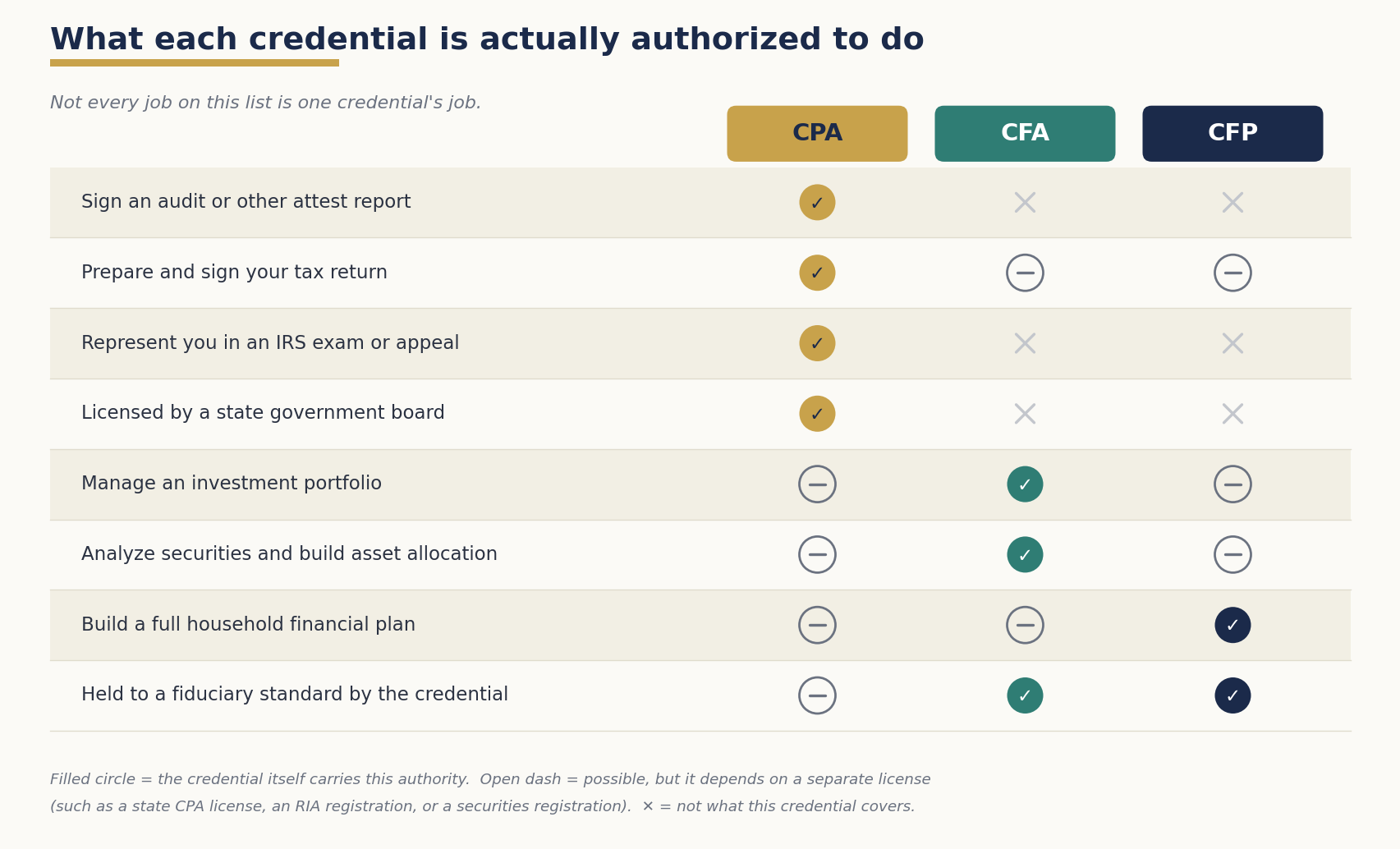
A CPA — Certified Public Accountant — is the only one of the three that is a government license. A state board of accountancy issues it, a state board can revoke it, and the letters carry legal authority that the other two do not.
Two pieces of that authority matter most to business owners:
Attest work. Only a licensed CPA can issue an audit or review report on financial statements. When your bank, your bonding company, or a buyer says “we need audited financials,” they are legally requiring a CPA. No other credential substitutes.
IRS representation. Under Circular 230, only attorneys, CPAs, and enrolled agents have unlimited representation rights before the IRS. That means walking into an examination on your behalf, arguing the merits, and negotiating an appeal. A CFA or CFP cannot do that — not because they aren’t smart enough, but because they aren’t authorized.
CPAs also live in the tax code. Suppose your Schedule C nets $120,000. Elect S corporation treatment, pay yourself a defensible $70,000 salary, and roughly $50,000 flows through as a distribution rather than self-employment income — about $7,650 in self-employment tax that never gets assessed, before payroll filing costs. That analysis is a CPA question, not an investment question.
As of August 2026, there were about 650,667 actively licensed CPAs in the United States.
CFA: the analyst
A CFA — Chartered Financial Analyst — is a designation from the CFA Institute, not a license. Its subject is securities: valuation, portfolio construction, asset allocation, risk. Charterholders tend to sit on the institutional side of the business, managing money or analyzing what other people are managing.
You want a CFA in the room when the question is what should this portfolio own, and is what it owns worth the price. That is not a small question. Take a $1,000,000 portfolio earning 6% before costs. Move it from a 0.95% fund lineup to a 0.25% lineup and you keep an extra 0.70% a year. Over 20 years that is roughly $3.21 million versus $2.81 million — about $398,000 in difference, produced entirely by cost, not by picking better investments.
Worldwide, CFA Institute reports nearly 200,000 members and charterholders across 160 locations.
CFP: the planner
A CFP® — Certified Financial Planner — is a certification from CFP Board, and its subject is the household, not the portfolio. Coursework spans nine areas including insurance, investments, taxes, retirement, estate planning, and the psychology of financial planning, and finishes with a capstone in which the candidate builds an actual plan.
The CFP is who you call when the question has a life in it rather than a security. Can we retire at 62? Claiming Social Security at 62 instead of a full retirement age of 67 permanently reduces the benefit by about 30% — a decision that runs for thirty years and cannot be undone after the first twelve months.
Notably, CFP Board holds CFP professionals to a fiduciary duty at all times when providing financial advice. That is a meaningful commitment, and it is worth asking any advisor whether they are actually bound by it. As of the end of 2025 there were 107,529 CFP professionals, an all-time high and nearly double the 2007 count.
What it takes to earn each one
None of the three is a weekend course.
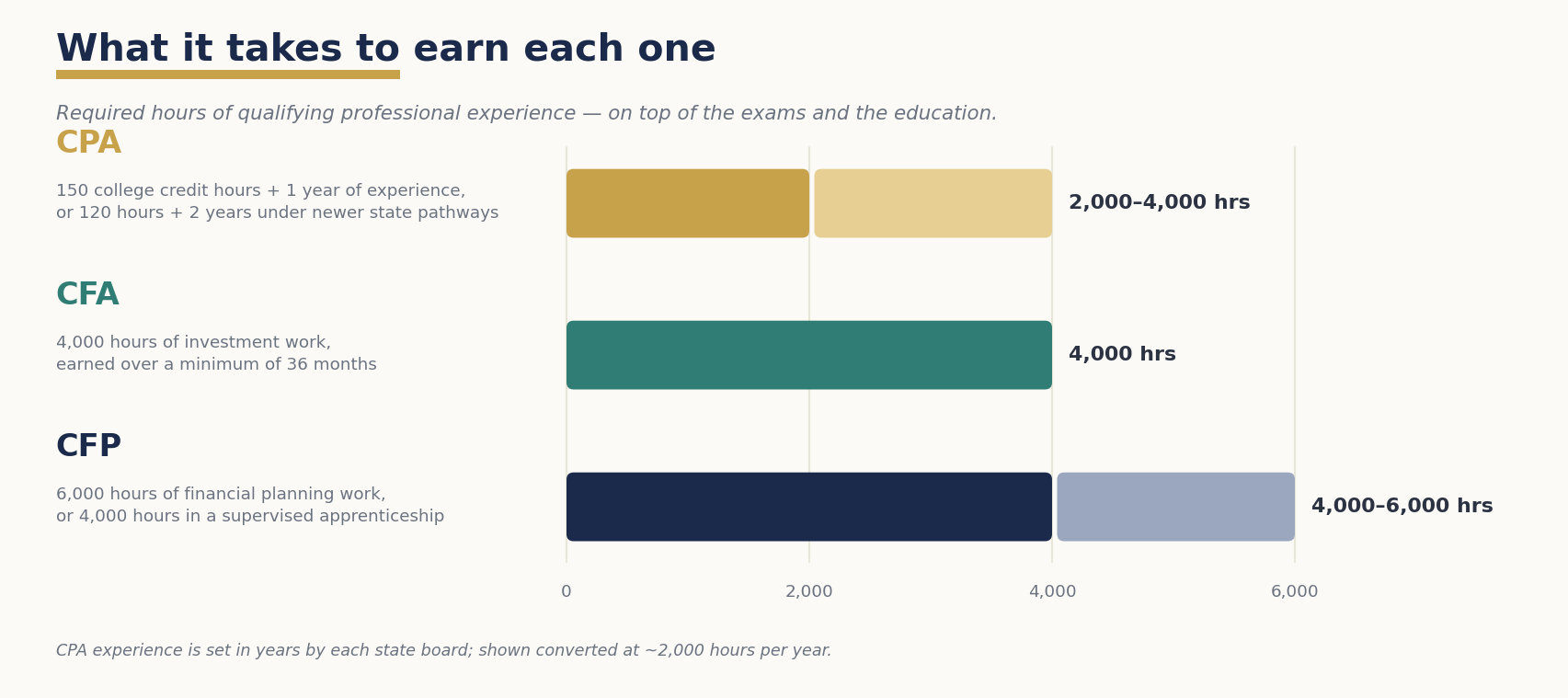
A CPA needs 150 college credit hours plus a year of qualifying experience — or, under the newer pathways a growing number of states have adopted, a 120-hour bachelor’s degree plus two years. The exam runs three core sections (AUD, FAR, REG) plus one discipline section the candidate chooses.
A CFA needs three exam levels and 4,000 hours of investment work over a minimum of 36 months. Most charterholders take three to four years.
A CFP needs a bachelor’s degree in any field, the nine-area coursework, and 6,000 hours of financial planning experience — or 4,000 hours in a supervised apprenticeship.
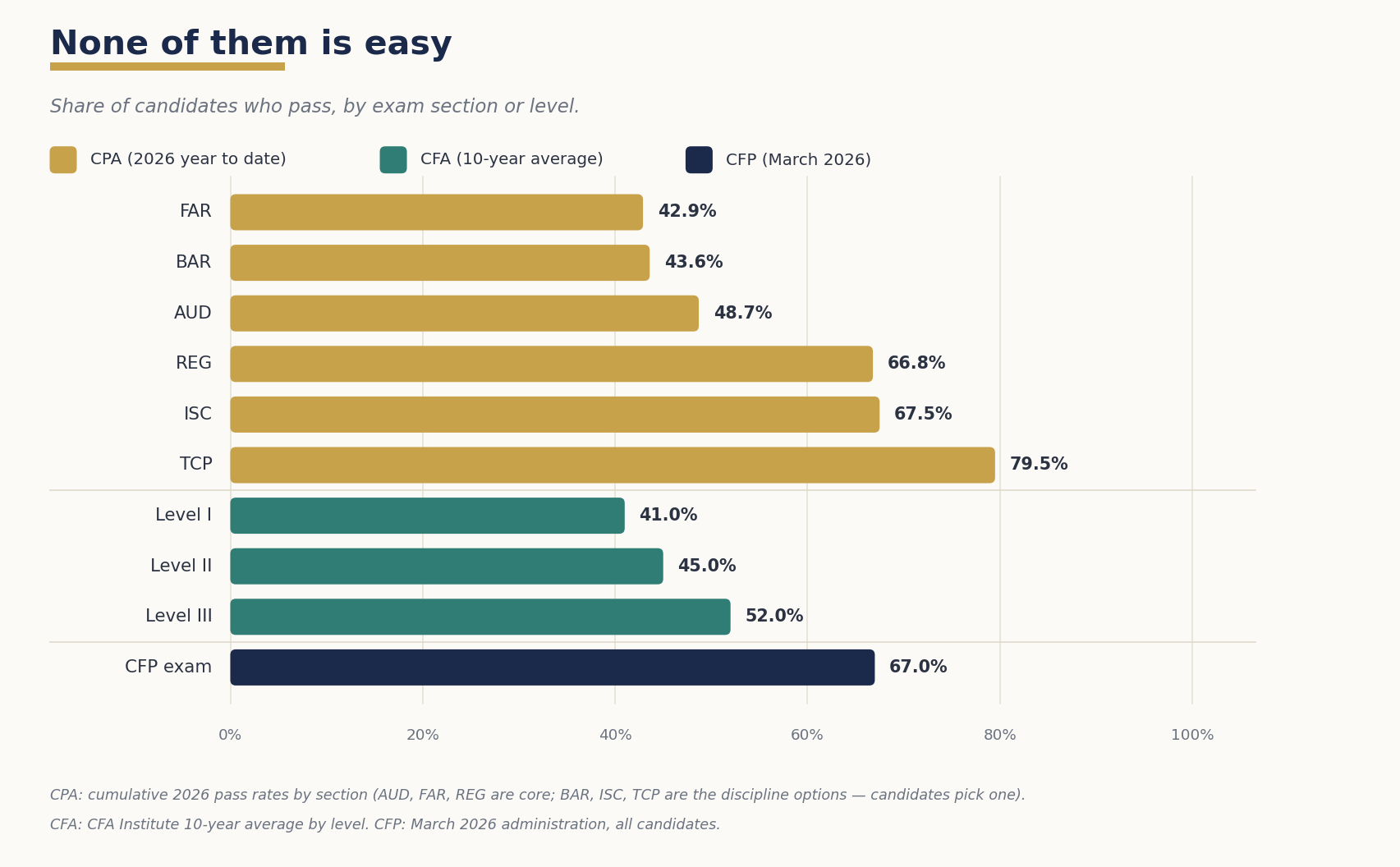
The pass rates tell you these are real filters. In 2026 to date, FAR has passed about 43% of candidates and AUD about 49%. CFA Level I averages 41% over ten years. The CFP exam ran 67% in March 2026 — the friendliest of the three, and still a third of the room going home to study again.
When you need more than one
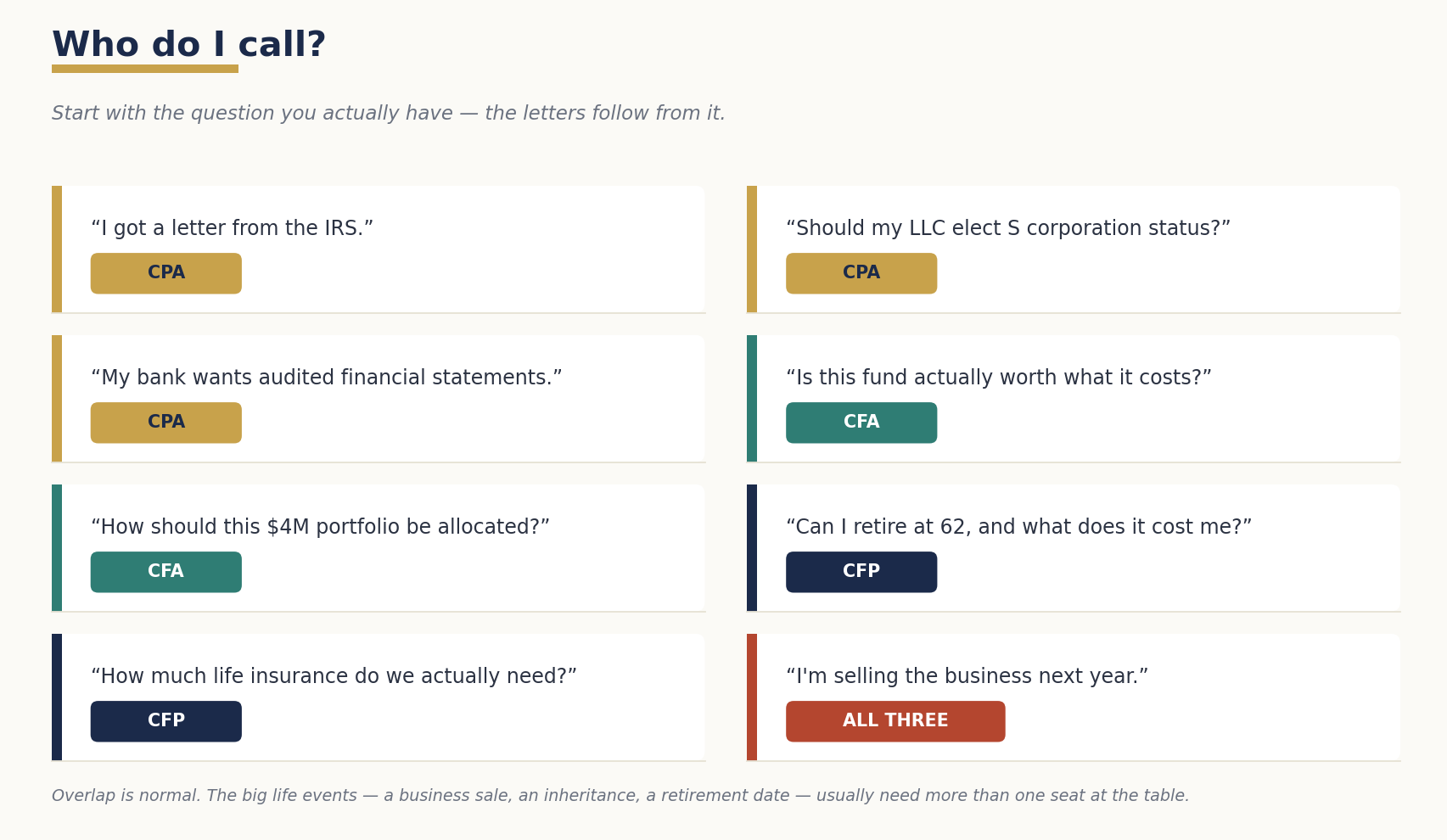
The honest answer to most sophisticated questions is that the credentials overlap, and the big moments need more than one seat at the table.
Sell a business and you have a CPA question (structure, basis, installment treatment, state apportionment), a CFA question (what the proceeds should be invested in), and a CFP question (whether the after-tax number actually supports the life you have in mind). Inherit an IRA and you have all three again. A good professional in any of these lanes will tell you plainly when the question has left theirs.
The letters are not a ranking. They are a description of the lane.
The bottom line
Start with the question, not the credential. If it involves a tax return, an audit, or an IRS notice, you want a CPA. If it involves what a portfolio should own and what it should cost, you want a CFA. If it involves your household’s whole picture — retirement dates, insurance, education funding, the order in which accounts get spent — you want a CFP. And if the question is large enough, you want them talking to each other rather than each solving a third of it in isolation.
If you’re not sure which lane your question is in, that itself is a fine reason to call. Half of what we do at the front end of an engagement is telling people which specialist they actually need.
This article is provided for general educational purposes and is not tax, legal, or investment advice. Rules, thresholds, and credentialing requirements change, and the right answer depends on your specific facts. Please reach out before acting on anything here.
Sources: NASBA Accountancy Licensee Database; AICPA & NASBA CPA licensure pathways; IRS Circular 230 and Office of Professional Responsibility guidance; CFA Institute exam and charter requirements; CFP Board education, experience, and Code of Ethics and Standards of Conduct; UWorld and CFA Institute published pass-rate data.
Passelli Accounting Services, LLC · Loxahatchee, FL · 561-386-3997
