The S Corp Election: Pros, Cons, and When It Actually Makes Sense
Business owners in Royal Palm Beach and Wellington, If you own a profitable LLC or sole proprietorship, someone has almost certainly told you to “become an S corp.” It’s good advice — for the right business, at the right income level. For everyone else, it’s an expensive way to add paperwork. The difference comes down to a handful of numbers you can actually run.
First, what the election actually is
An S corporation isn’t a type of business entity — it’s a tax election. Your LLC (or corporation) stays exactly what it is legally; you simply ask the IRS, using Form 2553, to tax it under Subchapter S. Nothing about your liability protection or ownership changes.
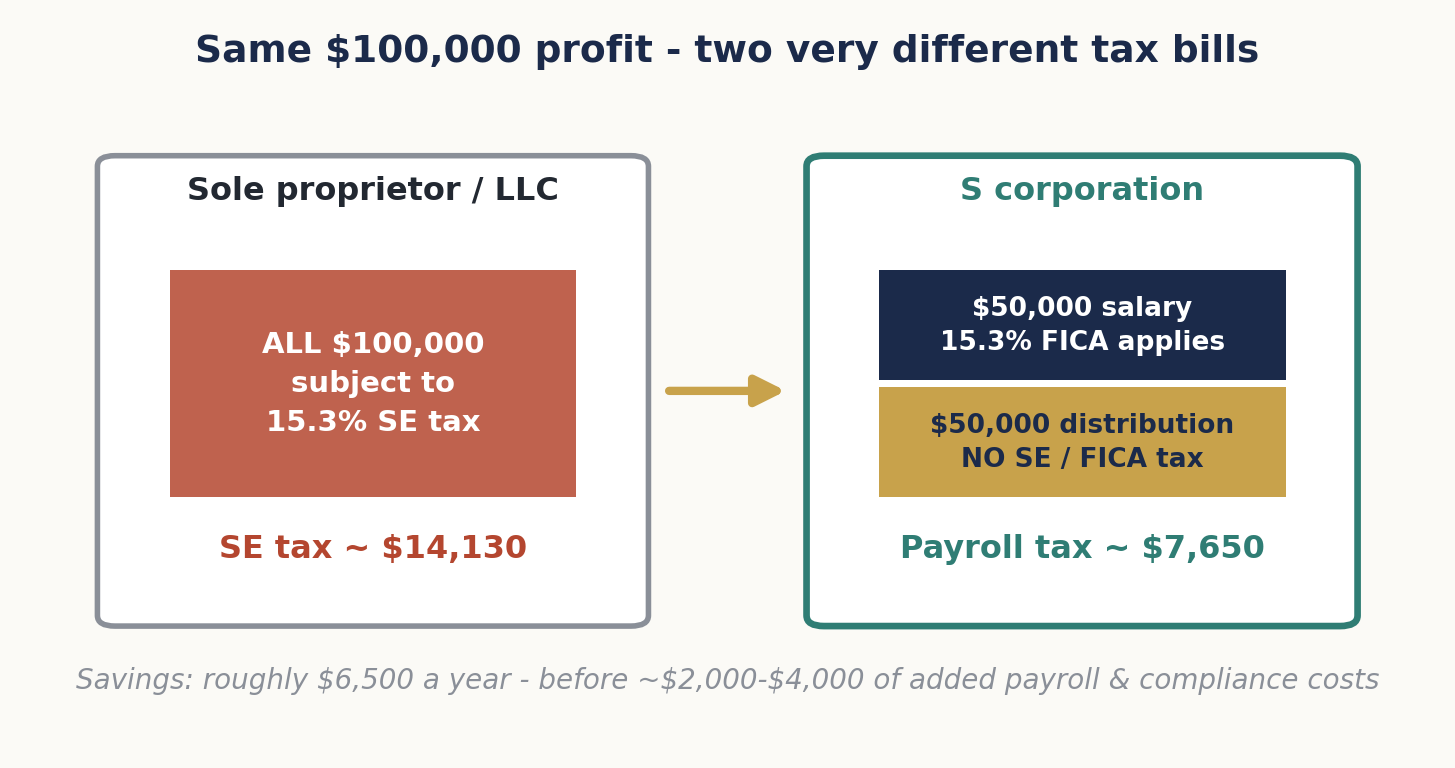
What changes is how your profit is taxed. As a sole proprietor or standard LLC, every dollar of net profit is hit with 15.3% self-employment tax (12.4% Social Security up to the 2026 wage base of $184,500, plus 2.9% Medicare with no cap). As an S corp, you split that profit into two buckets: a reasonable W-2 salary, which is subject to payroll tax, and the remaining distributions, which are not subject to self-employment or payroll tax.
That’s the entire engine of the strategy. On $100,000 of profit with a $50,000 salary, you’d pay payroll tax on half your income instead of all of it — roughly $6,500 in annual savings before costs.
The pros and cons, side by side
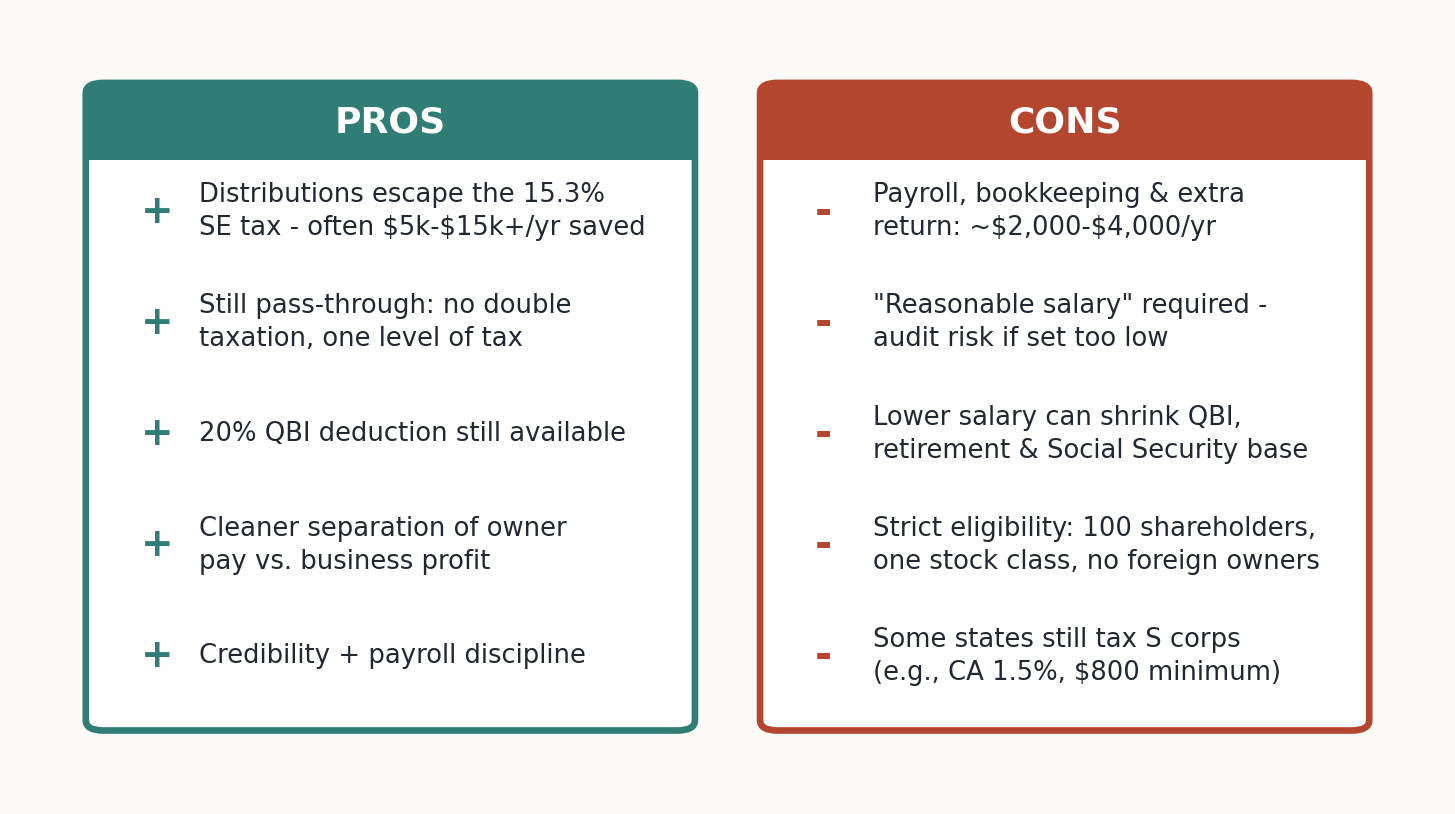
The savings are real, but they don’t arrive for free. On the plus side: distributions escape the 15.3% SE tax (often $5,000-$15,000+ a year saved), you keep pass-through treatment with no double taxation, the 20% QBI deduction is still available, and you get a cleaner separation between owner pay and business profit.
On the minus side: payroll, bookkeeping, and a separate return run about $2,000-$4,000 a year; “reasonable compensation” is required and carries audit risk if set too low; a lower salary can shrink your QBI deduction, retirement contributions, and future Social Security benefit; eligibility is strict (100 shareholders, one class of stock, no foreign owners); and some states still tax S corps at the entity level.
The math: where the breakeven really sits
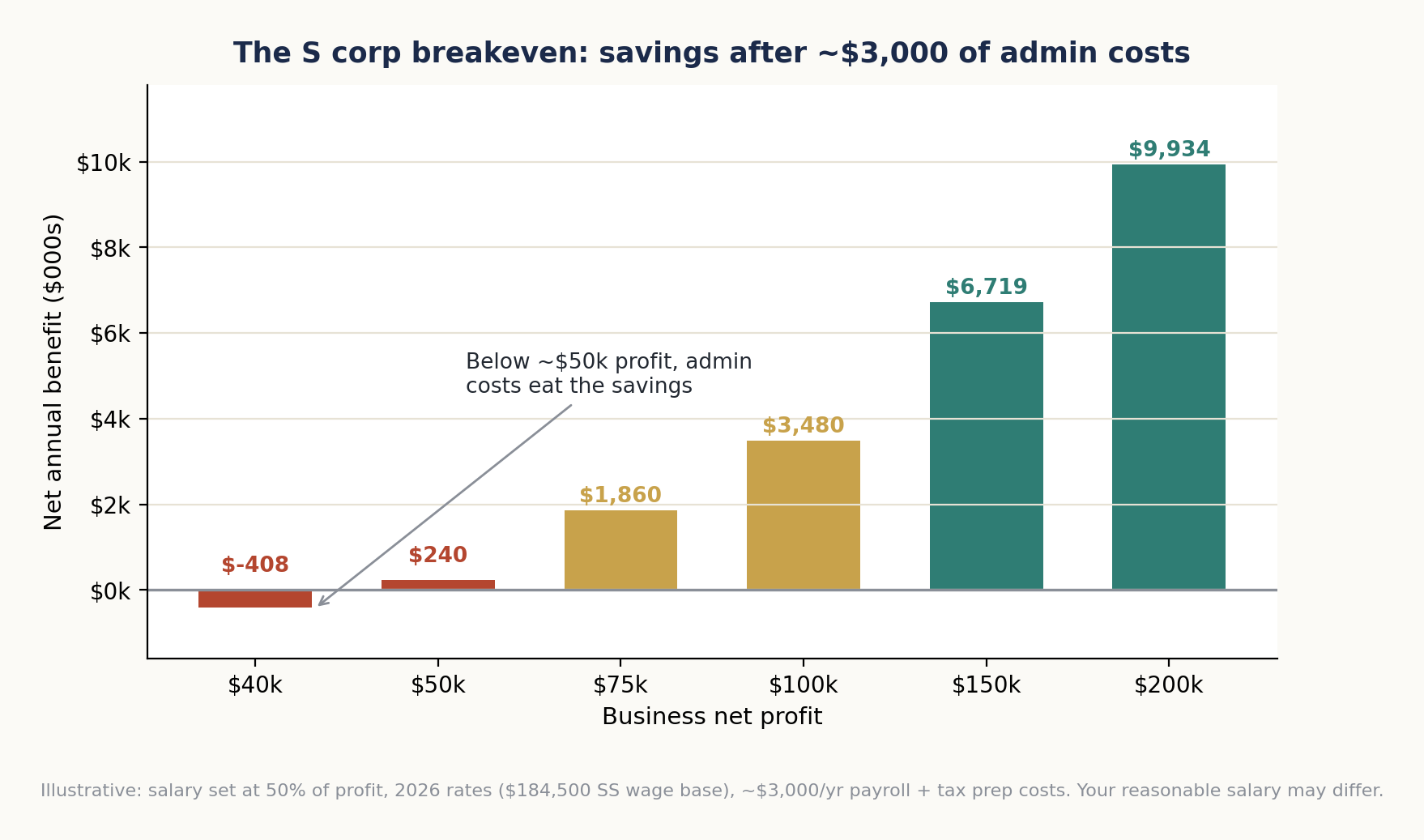
Payroll processing, bookkeeping, and a separate 1120-S return typically run $2,000 to $4,000 a year. Until your self-employment tax savings clear that hurdle, the election is a net loss. At roughly $40,000 of profit you’d likely lose money. Around $50,000 you’re breaking even. The election starts genuinely paying at $75,000 and above — a business at $100,000 of profit nets about $3,500 a year, and at $200,000 closer to $10,000. That’s why the common rule of thumb puts the tipping point at $50,000 of net profit, with the sweet spot from $75,000 to $200,000.
When it makes sense — a quick self-test
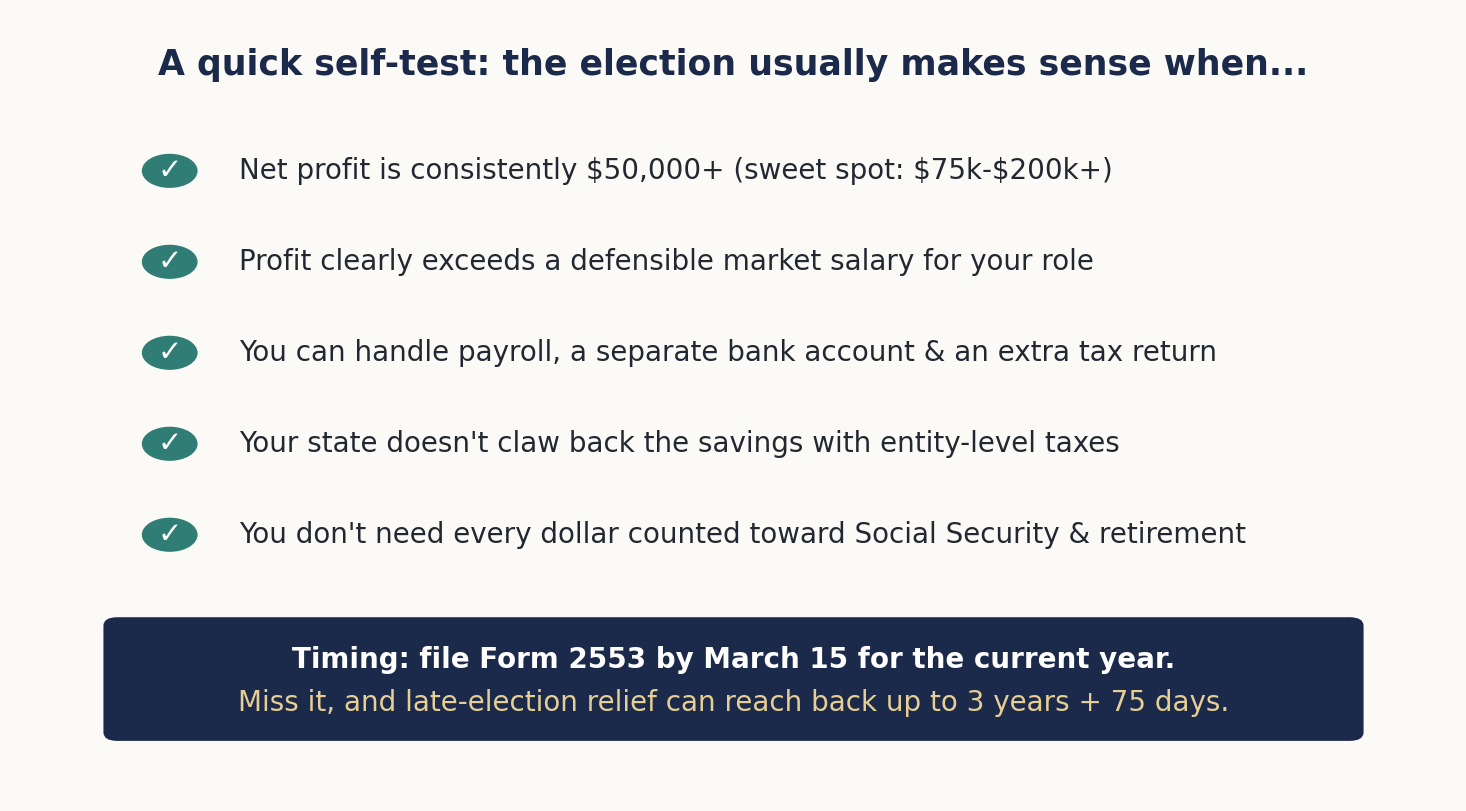
The election usually makes sense when net profit is consistently $50,000 or more, your profit clearly exceeds a defensible market salary for your role, you can handle payroll and an extra tax return, your state doesn’t claw back the savings with entity-level taxes, and you don’t need every dollar counted toward Social Security and retirement.
If your profit swings wildly year to year, if you’re reinvesting nearly everything back into the business, or if you’re in a state that taxes S corps at the entity level, be more cautious — the savings can evaporate quickly. And watch the calendar: Form 2553 is due by March 15 for the current tax year, though late-election relief can reach back up to three years and 75 days.
The bottom line: the S corp election is a legitimate, powerful way to cut self-employment tax — but it’s a threshold strategy, not a universal one. Below roughly $50,000 of profit, compliance costs usually swallow the benefit. Above $75,000, it often saves thousands a year. The deciding factors are your profit level, a defensible salary, your state’s rules, and whether you’re prepared to run real payroll. If your business is approaching that range, it’s worth a conversation before the March 15 deadline.
This article is for general educational purposes and is not tax advice. Figures are illustrative and assume a salary set at 50% of profit, 2026 rates (including the $184,500 Social Security wage base), and roughly $3,000 per year of payroll and compliance costs. Reasonable compensation, state taxes, and QBI effects vary by situation — please reach out before making an election.
