5 Easiest Tax-Saving Moves: Simple Strategies Almost Any Taxpayer Can Use in 2026
Most people overpay their taxes not because they missed something exotic, but because they never got around to the basics.
Every spring I meet people who assume tax savings require a complicated structure, an offshore something, or an income level they do not have. It is almost never true. The strategies that move the needle for ordinary households are the plain ones, and most of them take an afternoon to set up and then run themselves.
The five below are ranked by how little effort they take relative to what they save. None of them require you to change jobs, start a business, or take investment risk you would not otherwise take. Every dollar figure here is the 2026 number.
1 — Fund Your 401(k) at Least Up to the Match
This is the easiest money in the tax code and the most commonly left on the table.
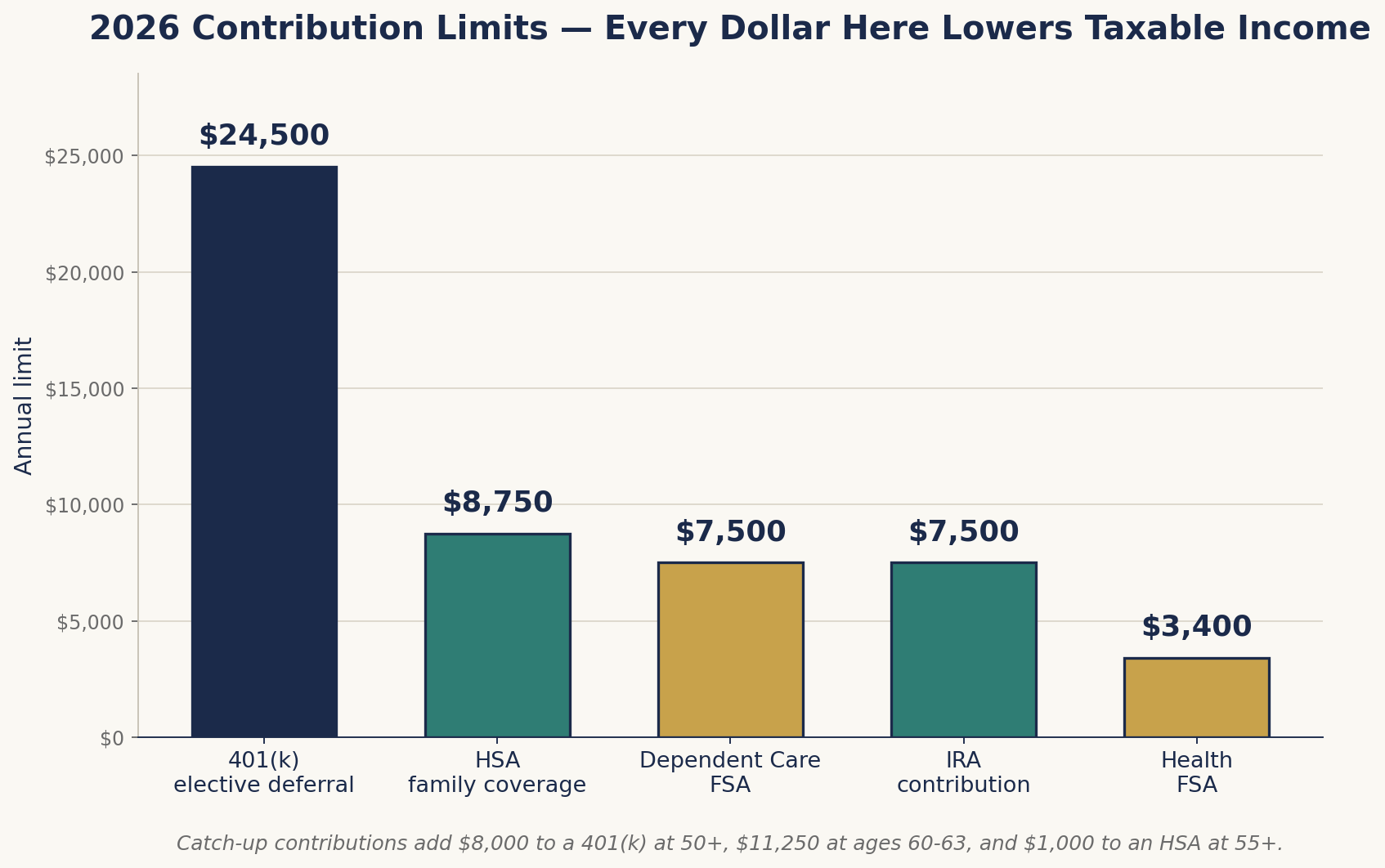
For 2026 you can defer up to $24,500 of salary into a 401(k), 403(b), or governmental 457 plan. If you are 50 or older you can add $8,000 more, for $32,500. And under the SECURE 2.0 rules, workers aged 60 through 63 get an enhanced catch-up of $11,250, which brings the ceiling to $35,750.
Traditional pre-tax deferrals reduce your taxable income dollar for dollar. If you are in the 22% bracket and you contribute $10,000, your federal tax bill drops roughly $2,200 and your take-home pay falls by far less than $10,000 because the government funded part of the deposit.
Then there is the employer match. If your plan matches 50% of the first 6% of pay and you earn $80,000, contributing $4,800 earns you $2,400 you would otherwise never see. That is a 50% immediate return before the tax deduction. Declining a match is the only investment decision I would call unambiguously wrong.
If you cannot fund the whole thing, fund the match. Then raise your deferral one percentage point every time you get a raise. You will not feel it, and in five years you will be maxed out without ever having made a hard decision.
2 — Use a Health Savings Account If You Are Eligible
The HSA is the only account in American tax law that is never taxed at any stage. Contributions go in deductible or pre-tax, growth is untaxed, and qualified medical withdrawals come out tax-free. Retirement accounts get you two of those three. An HSA gets all three.
For 2026 the limits are $4,400 for self-only coverage and $8,750 for family coverage, plus a $1,000 catch-up starting at age 55. To be eligible you need a qualifying high-deductible health plan, which for 2026 means a deductible of at least $1,700 for self-only or $3,400 for family coverage, with out-of-pocket maximums capped at $8,500 and $17,000.
Here is the part most people miss: you are not required to spend it. If you can pay current medical bills out of pocket, leave the HSA invested and let it compound for decades. Save your receipts. There is no deadline for reimbursing yourself, so a receipt from 2026 can fund a tax-free withdrawal in 2050. After age 65 you can withdraw for any purpose and simply pay ordinary income tax, which makes a fully funded HSA function like a traditional IRA with a tax-free medical option layered on top.
Contributions made through payroll also escape Social Security and Medicare tax, which the IRA and 401(k) deduction do not.
3 — Run Predictable Spending Through an FSA
Flexible spending accounts are unglamorous and quietly effective. You are going to spend the money anyway. Running it through an FSA means you spend pre-tax dollars instead of after-tax dollars.
The 2026 health FSA limit is $3,400, with up to $680 eligible to carry over into 2027 if your plan allows it. If you are in the 22% bracket and pay 7.65% in payroll tax, funding $3,000 of predictable medical spending through an FSA saves roughly $890.
The bigger news for 2026 is the dependent care FSA. The limit rose to $7,500, the first increase since the account was created in 1986. For a family paying for daycare, after-school care, or day camp, that is a meaningful shift. At the same 22% bracket plus payroll tax, running $7,500 through a dependent care FSA saves about $2,200.
The catch is that FSAs are use-it-or-lose-it beyond the carryover, so estimate conservatively. Fund what you are confident you will spend. Underfunding costs you a little; overfunding costs you the whole surplus.
Note that you generally cannot have both a health FSA and an HSA. If you qualify for an HSA, take the HSA. A limited-purpose FSA for dental and vision can coexist with an HSA if your employer offers one.
4 — Claim the Saver’s Credit If You Qualify
Deductions reduce the income you are taxed on. Credits reduce the tax itself, dollar for dollar, which makes them roughly four times more valuable per dollar for a taxpayer in the 22% bracket. The Saver’s Credit is one of the few credits available simply for doing something you should already be doing.
Contribute to an IRA or a workplace retirement plan and, if your income is low enough, you get back 50%, 20%, or 10% of the first $2,000 you contribute per person. At the top rate that is $1,000 for an individual and $2,000 for a married couple filing jointly. The credit sits on top of the deduction you already took for the contribution, which means the same dollar works twice.
For 2026 the AGI ceilings are $40,250 for single filers, $60,375 for heads of household, and $80,500 for married couples filing jointly. The 50% rate applies at the bottom of each range and steps down to 20% and then 10% as income climbs toward the ceiling.
This credit is badly underclaimed, largely because the people eligible for it are also the people least likely to be working with a preparer who mentions it. If your income is anywhere near those thresholds, ask about Form 8880. A part-time worker, a recent graduate, a semi-retired spouse, or a household that had a low-income year for any reason should all check.
5 — Bunch Your Charitable Giving
The standard deduction for 2026 is $16,100 for single filers, $32,200 for married couples filing jointly, and $24,150 for heads of household. Those numbers are high enough that most households never itemize, which means their charitable giving produces no deduction at all.
Bunching fixes that without changing how much you give. Instead of giving $12,000 a year for two years, you give $24,000 in one year and nothing the next. In the bunching year your itemized deductions clear the standard deduction and you get real benefit. In the off year you take the standard deduction, which you were taking anyway. Same total giving, meaningfully lower two-year tax bill.
A donor-advised fund makes this painless. You contribute the lump sum, take the deduction in that year, and then distribute grants to your charities on whatever schedule you prefer. The charities see no change in your giving pattern. Only the IRS does.
Two 2026 changes matter here. Itemizers now face a 0.5% AGI floor on charitable deductions, so the first half percent of your income in gifts produces nothing, which strengthens the case for concentrating gifts rather than spreading them thin. And taxpayers in the top bracket now see itemized deductions capped at 35 cents on the dollar rather than 37. On the other side, non-itemizers gained a new above-the-line charitable deduction of up to $1,000, or $2,000 for joint filers, so modest giving now produces some benefit even without itemizing.
If you hold appreciated stock, donate the shares rather than cash. You deduct the full fair market value and never pay capital gains tax on the appreciation. It is the same gift to the charity and a better outcome for you.
Putting It Together
None of these five require you to be wealthy, self-employed, or sophisticated. They require you to fill out a form during open enrollment, set an automatic contribution, and think about timing once a year.
Start with the match, because the return is immediate and enormous. Add the HSA if you are eligible, because no other account is treated as well. Fund the FSAs for spending you already know is coming. Check the Saver’s Credit if your income is in range, because it is free and frequently missed. And if you give to charity at all, look at whether bunching moves you across the standard deduction line.
Do those five and you have captured most of what is realistically available to a household without a business entity. The exotic strategies get the attention. The basic ones get the money.
This article is provided for general educational purposes and is not a substitute for professional tax advice. Contribution limits, income thresholds, and eligibility rules depend on your specific situation and can change. Reach out before acting on this guidance and let’s review your circumstances together.
