Business Due Diligence: The Foundation of Smart Acquisitions

The difference between a sound acquisition and a financial disaster often comes down to one thing: how thoroughly you looked before you leaped.
You’ve found a business for sale. The cash flow looks good. The owner is friendly. The SBA loan seems within reach. So naturally, you’re eager to move forward—and fast. But before you sign on the dotted line and commit your personal guarantee to an SBA loan, you need to ask yourself: do you really know what you’re buying?
Business due diligence isn’t busywork. It’s your defense against hidden liabilities, inflated financials, customer concentration risk, and operational surprises that could turn your acquisition into an anchor. When you’re financing 70-90% of the purchase price with an SBA loan, due diligence isn’t optional—it’s non-negotiable. Here’s why it matters, and what savvy buyers focus on.
The Cost of Skipping Due Diligence
Imagine this: you buy a business for $500,000. The owner’s P&L shows $150,000 in net income. You feel confident and put down 10% ($50,000) as your down payment. You personally guarantee a $375,000 SBA loan.
Six months in, you discover the business’s largest customer—which represented 35% of revenue—just walked to a competitor. Suddenly, your actual cash flow is half what the seller claimed. You’ve also uncovered two pending lawsuits the seller didn’t mention, and three key employees leave because the former owner didn’t document their roles.
You’re now underwater on a loan you personally guaranteed, with a cash-flowing business that can’t pay it. The tax write-off might help, but you’d rather have asked the hard questions upfront.
This scenario happens far too often—and many of those deals could have been saved or avoided entirely with proper due diligence.
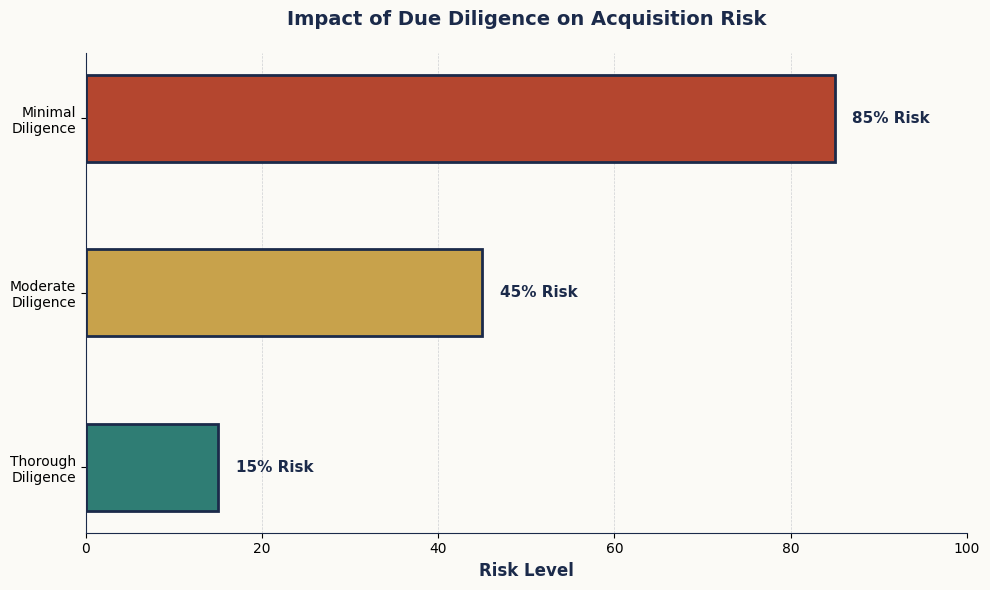
The Five Core Areas SBA Lenders Will Scrutinize
Your SBA lender will do some due diligence themselves, but smart buyers don’t wait passively. You do it first, and you do it right. Here are the five areas that matter most:
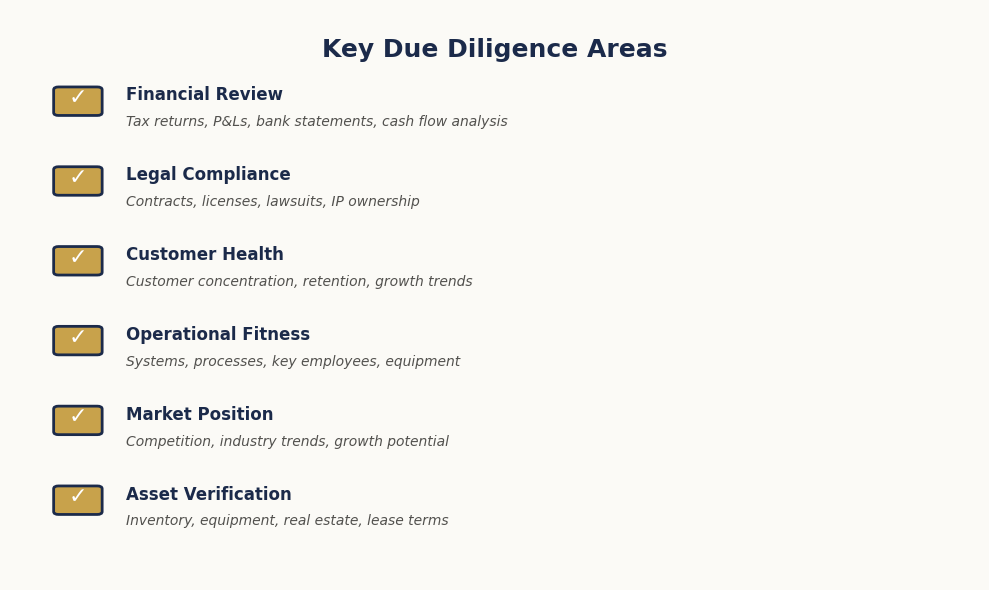
Financial Due Diligence
Obtain the last three years of tax returns, profit-and-loss statements, balance sheets, and bank statements. Verify that the revenue numbers the seller is quoting actually show up in their bank deposits. Ask the seller to document add-backs, the discretionary expenses like owner’s salary, personal vehicle payments, or travel that won’t continue under your ownership. A seller’s add-back of $50,000 annually is fine if you can prove it; otherwise, assume it’s part of your cost of business.
Customer and Revenue Health
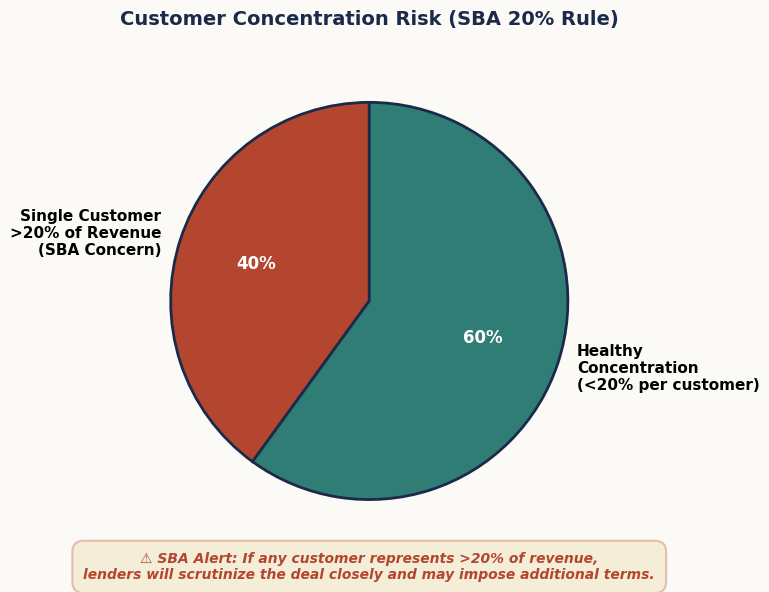
Here’s where the SBA’s 20% rule kicks in: if any single customer represents more than 20% of revenue, lenders will scrutinize the deal heavily and may impose additional terms or require higher equity. Beyond that, ask: are customers on multi-year contracts, or can they leave anytime? Which customers are most profitable? Have customer numbers been growing or shrinking over the last 3-5 years?
Legal and Compliance
Review all contracts, especially any that have change-of-control clauses, meaning they auto-terminate when ownership changes. Check for pending lawsuits, regulatory actions, or liens on assets. Verify that all business licenses, permits, and insurance are current and will transfer to you. A forgotten tax lien or a lawsuit can easily wipe out years of profits.
Operational Fitness
Walk through the business. Meet the key employees. Understand the systems and processes. If the business depends entirely on the owner doing everything, that’s a major red flag: you’re not buying a business, you’re buying a job. Evaluate the condition of equipment, inventory, and technology. If the owner has been deferring maintenance, that becomes your repair bill.
Real Estate and Lease Terms
If the business rents its location, review the lease carefully. Does it extend through the life of your SBA loan? What’s the current rent, and what’s it climbing to after renewal? Who pays for renovations or maintenance? Landlord issues can sink a deal faster than bad financials.
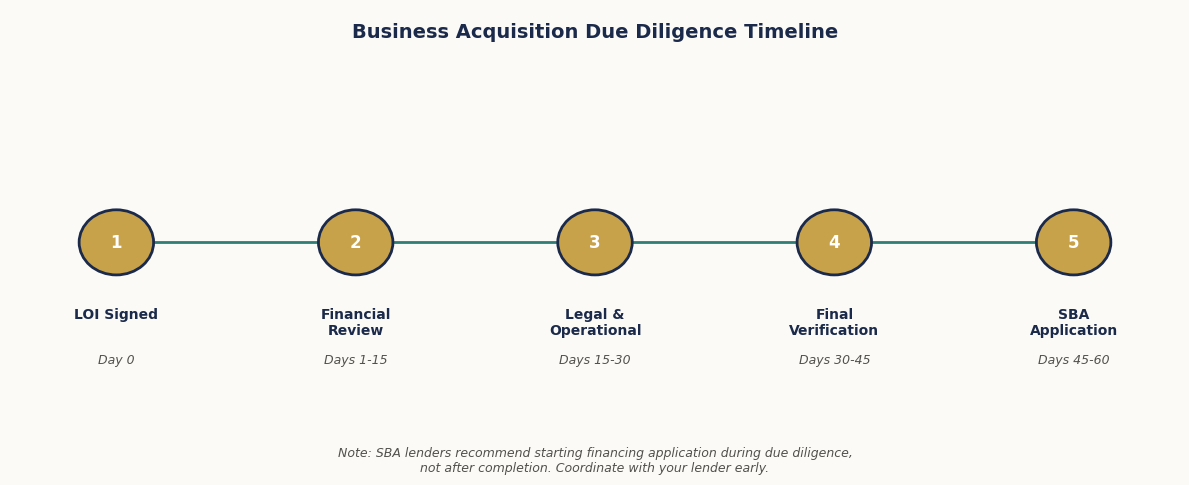
Due Diligence Takes Time, But It’s Worth It
The typical due diligence period spans 30-60 days after signing a Letter of Intent. That feels like a long time when you’re excited to get started, but it’s not optional: it’s your contractual protection against walking away if red flags emerge.
Here’s a critical insider tip: start your SBA financing application during due diligence, not after it completes. Many buyers wait until due diligence is done, then begin the SBA process. That adds 30-45 days to your timeline. Savvy buyers coordinate with their SBA lender upfront so the financial review and documentation work in parallel.
A Real-World Example
Let’s say you’re buying a service business for $400,000. The owner is retiring and has two major contracts (Client A and Client B) that together represent 60% of revenue.
During due diligence, you discover that Client A’s contract expires in eight months under a renewal clause you didn’t know about; that Client B’s CEO is retiring in six months and the incoming team is exploring bringing the work in-house; and that the owner’s personal credit card bills, roughly $2,000 a month, are mixed into the business expenses.
If you’d ignored due diligence and jumped to closing, you’d have inherited massive risk: a loan you’re personally liable for and two customers who could walk. With proper diligence, you can either renegotiate the purchase price downward, build in contingencies, or walk away before putting your name on the note.
The Bottom Line
Business due diligence isn’t paperwork for paperwork’s sake. It’s your insurance policy. A thorough review costs a few thousand dollars and takes six to eight weeks of focused work. A bad acquisition costs hundreds of thousands and years of regret.
Before you commit to an SBA loan, you’ve already decided this is serious, so act like it. Treat due diligence as your most important business tool, not a checkbox before closing. Ask the hard questions. Hire a CPA to validate the financials. Have an attorney review contracts. Meet the customers and employees. Trust your instincts when something feels off, and walk if the numbers don’t add up.
A tax dollar saved through smart acquisition planning is a dollar protected for growth. The same logic applies to protecting your capital: spend the time upfront so you don’t spend the penalty later.
This article is provided for general educational purposes and is not a substitute for professional tax or legal advice. Every business acquisition is unique, and tax and legal implications depend on your individual circumstances. Reach out before acting on this guidance and let’s review your specific situation together.
