IRS Penalties and Interest: What Each One Costs — and How to Get Them Removed
Every year, the IRS assesses tens of billions of dollars in penalties — and a surprising share of them could have been avoided or removed. Whether you missed a deadline, underpaid during the year, or got a notice you don’t understand, the first step is knowing what you’re actually being charged. Here’s the breakdown.
The two workhorses: failure to file vs. failure to pay
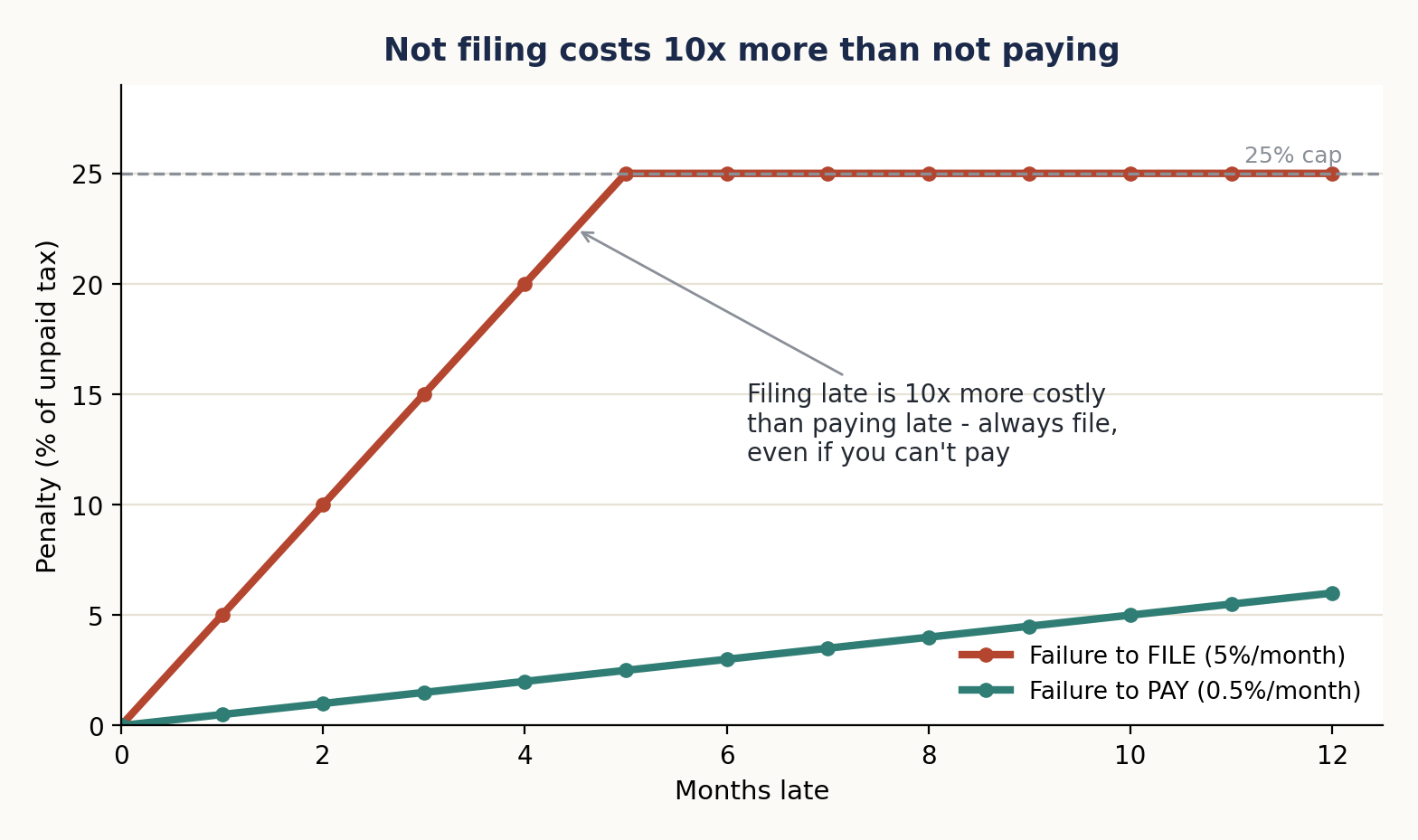
These are the penalties most people meet first, and the difference between them is dramatic. Failure to file costs 5% of the unpaid tax for each month (or part of a month) your return is late, capping at 25%. If you’re more than 60 days late, there’s a minimum penalty — for returns due in 2026, the lesser of $525 or 100% of the tax owed. Failure to pay costs just 0.5% per month, also capping at 25% — but it takes 50 months to get there instead of 5. The rate drops to 0.25% while you’re on an approved installment agreement, and rises to 1% if the IRS issues a final levy notice.
When both apply in the same month, the failure-to-file penalty is reduced to 4.5% so the combined hit is 5% per month. The lesson is one of the most valuable in all of tax: filing late is ten times more expensive than paying late. Always file on time — even if you can’t pay a dime.
The conduct penalties: accuracy, fraud, and the trust fund
Accuracy-related penalty — 20%. Applied when an underpayment comes from negligence or a “substantial understatement” of income. This is the penalty that typically rides along with an audit adjustment.
Civil fraud — 75%. When the IRS can show intentional wrongdoing, the penalty jumps to 75% of the underpayment. There’s no cap and no statute of limitations on a fraudulent return.
Trust fund recovery penalty — 100%, and it’s personal. If a business withholds payroll taxes from employees and doesn’t remit them, the IRS can assess 100% of the unpaid trust fund taxes personally against anyone deemed a “responsible person” — owners, officers, even bookkeepers with check-signing authority. Incorporation does not protect you.
The quiet ones: estimated taxes and information returns
Estimated tax penalty. If you’re self-employed or have income without withholding and don’t pay in evenly through the year, the IRS charges what is effectively interest on each quarter’s shortfall. Safe harbors: pay in 90% of this year’s tax or 100% of last year’s (110% if your AGI topped $150,000).
Information return penalties. Late or missing 1099s and W-2s cost $60 each if filed within 30 days, $130 through August 1, and $340 after that — with no cap if the IRS finds intentional disregard ($680 per form). For a business with dozens of contractors, these add up fast.
Interest: the meter that never stops
On top of every penalty, the IRS charges interest — currently 7% per year for individuals, compounded daily (the federal short-term rate plus 3 points, adjusted quarterly). Interest runs on the unpaid tax and on the penalties, from the original due date until the day you pay. An extension to file is not an extension to pay: interest starts on the April deadline regardless. On a $10,000 unfiled, unpaid tax bill, the combination of both penalties and daily-compounding interest can push the balance past $13,000 within a year and toward $14,500 by year two.
The part most people miss: penalties can be removed
First-time abatement (FTA). If you have a clean compliance history for the prior three years, the IRS will waive failure-to-file, failure-to-pay, and deposit penalties — and starting with the 2026 filing season, this relief is being granted automatically for eligible taxpayers on 2025-and-later returns. You can qualify more than once in a lifetime, as long as you rebuild a clean three-year history.
Reasonable cause. Serious illness, natural disaster, fire, death in the family, or inability to obtain records can justify removing penalties — decided case by case, and documentation is everything. And under statutory exceptions, if you relied on written IRS advice, were in a declared disaster area, or the IRS itself caused the delay, penalties must be removed.
One catch: interest generally can’t be abated on its own — but when a penalty is removed, the interest that accrued on that penalty disappears with it.
The bottom line
IRS penalties range from a slow 0.5% drip to a career-ending 100% personal assessment, and daily-compounding interest runs underneath all of them. The playbook is simple: file on time even if you can’t pay, use safe harbors to stay ahead of estimated taxes, deposit payroll taxes like they’re sacred — and if you’ve already been penalized, ask about abatement before you simply write the check. Many penalties are removable; most people never ask.
