No Tax on Tips and Overtime: What It Really Means for Your Paycheck
“No tax on tips” and “no tax on overtime” were among the most eye-catching promises in the One Big Beautiful Bill Act, and for 2026 they’re real, claimable deductions. But the headlines oversimplify them. Neither one makes your tips or overtime completely tax-free, and both come with caps, income limits, and an expiration date. Here’s the plain-English version.
The big picture
Both are temporary federal income tax deductions that run from 2025 through 2028. They lower the income tax on certain pay, but they do not remove Social Security and Medicare (FICA) taxes — those still come out of every check. And both are above-the-line deductions, so you can claim them whether or not you itemize.
No tax on tips: up to $25,000
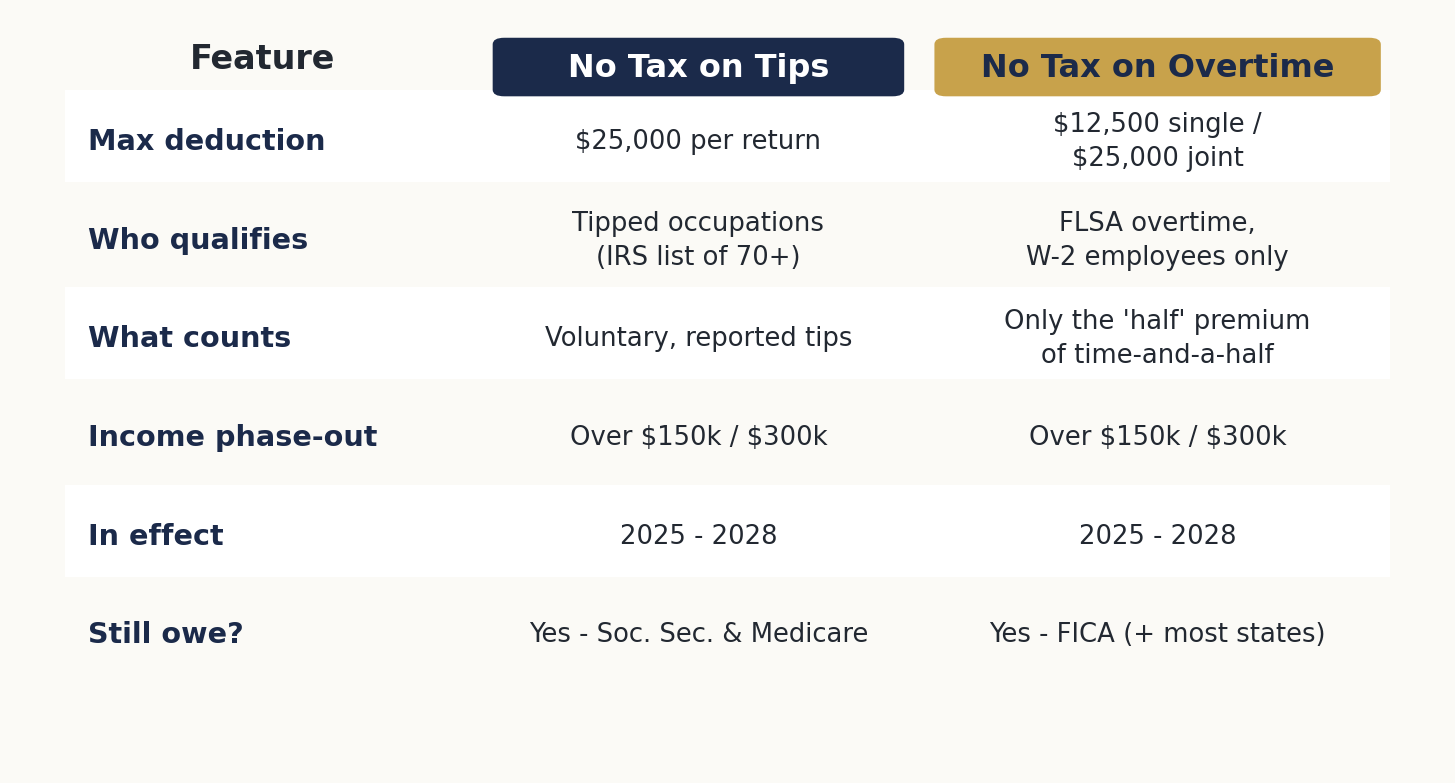
If you work in an occupation that customarily and regularly receives tips — servers, bartenders, hairstylists, bellhops, and about 70 others on the IRS’s official list — you can deduct up to $25,000 of qualified tip income per tax return. Only voluntary tips count; mandatory service charges and auto-gratuities do not. A few key limits: the $25,000 is per return (for a married couple it’s the combined total, not $25,000 each), you must file jointly if married, and everyone claiming it needs a valid Social Security number. Self-employed workers can qualify too, but the deduction can’t exceed net income from the tipped business.
No tax on overtime: only the “half”
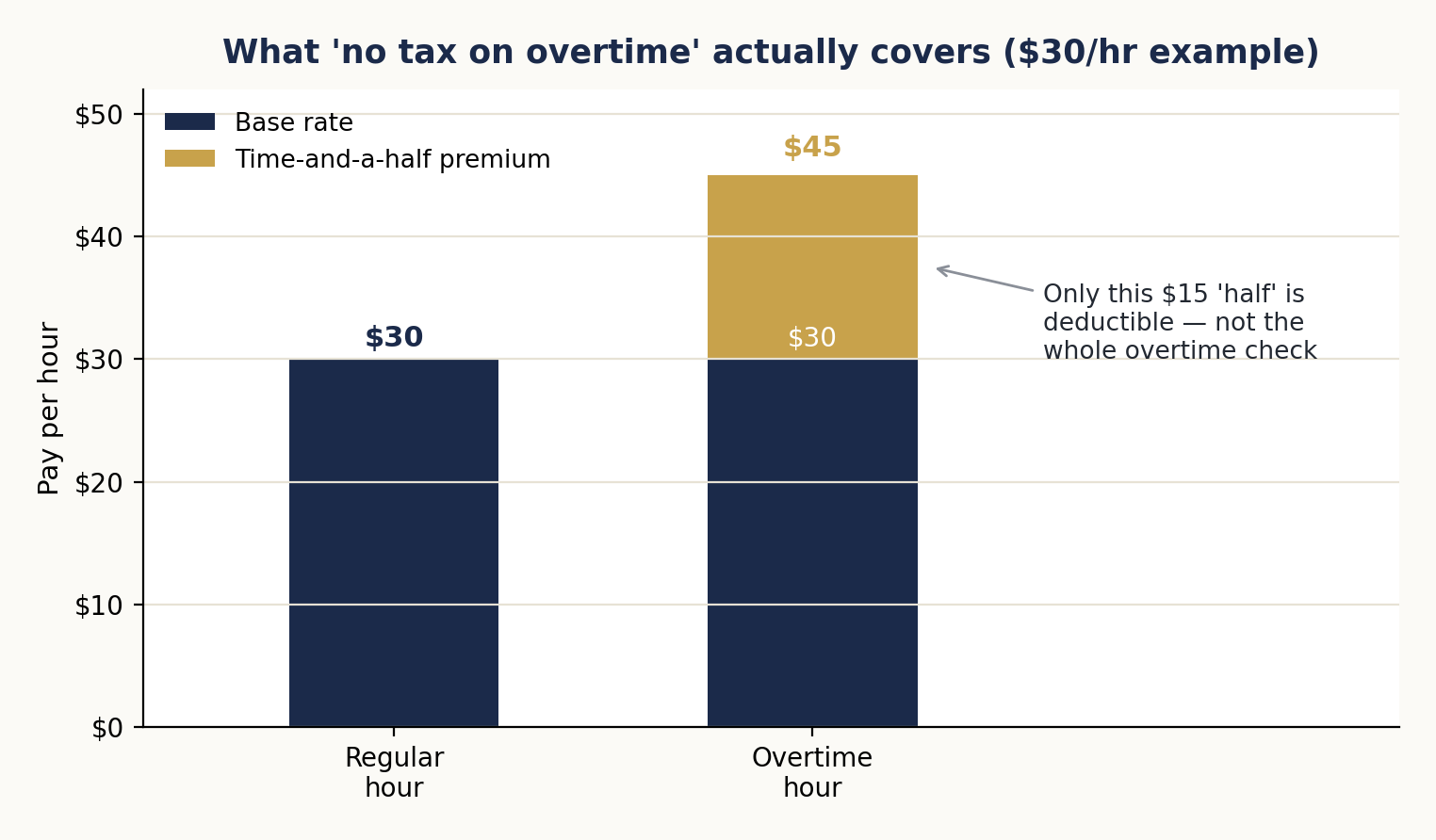
This is the most misunderstood part. The deduction does not apply to your entire overtime paycheck — only to the premium portion, the extra “half” of time-and-a-half required under the Fair Labor Standards Act. So if your regular rate is $30 an hour and overtime pays $45, only the $15 premium on each overtime hour is deductible — not the full $45. The cap is $12,500 for single filers and $25,000 for joint filers, and it’s limited to W-2 employees (independent contractors don’t qualify).
What it’s actually worth
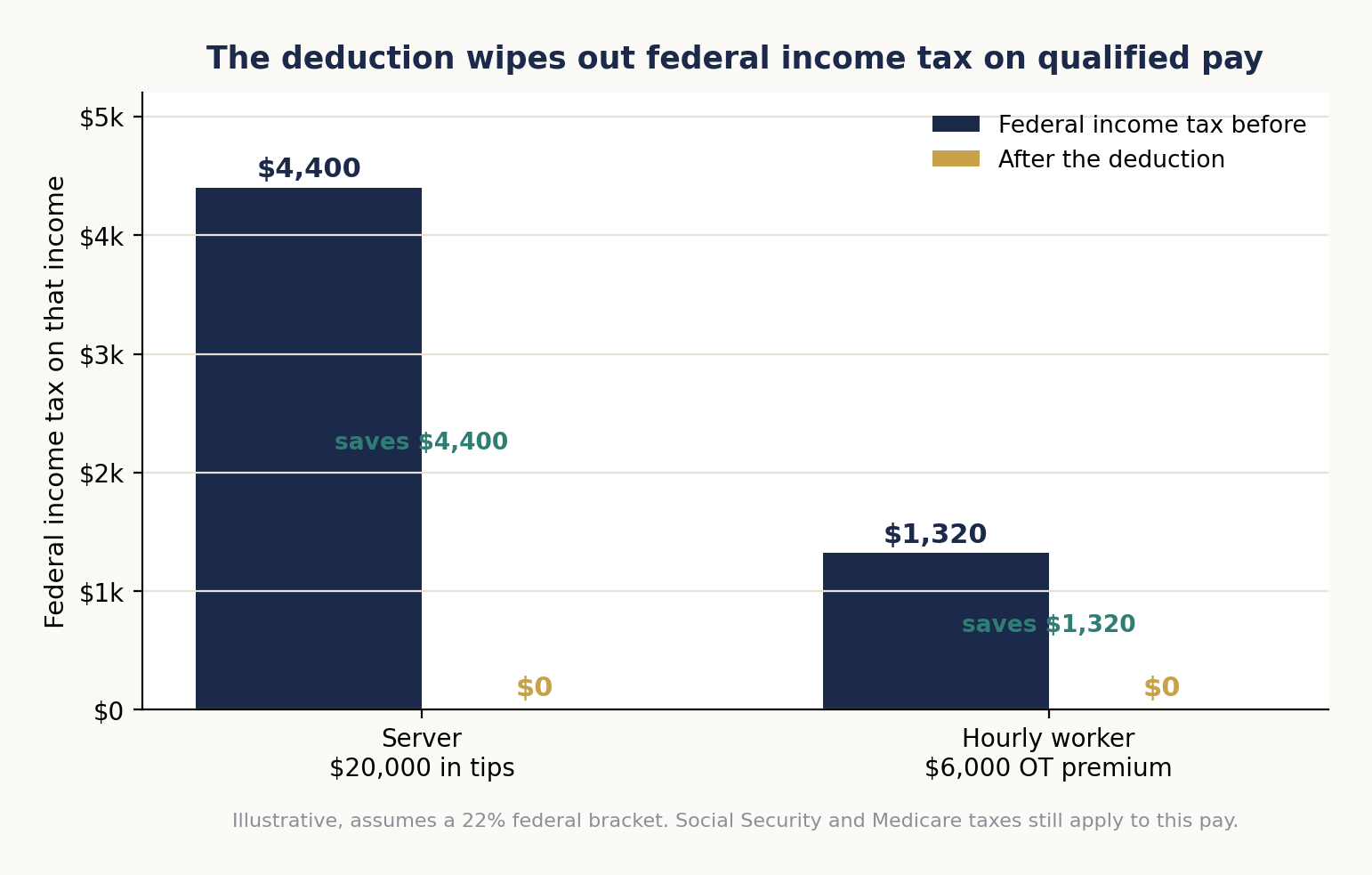
Because these are deductions, not credits, the savings equal your tax rate times the deducted amount. For a worker in the 22% federal bracket, a server with $20,000 in qualified tips saves about $4,400 in federal income tax, and an hourly worker with $6,000 of overtime premium saves about $1,320 — real money, though Social Security and Medicare were still withheld on that same pay.
The income limits
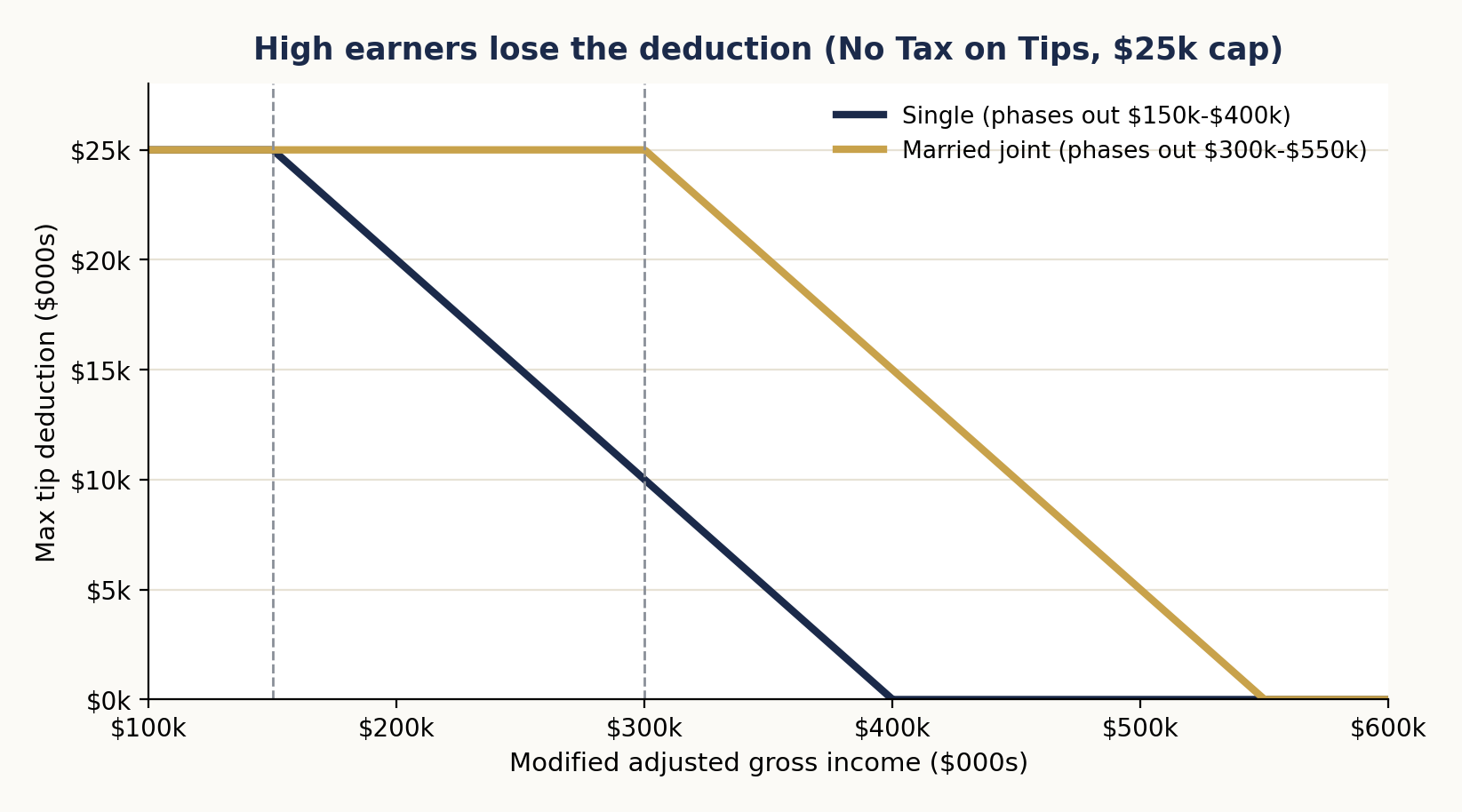
Both deductions are aimed at working- and middle-income earners, so they phase out as income climbs. The reduction is $100 for every $1,000 of modified adjusted gross income above $150,000 (single) or $300,000 (married filing jointly). For the $25,000 tip deduction, that means it disappears entirely around $400,000 of income for a single filer.
What you’ll need to do
For 2026, the IRS has updated Form W-2 and the 1099s to report qualified tips (with a tip-occupation code) and qualified overtime separately — and that reporting is what makes the deduction claimable. So the practical steps are simple: check your pay stubs and year-end W-2 for separately reported tips and overtime premium, keep your own records of voluntary tips (especially cash), and file jointly if married, with a valid Social Security number for everyone claiming it.
The bottom line
“No tax on tips and overtime” is a genuine break for tipped and hourly workers — worth up to a few thousand dollars a year — but it’s a capped, income-limited, income-tax-only deduction that expires after 2028. If you or your employees earn tips or overtime, it’s worth a quick check to make sure the pay is being reported correctly so the deduction isn’t left on the table.
This article is for general educational purposes and is not tax advice. Eligibility, caps, and reporting depend on your specific facts and continue to be refined by IRS guidance; please reach out before acting. Dollar examples are illustrative and assume a 22% federal tax bracket.
