Depreciation: The Basics
Every business that buys equipment, vehicles, or real estate gets to deduct the cost over time through depreciation. What many owners don’t realize is that how fast you take those deductions can be worth thousands of dollars — even when the total deduction is exactly the same.
This is the same principle behind why a tax dollar saved today beats one saved tomorrow: a deduction you take now is more valuable than the identical deduction spread over the next 39 years. Let’s break down the basics.
Straight-line vs. accelerated: the same asset, two speeds
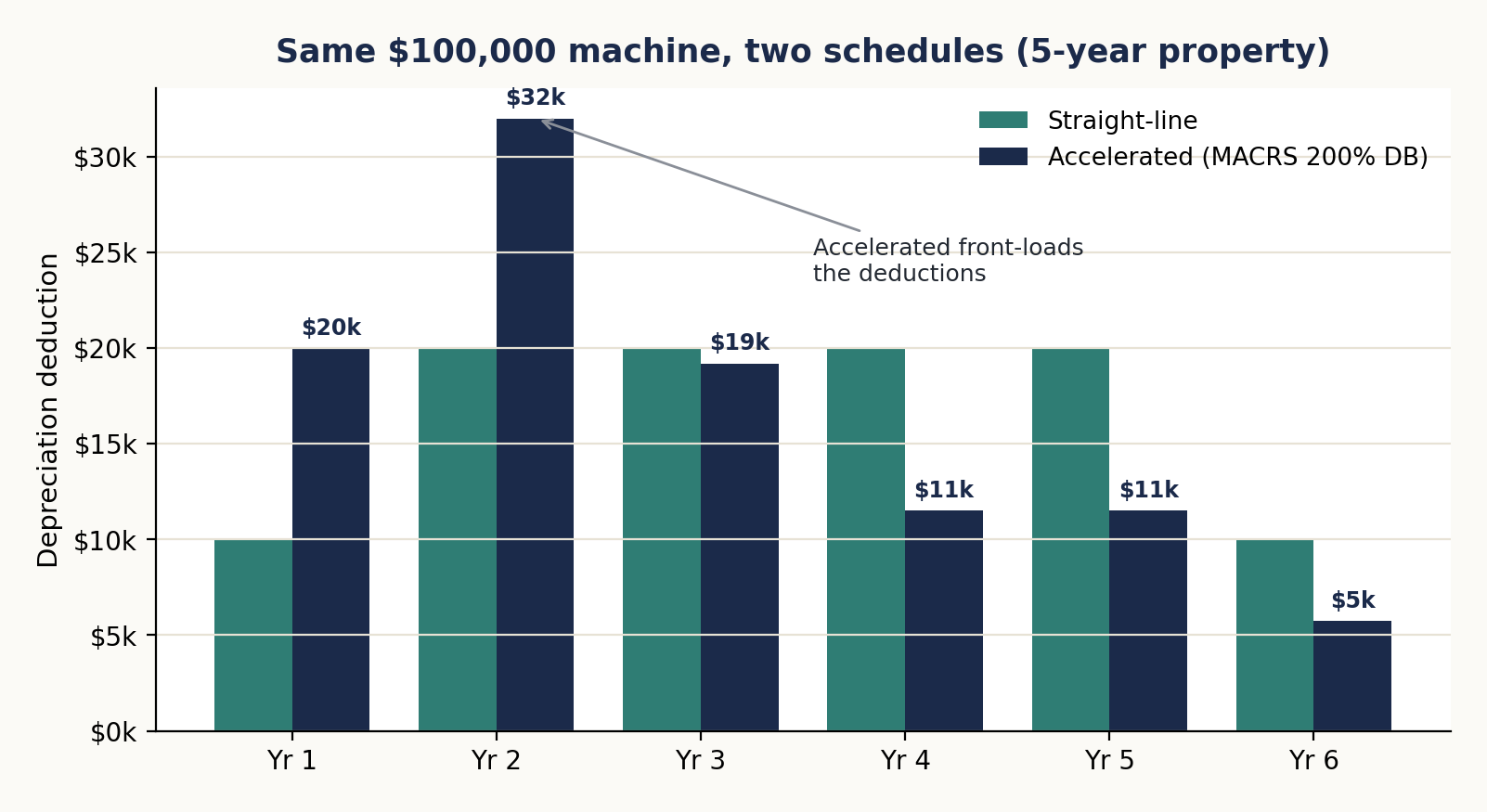
Straight-line depreciation spreads an asset’s cost evenly across its useful life. Buy a $100,000 machine with a 5-year life and you deduct roughly $20,000 a year — simple and predictable.
Accelerated depreciation — the default MACRS method the IRS uses for most business property — front-loads the deductions. You write off more in the early years and less later. The total over the asset’s life is identical; only the shape changes.
Why timing alone is worth real money
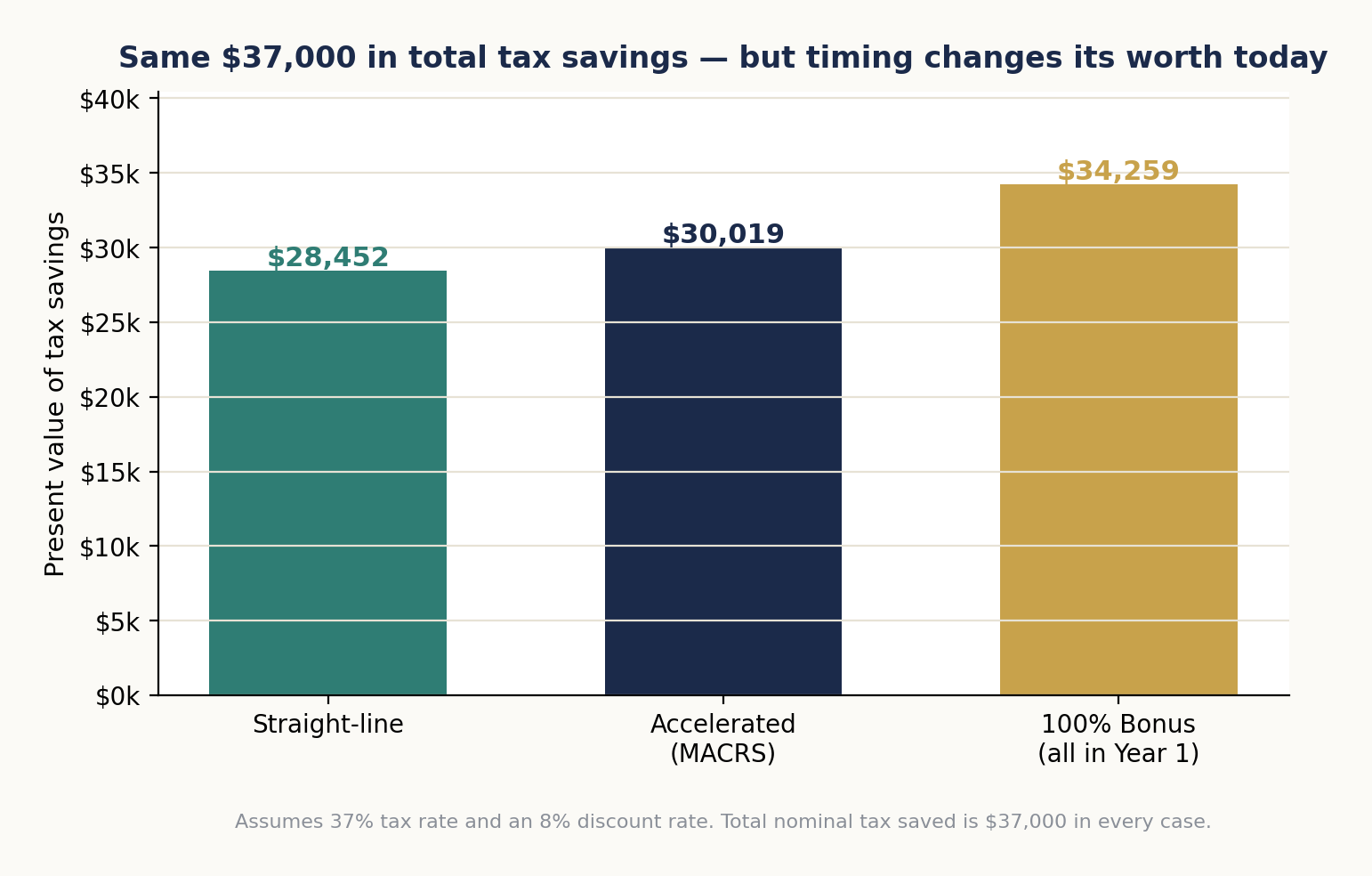
Here’s the surprising part. Whether you use straight-line or accelerated, you deduct the full $100,000 and save the same $37,000 in tax over the asset’s life (at a 37% rate). But a dollar of tax savings today is worth more than one five years from now — you can reinvest it, pay down debt, or simply earn a return on it. Measured in today’s dollars, accelerating those deductions is worth meaningfully more.
Same total deduction; very different present value. Taking the whole write-off in year one is worth the most of all — which is exactly what bonus depreciation lets you do.
Bonus depreciation: 100%, restored and permanent
Under the One Big Beautiful Bill Act, 100% bonus depreciation is back — and now permanent — for qualifying property acquired and placed in service after January 19, 2025. The full cost of eligible assets can be deducted in the first year rather than stretched out over time.
It generally applies to tangible personal property with a recovery period of 20 years or less — machinery, equipment, furniture, computers, vehicles — and to qualified improvement property. It works on both new and used assets, as long as the asset is new to you and bought in an arm’s-length deal.
Section 179 vs. bonus depreciation
Section 179 expensing is the other way to write off assets immediately. It overlaps with bonus depreciation but has some important differences worth knowing:
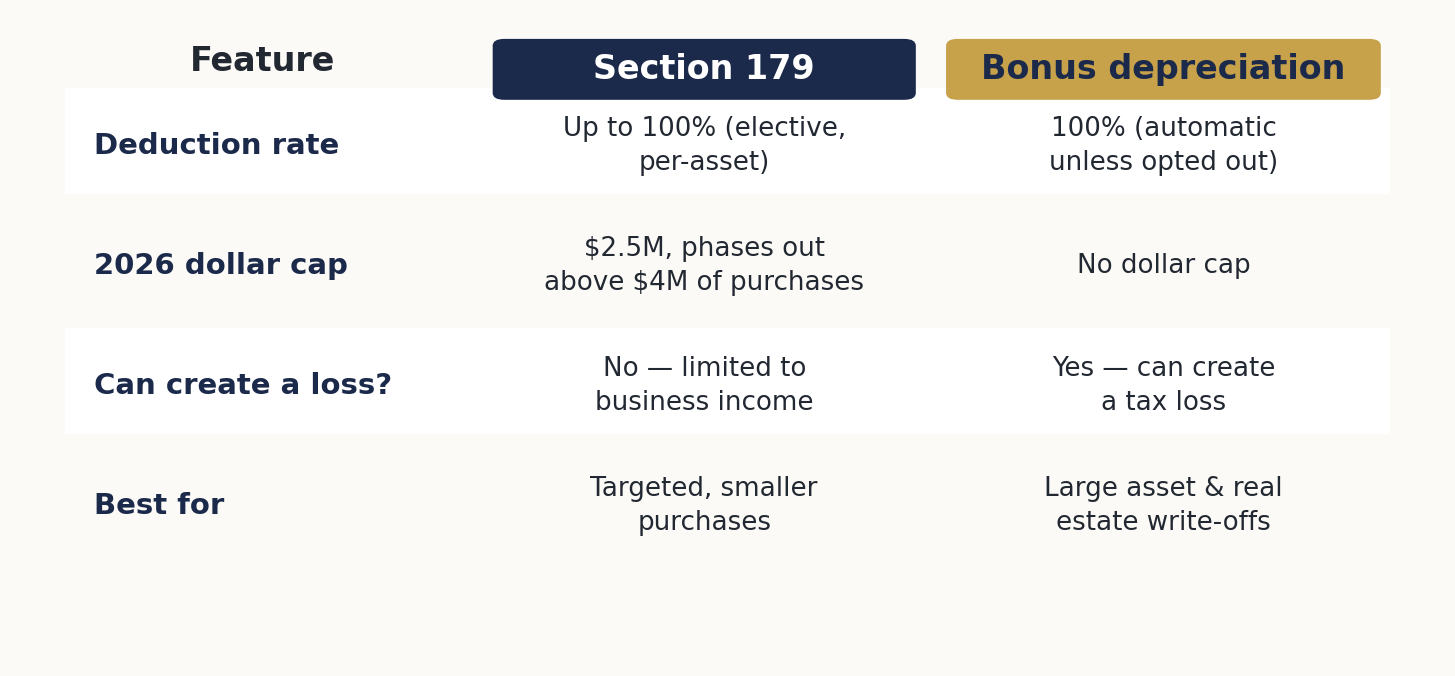
For 2026, Section 179 lets you expense up to $2.5 million of qualifying purchases, phasing out above $4 million — both figures now permanent and indexed for inflation. Section 179 can’t create a tax loss, while bonus depreciation can. In practice, many businesses use Section 179 for targeted purchases and let bonus depreciation handle the rest.
Cost segregation: acceleration on real estate
Real estate is where acceleration gets powerful — and most overlooked. A commercial building normally depreciates over a slow 39 years (27.5 for residential rental). A cost segregation study fixes that by having an engineer break the building into its components and reclassify the ones that don’t belong on a 39-year clock.
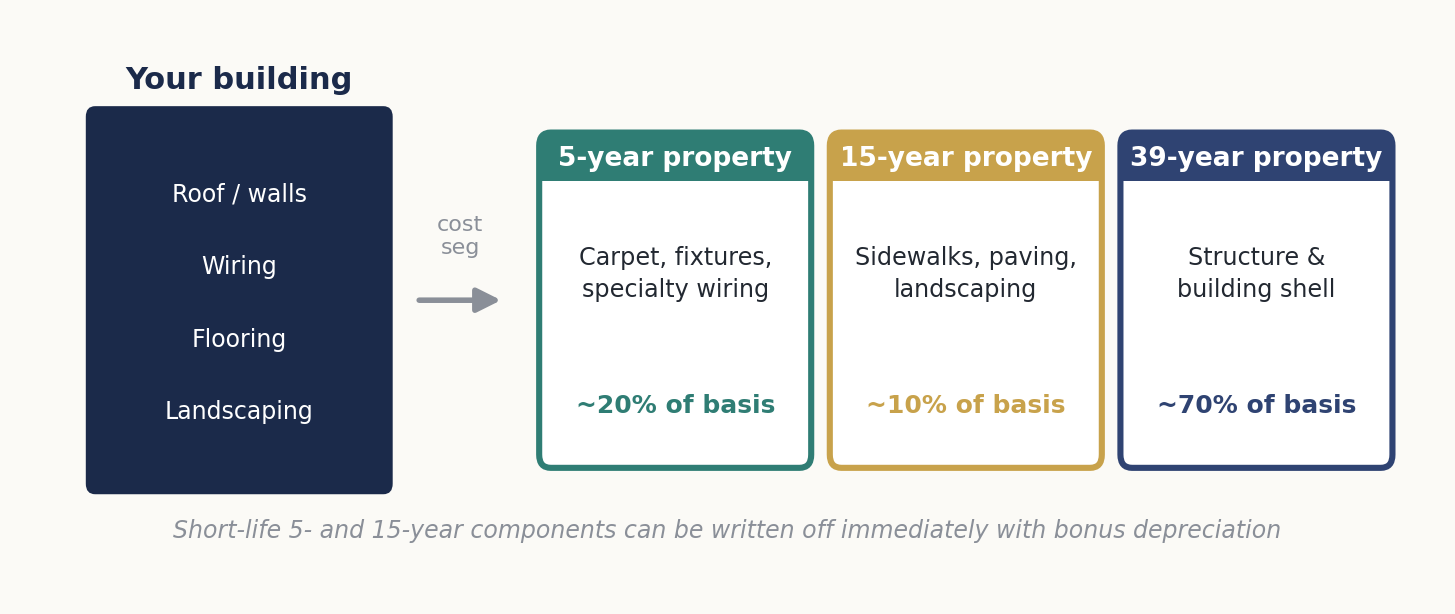
Carpet, cabinetry, and specialty electrical can be 5-year property; sidewalks, paving, and landscaping can be 15-year property. A typical study reclassifies 15–40% of a building’s basis into these shorter lives — and because they’re 20-year-or-less property, they qualify for 100% bonus depreciation.
The effect on your first-year deduction is dramatic. Take a $1,000,000 building with $800,000 of depreciable basis:
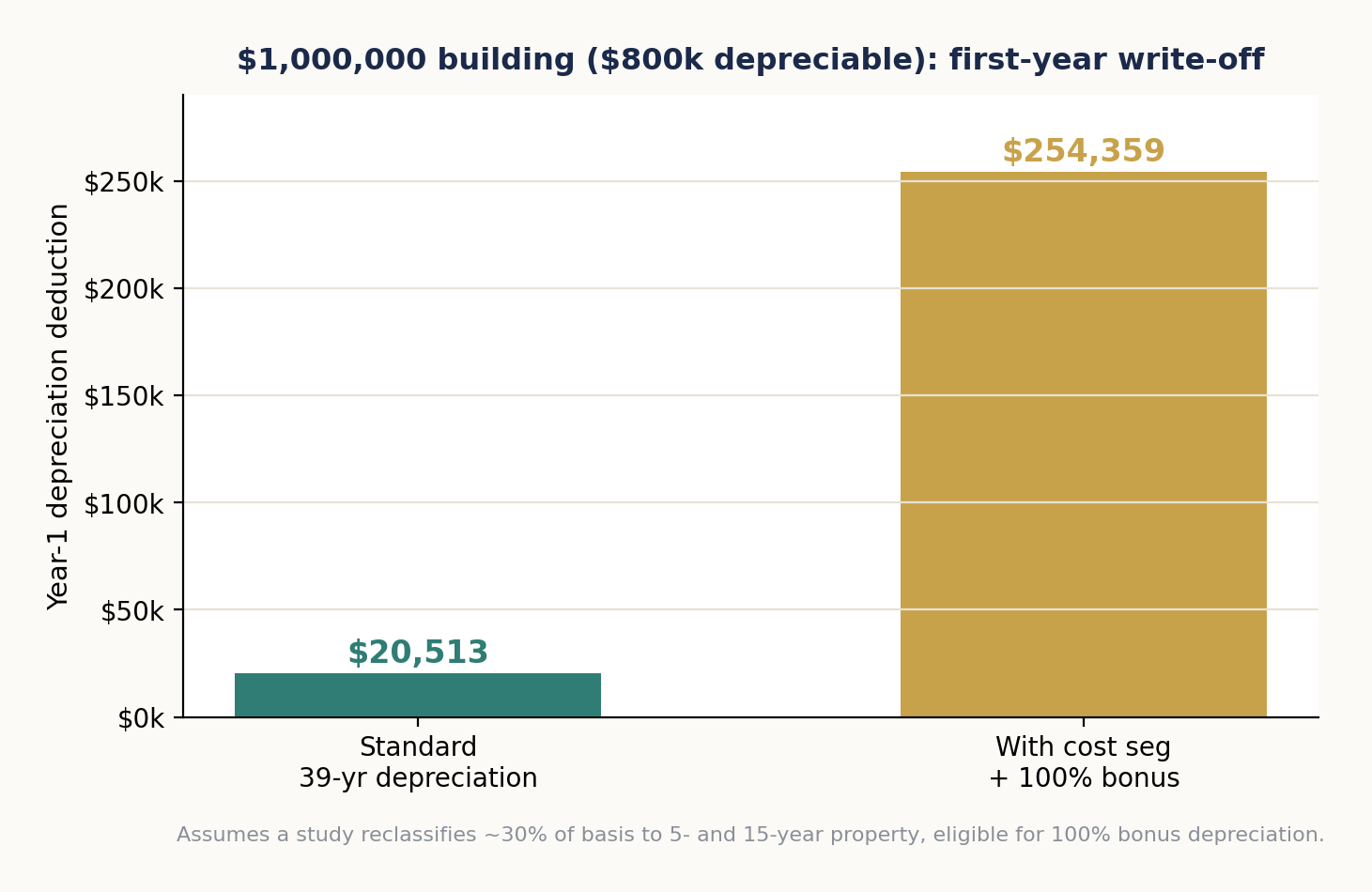
Standard 39-year depreciation gives about $20,500 in year one. A cost segregation study that moves ~30% of the basis into short-life property — then applies 100% bonus — can push the first-year deduction north of $250,000. At a 37% rate, that’s the difference between roughly $7,600 and $94,000 of tax savings in year one.
The catch: depreciation recapture
Accelerating deductions isn’t free money — it’s a timing benefit. When you sell an asset, some of the gain tied to the depreciation you’ve taken is recaptured and taxed. But you’ve had the use of that cash in the meantime, and recapture rates on real property are often lower than the ordinary rates you saved against. The core idea holds: deductions today are worth more than the same deductions tomorrow.
The bottom line
Straight-line and accelerated depreciation reach the same destination — but accelerated gets your tax savings back sooner, and in present-value terms that’s worth real money. Bonus depreciation (now a permanent 100%), Section 179, and cost segregation are the levers that pull those deductions forward. If you’ve bought or built property recently, it’s worth a conversation about whether a cost segregation study or a bonus-vs-179 election could put cash back in your hands this year.
This article is for general educational purposes and isn’t tax advice. Depreciation elections, eligibility, and recapture depend on your specific facts — reach out before acting. Figures shown are illustrative and assume a 37% tax rate and an 8% discount rate.
