Most business owners think of sales tax as the customer's tax. In Florida, once you collect it, it's the state's money sitting in your account, and the Department of Revenue (DOR) treats it that way. Late or missing returns draw penalties even when no tax is owed, and the business owner can be held personally responsible for tax that was collected but not sent in.
The good news is that the system is predictable. Know your rate, your filing schedule, and one date each month, and most of the risk goes away. Several things also changed over the past year, including the rate here in Palm Beach County.
Who has to register and collect
You generally need a Florida sales tax certificate of registration if you sell or rent tangible goods, sell certain taxable services, or charge admissions in Florida. You register with DOR online (Form DR-1). After that, you collect tax from customers and file Form DR-15 for every period.
Out-of-state sellers are covered too. Since July 1, 2021, a retailer with no physical presence in Florida has to register and collect if its taxable remote sales into the state topped $100,000 in the prior calendar year. Florida has no transaction-count test. Marketplace providers such as Amazon generally collect for the sellers on their platforms.
If you buy goods to resell, DOR's Annual Resale Certificate (Form DR-13) lets you buy them tax-free. DOR issues a new one each November for the next calendar year, so now is the time to send the 2027 certificate to your vendors.
What rate to charge
The state rate is 6%. Most counties add a discretionary sales surtax, and the total depends on where the goods are delivered.
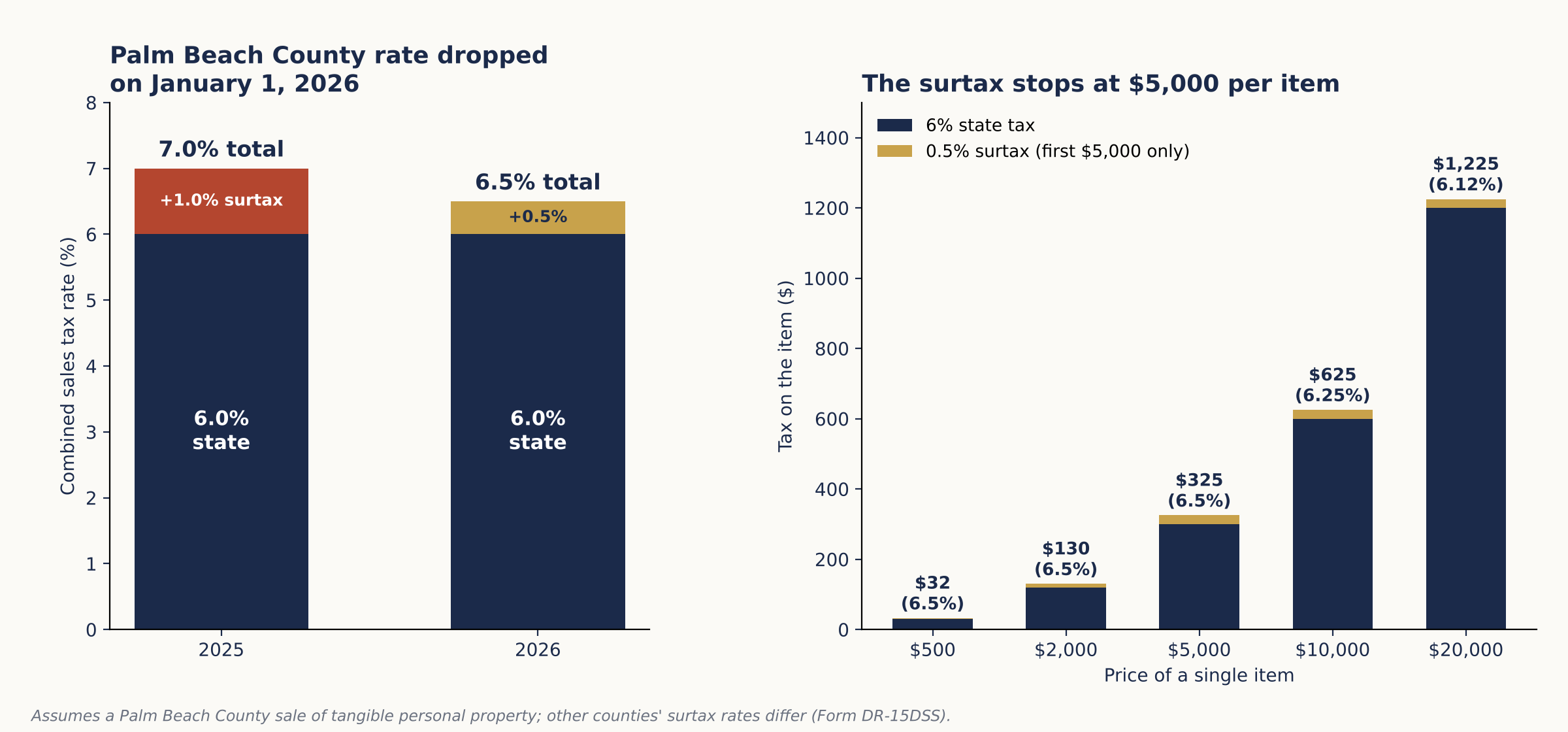
Palm Beach County's rate went down on January 1, 2026. The 1% infrastructure surtax ended December 31, 2025, and the 0.5% school capital outlay surtax that voters approved in 2024 took its place. The combined rate went from 7% to 6.5%.
Two practical points follow from that change:
Check your settings. If your point-of-sale system, QuickBooks, or invoicing software still charges 7% on Palm Beach sales, you are over-collecting. Over-collected tax doesn't belong to you. It has to be sent to the state or refunded to the customer.
The surtax has a cap. The county surtax applies only to the first $5,000 of the price of a single item. On a $20,000 piece of equipment sold in Palm Beach County, the tax is $1,200 of state tax plus $25 of surtax, or $1,225, not $1,300.
Use tax: the half that most businesses miss
Use tax is the same tax, owed by the buyer instead of collected by the seller. It applies when you buy something taxable for your own business from a seller that didn't charge Florida tax, such as an out-of-state supplier or a website that doesn't collect.
Say a Wellington dental office buys $12,000 of equipment online from a vendor that charged no Florida tax. The office owes use tax of 6% on $12,000 ($720) plus 0.5% on the first $5,000 ($25), for $745. A registered dealer reports it on the regular DR-15. This is one of the first things a DOR auditor tests, because it's easy to find in the accounts payable records.
How often you file
DOR assigns your filing schedule based on how much sales and use tax you remit in a year. More than $1,000 means monthly. $501 to $1,000 means quarterly, $101 to $500 means semiannual, and $100 or less means annual. DOR reviews accounts each year and will notify you if your schedule changes.
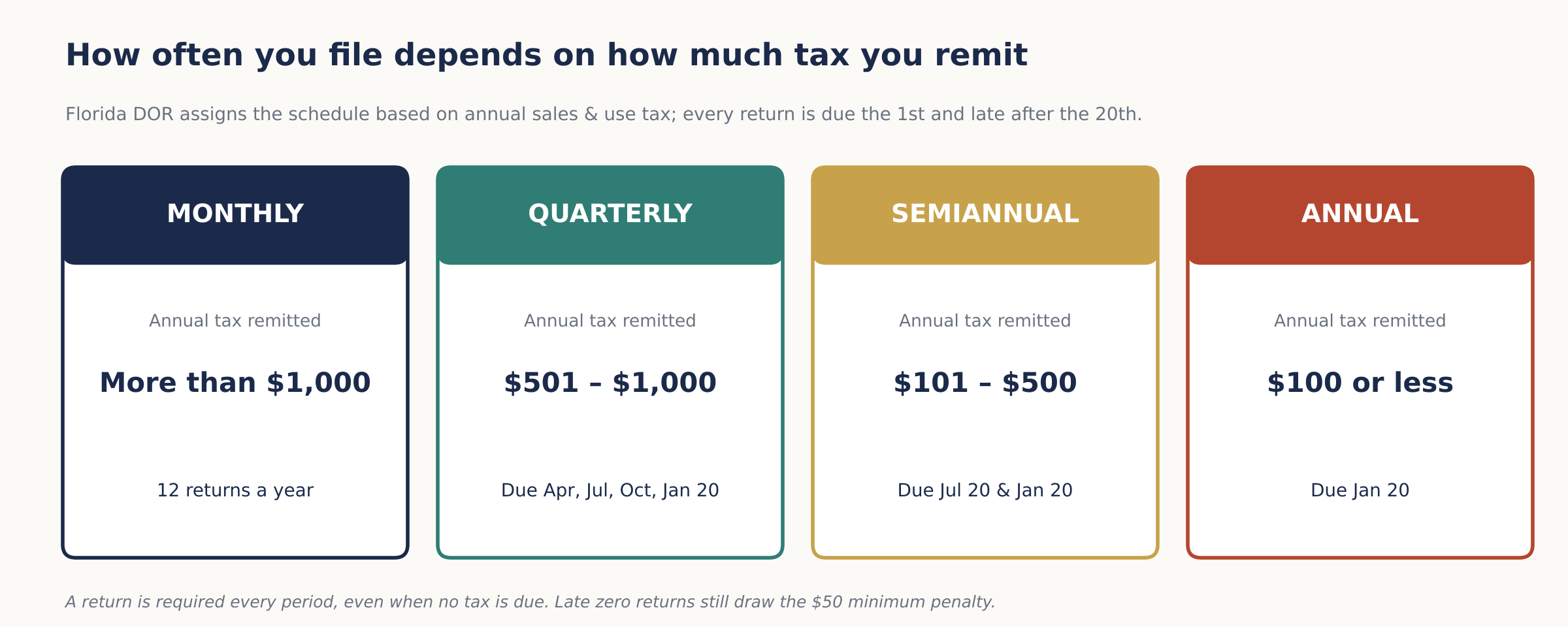
You must file a return every period, even if you had no sales. A zero return filed late still costs the $50 minimum penalty.
When it's due
Every Florida sales tax return, whatever the schedule, is due on the 1st and late after the 20th of the month after the period ends. If the 20th falls on a weekend or holiday, the deadline moves to the next business day.
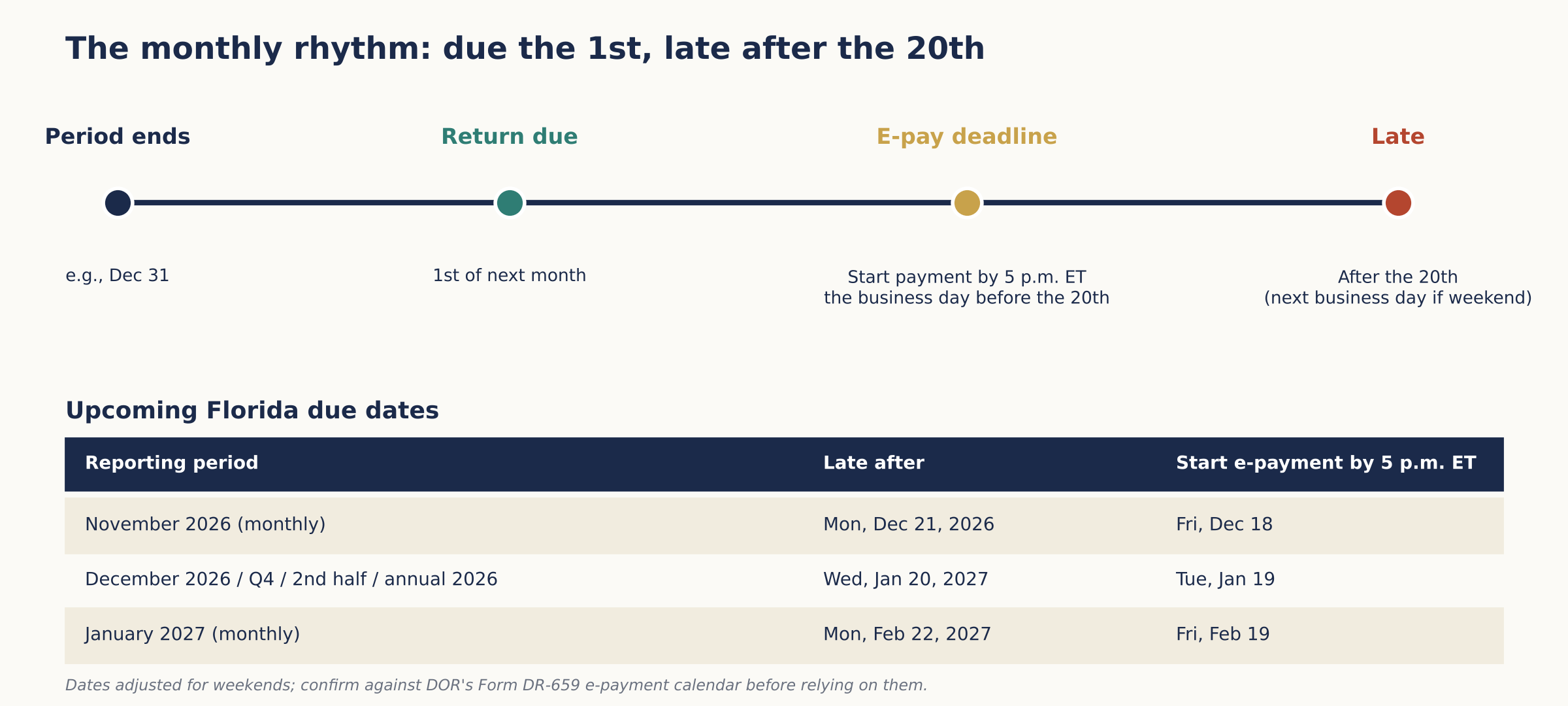
Electronic payments have their own cutoff. You have to start the payment and get a confirmation number by 5 p.m. Eastern on the business day before the 20th. Businesses that paid $5,000 or more in sales tax in the prior state fiscal year (July through June) must file and pay electronically. For everyone else, e-filing is optional but worth it.
The next big date is Wednesday, January 20, 2027. That's when December monthly returns, fourth-quarter returns, second-half semiannual returns, and 2026 annual returns are all due. To pay electronically on time, start the payment by 5 p.m. on Tuesday, January 19.
The $30 reward and the 50% penalty
Florida pays you a little to file on time. If you file and pay electronically by the deadline, you can keep a collection allowance of 2.5% of the first $1,200 of tax, up to $30 per return. A monthly filer collecting at least $1,200 a month keeps $360 a year. You lose it entirely if the return or payment is late.
Late returns cost much more. The penalty is 10% of the unpaid tax for each 30 days or part of 30 days late, with a $50 minimum and a cap of 50%. Interest is charged on top.
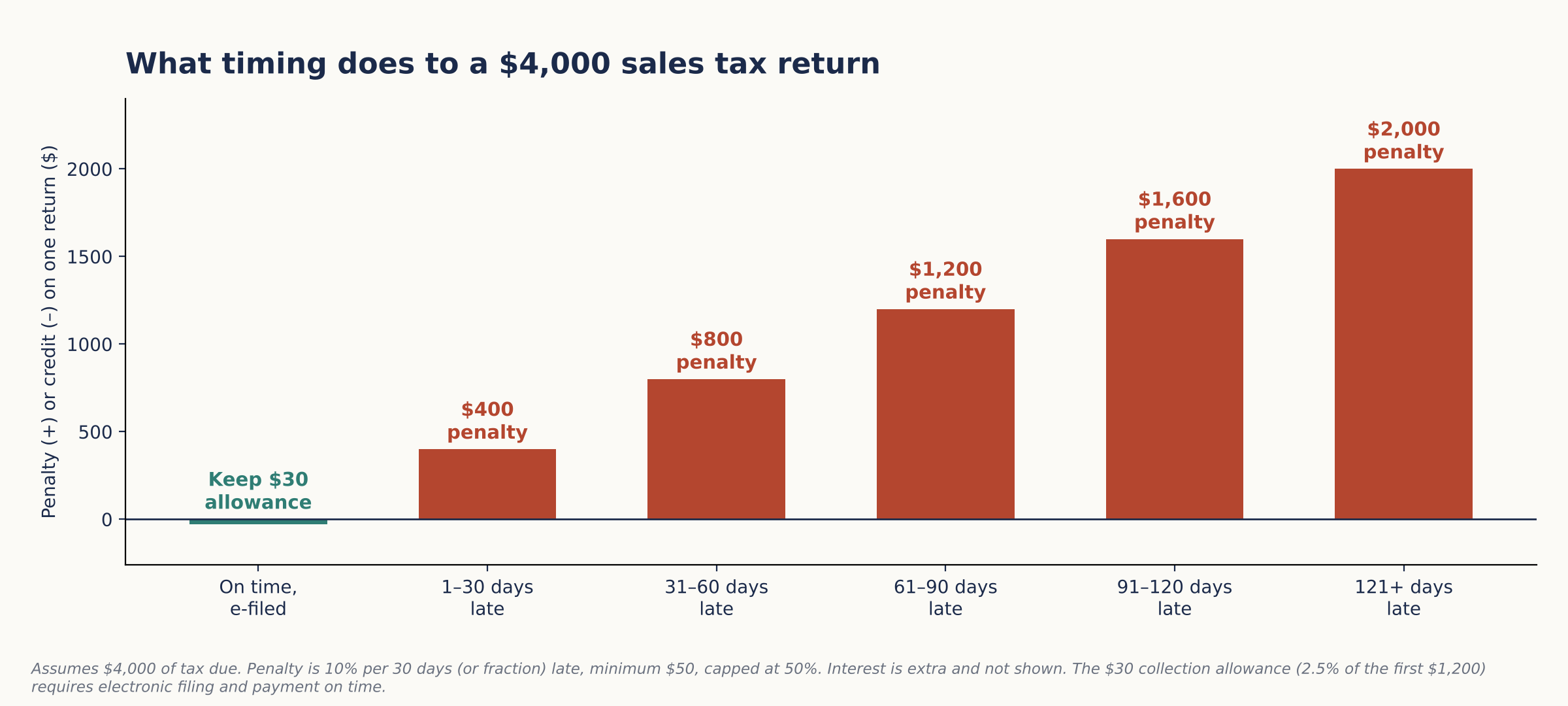
On a $4,000 return, being one day late costs a $400 penalty plus the lost $30 allowance. At 45 days late, the penalty is $800. As I wrote in Paying the IRS Online in 2026, scheduling a payment ahead of time is the easiest fix for this problem. Florida's eFile and ePay system lets you do the same thing.
A few 2025–2026 law changes worth knowing
Commercial rent is no longer taxed. Florida repealed its business rent tax for occupancy periods starting October 1, 2025. If your landlord still adds sales tax to your rent, question it.
Back-to-school holiday. The yearly back-to-school sales tax holiday now runs from July 20 to August 20.
Hunting, fishing, and camping holiday. This holiday runs through December 31, 2026. Retailers that sell qualifying items should check their tax settings.
Home hardening refund. Homeowners may be able to claim a sales tax refund of up to $500 on qualifying impact windows and doors bought between July 1, 2026, and June 30, 2029.
The bottom line
Florida sales tax is simple to follow but unforgiving when you miss it. Confirm the rate your system charges, especially if you sell in Palm Beach County, where the rate dropped to 6.5% this year. Report use tax on untaxed purchases. File every period, even with zero sales. Start your electronic payment by 5 p.m. the business day before the 20th, so you keep the $30 allowance and never pay the penalty.
If you haven't looked at your sales tax setup since the rate change, or a DOR notice is sitting on your desk, it's worth a short conversation before the January 20 deadline.
This article is provided for general educational purposes and is not tax, legal, or investment advice. Rules, rates, and thresholds change, and the right answer depends on your specific facts. Please reach out before acting on anything here.
Sources: Florida DOR Form DR-15 instructions (DR-15N) and Form DR-15DSS (2026 discretionary sales surtax rates); DOR TIP 25A01-15 (Palm Beach County surtax update); DOR TIP 22ADM-06 (electronic filing and payment threshold); §§ 212.11, 212.12, and 213.755, Florida Statutes; Rule 12A-1.056, F.A.C.; DOR out-of-state retailer requirements (SB 50, 2021); HB 7031 (2025) and HB 7031E (2026) analyses from EY, PwC, and Sales Tax Institute.
