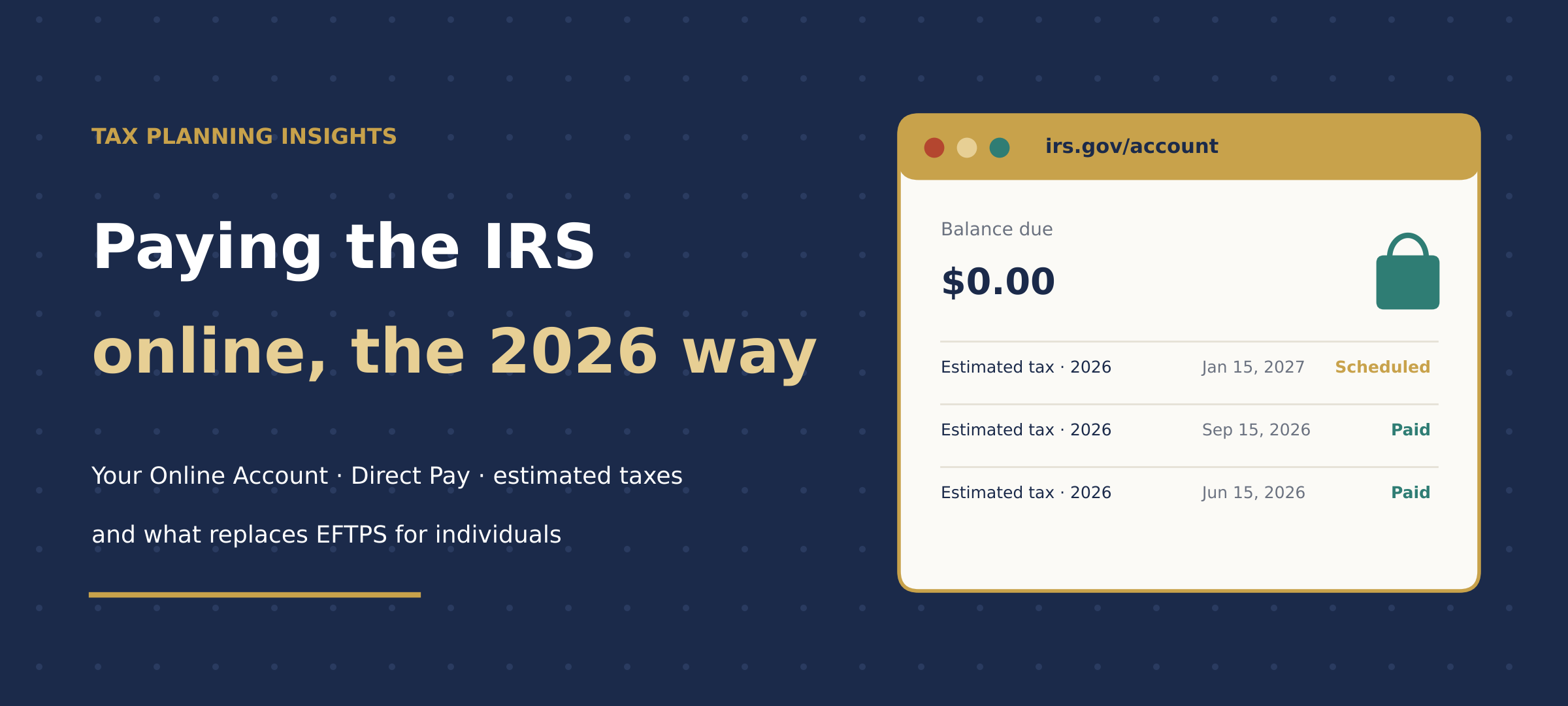
For years, paying the IRS meant one of two rituals. You mailed a check with a 1040-ES voucher and hoped it arrived, or you logged into EFTPS with a PIN that came by mail and a password you reset every time.
Both rituals are on the way out. Executive Order 14247 moved the federal government toward electronic payments in both directions. Paper refund checks for individuals largely stopped after September 30, 2025, and the IRS has said it will reduce paper payments over time. EFTPS stopped taking new individual enrollments on October 17, 2025, and the IRS plans to retire it for individuals in late 2026.
The timing matters, because the last 2026 estimated payment is due January 15, 2027. If that payment has always gone out through EFTPS or a mailed check, now is the time to set up the replacement, not the week it's due.
The two tools that replace the old way
For individuals, the IRS has settled on two free options. Both draw straight from your checking or savings account.
IRS Direct Pay is the quick one. You don't create an account. You verify your identity with information from a prior return, enter your bank details, choose the payment type and tax year, and you're done. It handles balances due, estimated tax, extension payments, and amended-return balances. You can change or cancel a scheduled payment up to two days before it goes out.
Your IRS Online Account is the full one, and the one I recommend. Once you're signed in, you can:
Pay same-day or schedule payments up to 365 days ahead
See pending and scheduled payments, and cancel them before their date
See up to five years of payment history, including every estimated payment
View your balance by tax year, transcripts, digital notices, and Forms W-2 and 1099
Apply for or revise a payment plan
Approve a power of attorney from your tax professional electronically
That payment history is the feature people undervalue. At filing time the question is always "what did you actually send in?" The account answers it in seconds, without a bank-statement hunt.
Setting up your account
The Online Account signs you in through ID.me, the IRS's identity partner. If you already have an ID.me login from Social Security or another agency, it works here too. If not, setup takes about 15 to 20 minutes, one time.
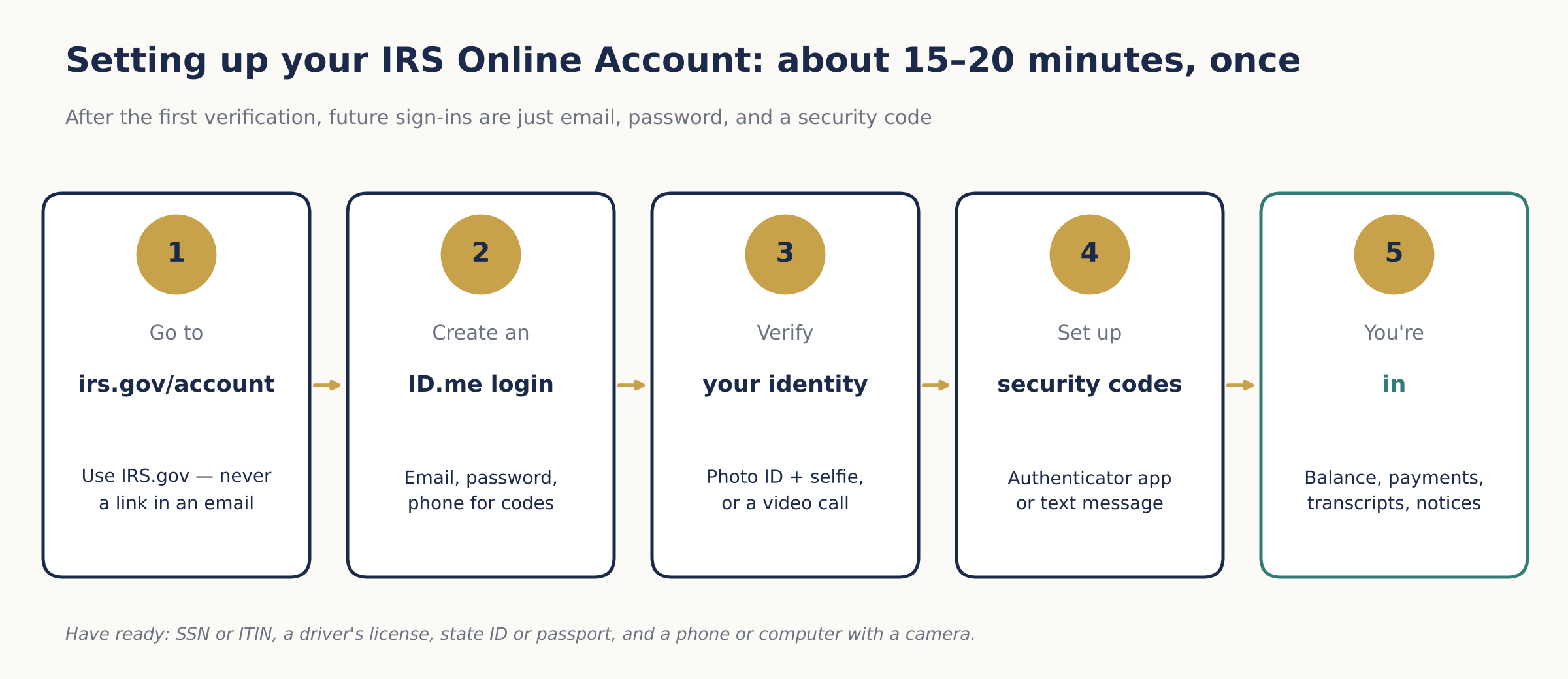
Have your Social Security number or ITIN ready, along with a driver's license, state ID, or passport and a phone or computer with a camera. Go to irs.gov/account and choose to create an account with ID.me. Then verify yourself with a photo of your ID and a selfie, or on a short video call if the automated check fails. After that, signing in takes your email, password, and a security code.
One safety rule: always start at IRS.gov. The IRS doesn't email you a link to log in or make a payment, and fake "tax deposit problem" emails are a common scam this year.
What the payment method costs you
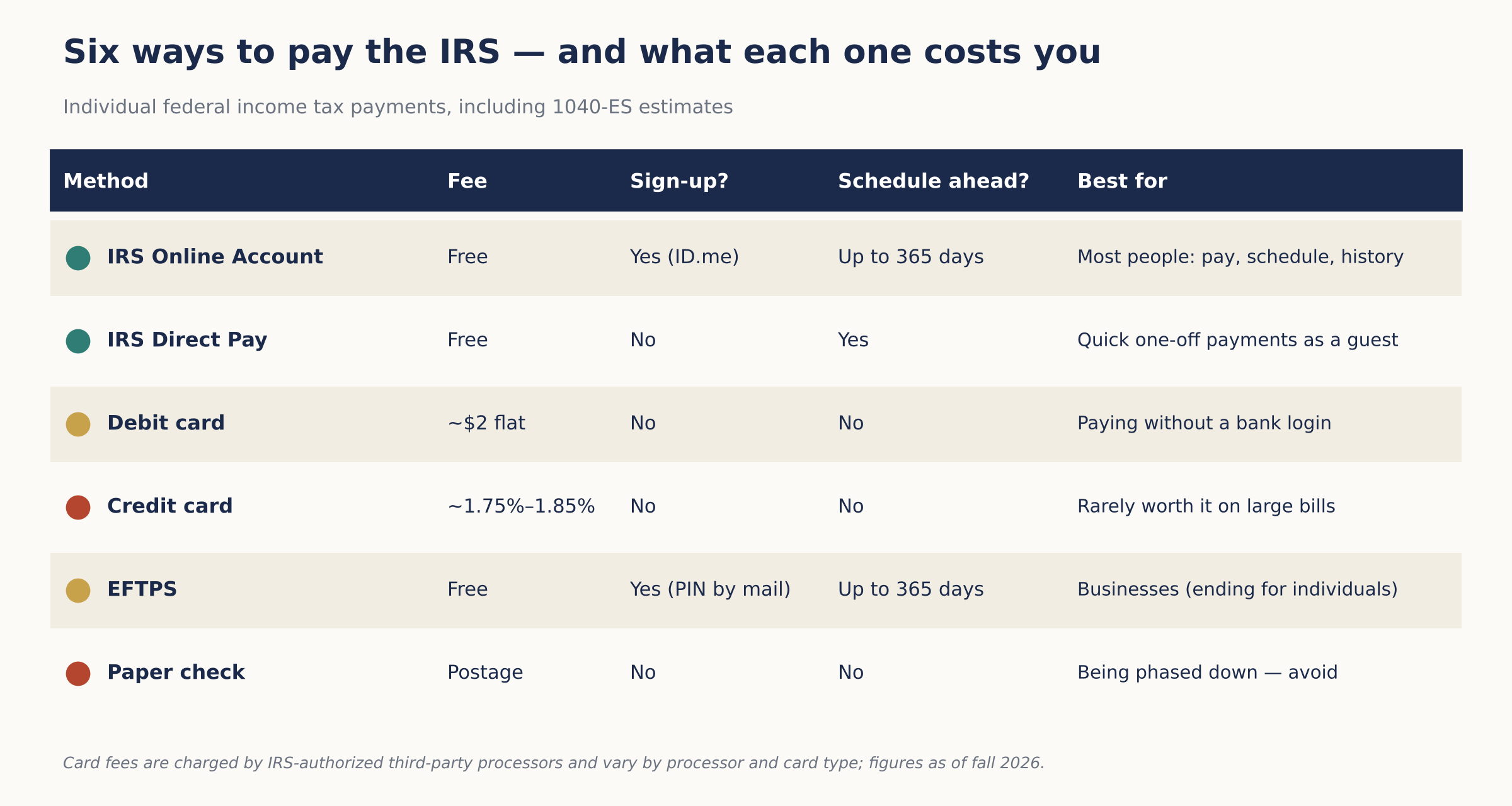
The IRS doesn't charge a fee to pay from a bank account. Card payments are different. They run through IRS-authorized third-party processors, and those processors charge you. Personal debit cards cost about $2 a payment. Personal credit cards generally cost 1.75% to 1.85% of the payment.
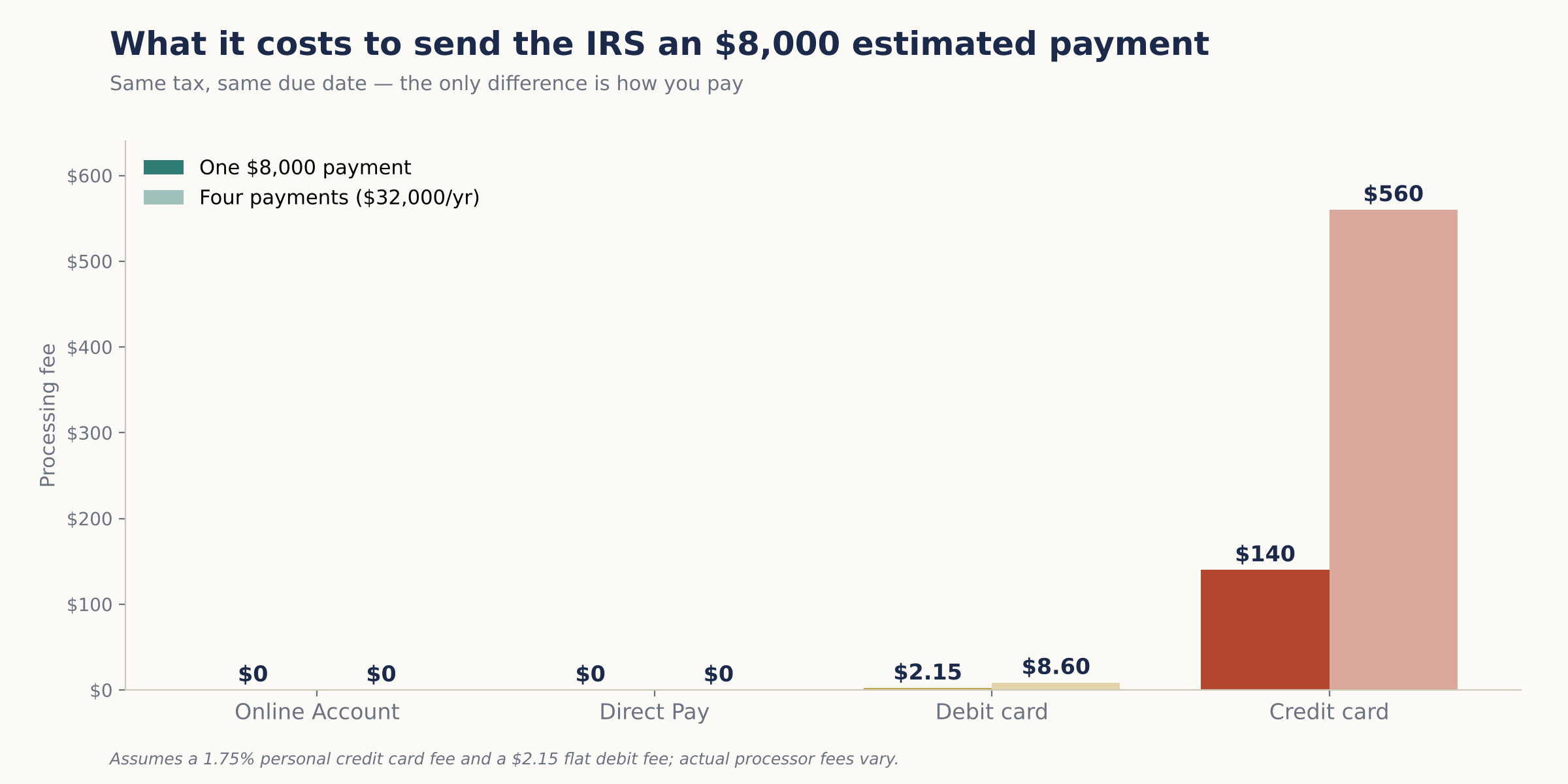
On an $8,000 quarterly estimate, a credit card costs about $140. Four of those in a year is $560, and few rewards cards earn enough to cover it. Direct Pay or your Online Account costs $0. (Recently finalized Treasury regulations allow the IRS to take cards directly in the future, but the cardholder still has to cover the processing cost.)
Making the January 15 payment correctly
The fourth 2026 estimate covers income from September through December. Here's how to send it from your Online Account:
Sign in and choose Make a payment.
Select Estimated tax as the reason, and Form 1040-ES if asked.
Choose tax year 2026. This is the step people miss.
Enter the amount, choose your bank account, and pick a date on or before January 15.
Save the confirmation number, then check that the payment shows as scheduled.
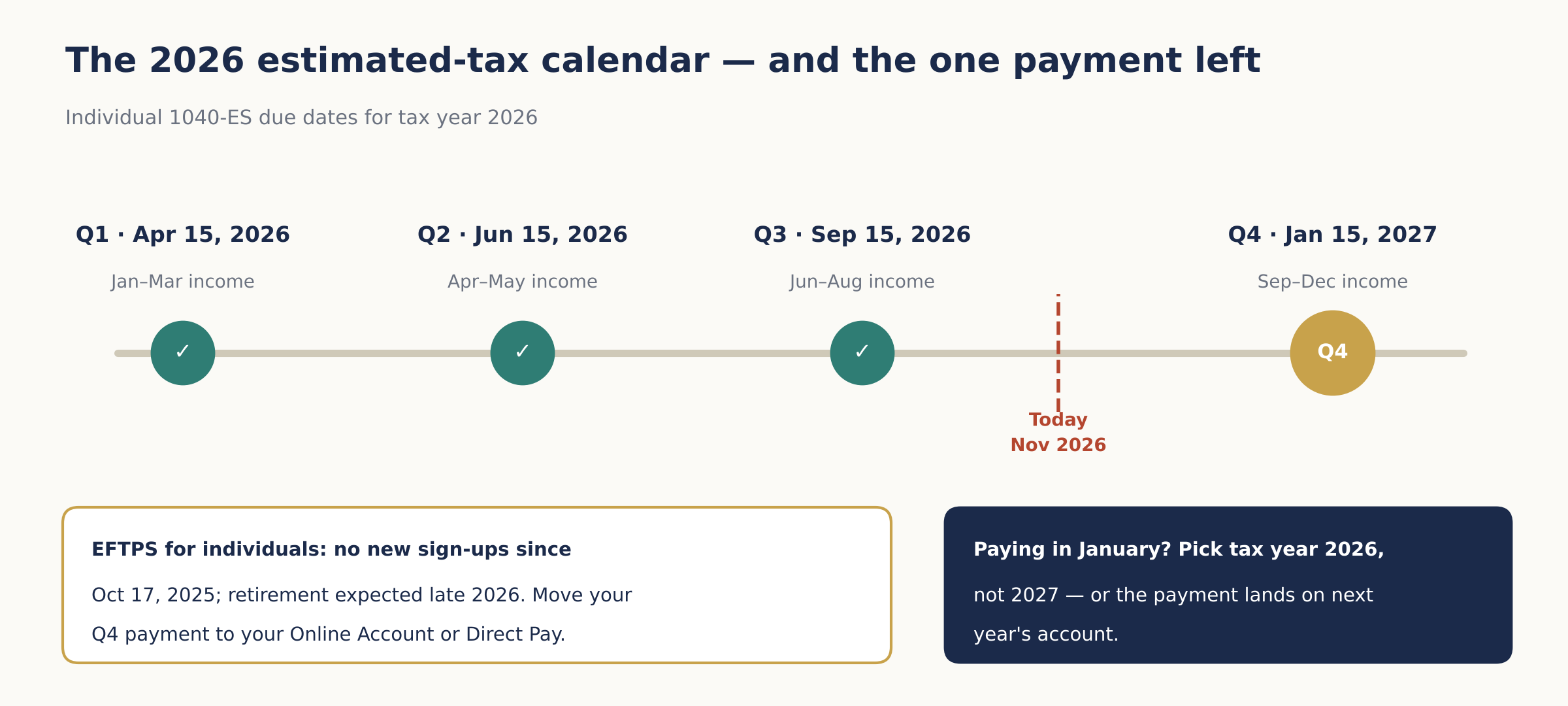
Why step 3 matters: in January, the payment screen offers both the current year and the prior year. Pick 2027 by mistake and your payment lands on next year's account. The IRS treats your 2026 estimate as unpaid and may charge a penalty, even though the money is sitting on file. It can be fixed, but only with a call or a letter.
How much to send is a separate question. The safe harbor is generally 100% of last year's total tax, or 110% if last year's AGI was over $150,000. Take a household that owed $40,000 for 2025 with AGI above $150,000. Their 2026 target is $44,000, or $11,000 a quarter. If they've paid $33,000 so far, January's payment is $11,000. As I wrote in The Best 2026 Tax Move Is the One Nobody Brags About, if your books are current you may be able to pay based on this year's actual income instead.
Missing the date costs something too. For the fourth quarter of 2026, the IRS rate on underpaid estimates is 7%, and the rate is reset each quarter. If that $11,000 goes in on April 15 instead of January 15, the penalty is about $190, assuming the rate holds. That's smaller than people fear, but it's money spent for nothing.
If you own a business
The individual changes don't move your business payroll. Corporations and partnerships can keep using EFTPS for federal tax deposits. Businesses can also pay through Direct Pay for Business, or through a Business Tax Account, which uses the same ID.me login as your personal account.
Two details trip people up. First, your personal estimated payments, including the tax on S corporation income, go through your individual account, not the company's. Second, a Business Tax Account for a sole proprietor requires an EIN and a Schedule C or F. Single-member LLCs reporting as sole proprietors can't use it yet. As I covered in S Corp or C Corp?, entity type changes which IRS doors are open to you.
The bottom line
Mailing checks and logging into EFTPS are both being phased out for individuals. The replacements are free, faster, and leave a record you can actually find. Set up your IRS Online Account once, schedule your January 15 estimate for tax year 2026, pay from your bank account instead of a credit card, and keep the confirmation number.
If you've been making estimated payments through EFTPS, or you're not sure what your January payment should be, a short conversation before the holidays will cover both.
This article is provided for general educational purposes and is not tax, legal, or investment advice. Rules, rates, and thresholds change, and the right answer depends on your specific facts. Please reach out before acting on anything here.
Sources: Executive Order 14247 and IRS Fact Sheet 2026-02 (Questions and answers on modernizing payments); EFTPS.gov individual transition notice; IRS Direct Pay and Online Account for Individuals pages; IRS Business Tax Account eligibility; IRS 2026 Form 1040-ES; IR-2026-98 and Rev. Rul. 2026-15 (fourth-quarter 2026 interest rates); T.D. 10060 (card payments under IRC §6311).
