The children's Trump Accounts got the headlines. The adult version is quieter, starts January 1, and for the right worker it is the best return on $2,000 anywhere in the tax code.
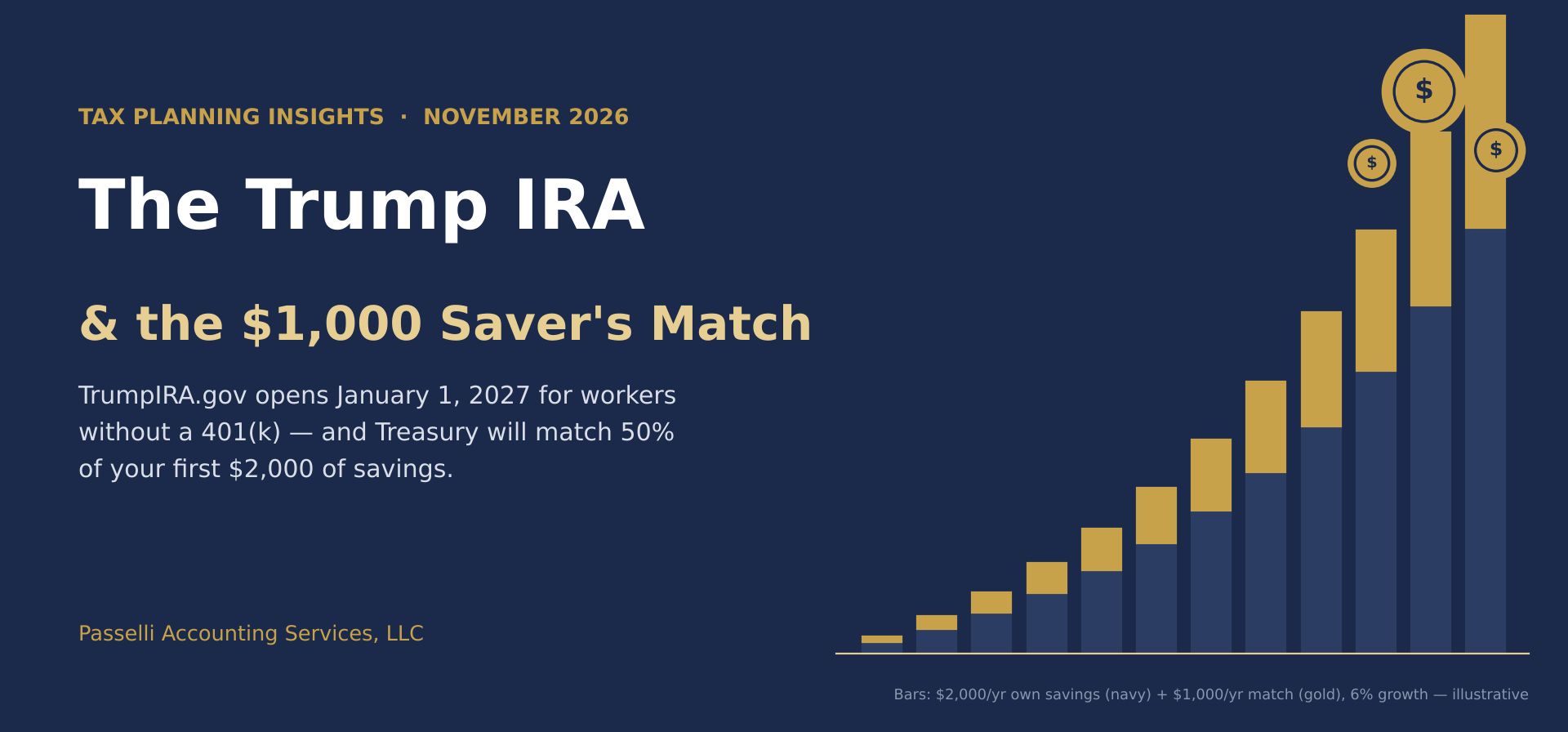
Most of the questions I've fielded this year about "Trump Accounts" have been about the children's version — the $1,000 Treasury seed for babies born 2025 through 2028. That program is live. This article is about the other one: the account for working adults that launches with the new year.
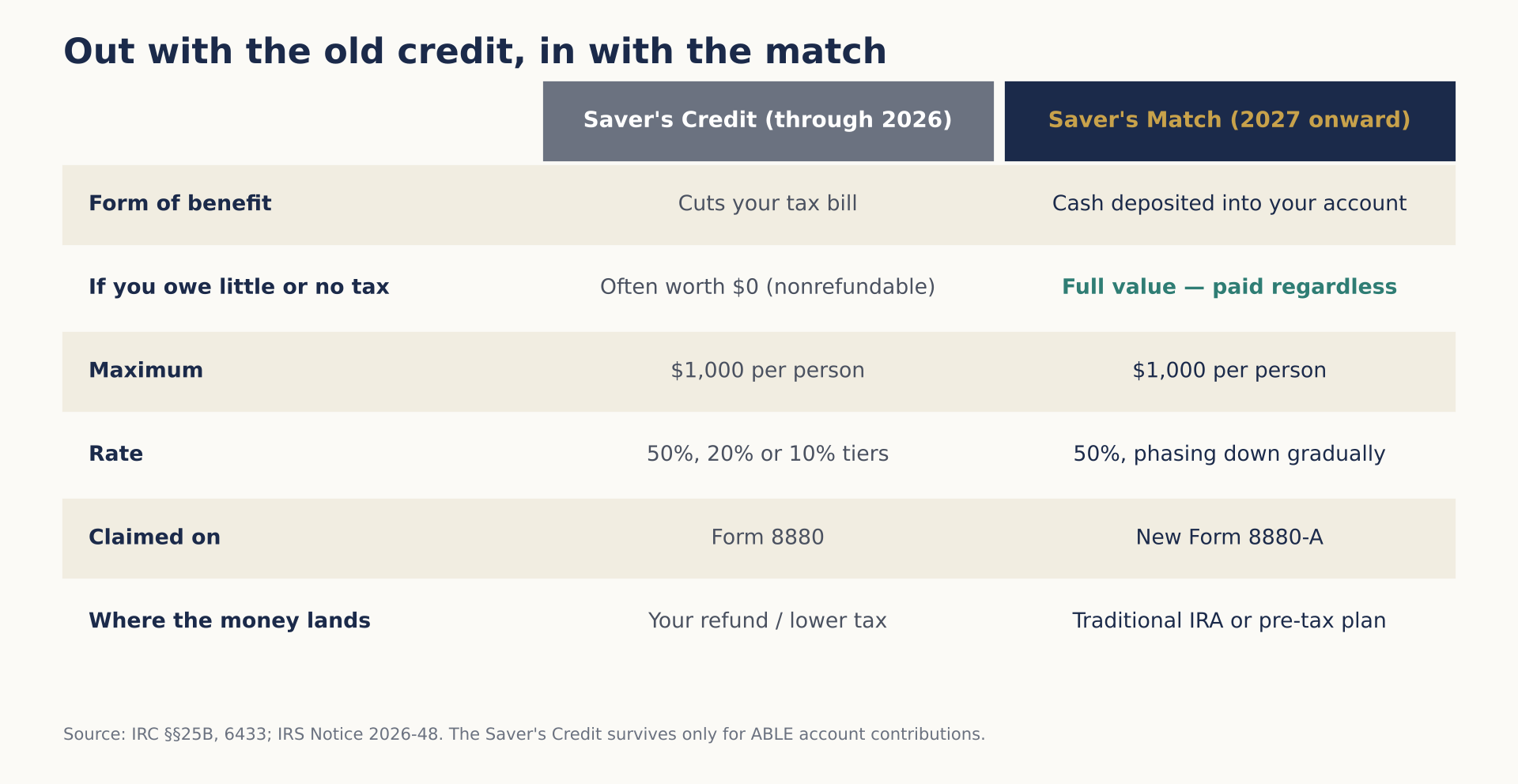
Here's the short version. On January 1, 2027, Treasury is scheduled to open TrumpIRA.gov, a marketplace of low-cost IRAs for people who don't have a retirement plan at work. At the same time, the old Saver's Credit is replaced by the Saver's Match: if your income qualifies, the federal government deposits up to $1,000 a year into your retirement account — even if you owe no income tax at all.
One naming note before we start. You may also see news about expanding the children's Trump Accounts to adults under 40. That is a proposal, not law. What starts in 2027 is TrumpIRA.gov plus the Saver's Match, and both are real.
What it actually is
"Trump IRA" isn't a new kind of account. It's an ordinary IRA, offered by private banks and brokerages, that meets standards set by Executive Order 14403. To be listed on TrumpIRA.gov, a provider has to:
Offer target-date, balanced, or principal-protection fund options
Keep total expense ratios at or below 0.15%
Impose no minimum balance or contribution
The money is the Saver's Match, which Congress created in SECURE 2.0 back in 2022 and which takes effect for tax year 2027. The executive order's job is to make sure people actually find it.
The audience is broad: independent contractors, part-time workers, gig workers, and employees of small businesses that don't sponsor a plan. Florida has no state-run auto-IRA program, so for a lot of workers in Palm Beach County this is the first organized path to a retirement account they've had.
How the match works
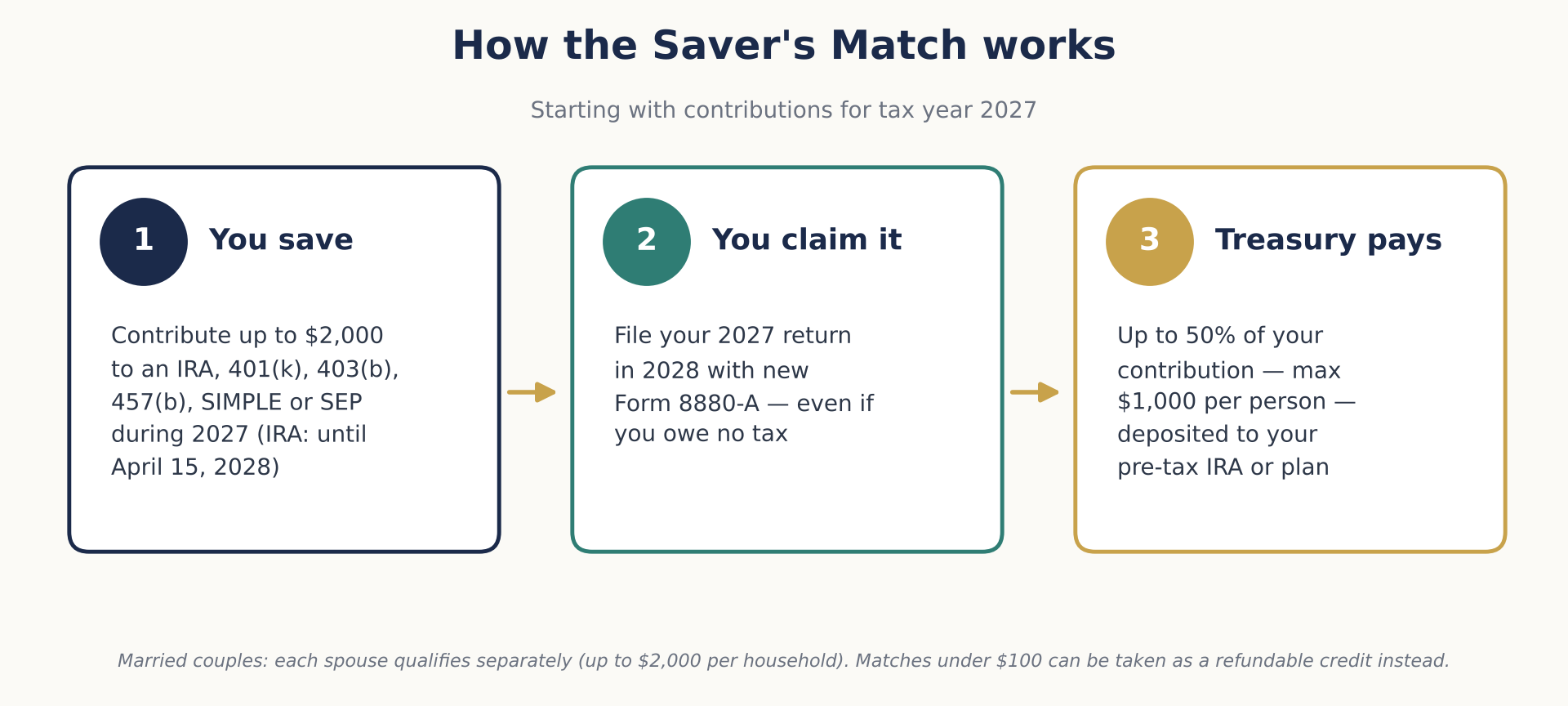
The formula is simple at the top: Treasury matches 50% of the first $2,000 you contribute, for a maximum of $1,000 per person. Married couples qualify separately, so a household can receive up to $2,000.
Almost any retirement contribution counts — a traditional or Roth IRA, a 401(k), 403(b), governmental 457(b), SIMPLE, or SEP. You claim the match on a new Form 8880-A filed with your 2027 return in 2028, and you choose where it goes. Three details matter:
It lands in a pre-tax account. The match can go into a traditional IRA or the pre-tax side of a workplace plan. You can route it to a Roth, but only through a conduit IRA, and that conversion is taxable.
It doesn't use up your own limit. The match is not counted against your IRA or 401(k) contribution cap.
It can't be seized for back debts. The statute shields the deposit from the federal offsets that normally grab refunds.
If your calculated match is under $100, you can take it as a refundable credit on your return instead.
Who qualifies — and the income catch
You must be at least 18, not a full-time student, and not claimed as someone's dependent. Then income decides how much you get. For 2027, the full 50% match runs up to $20,500 of modified AGI for single filers, $30,750 for heads of household, and $41,000 for joint filers. It phases down from there and disappears at $35,500, $53,250, and $71,000, respectively.
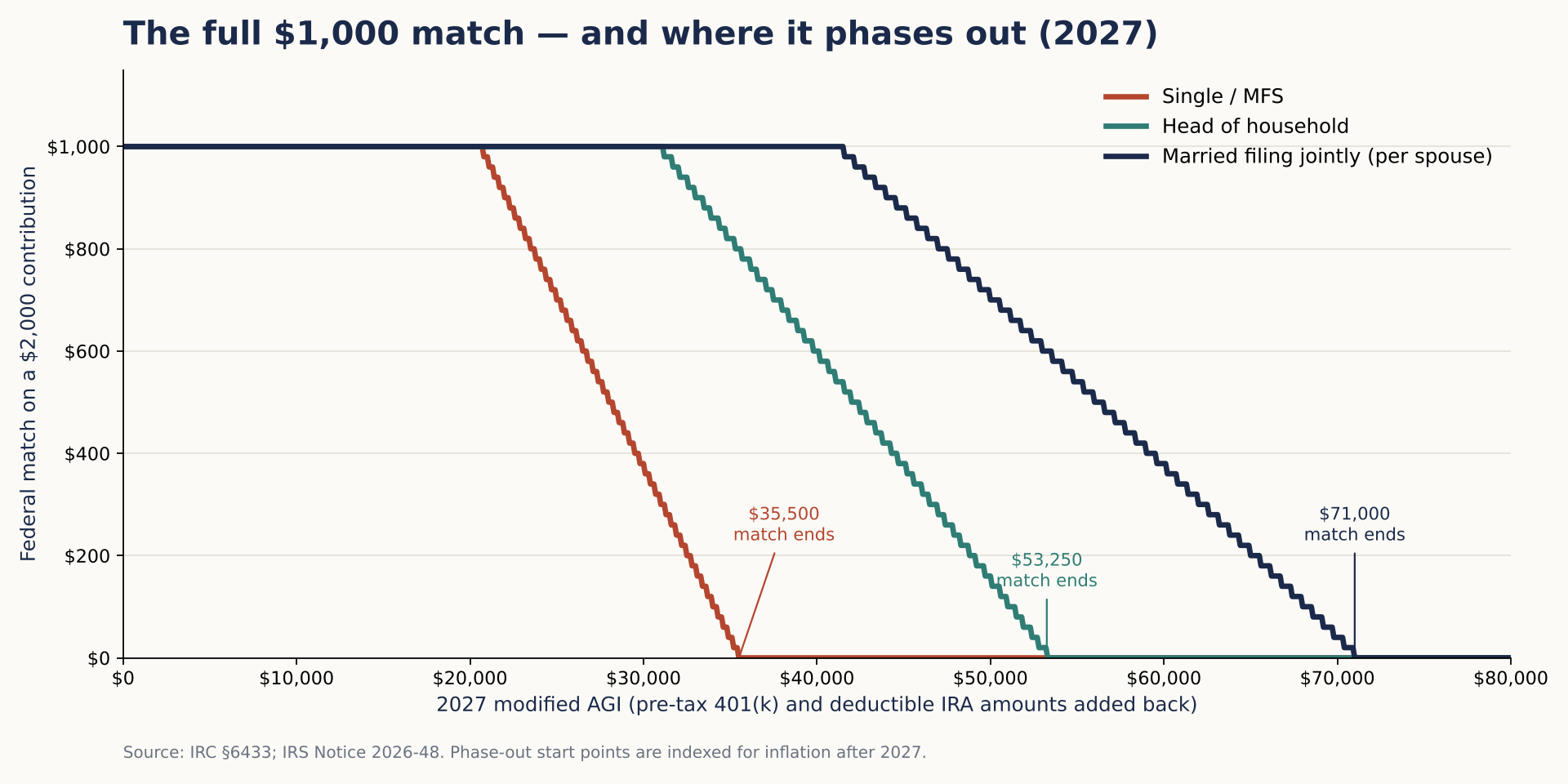
Here is the catch people will miss. For this test, "modified AGI" adds back your pre-tax 401(k) deferrals and any deductible IRA contribution. A traditional IRA deduction lowers your tax, but it does not lower your income for match purposes.
Take a single worker earning $24,000 who puts $2,000 into a traditional IRA. Taxable income drops to $22,000, but match income stays at $24,000. That's $3,500 into the phase-out, so the match rate falls from 50% to 39%. The match is $780, not $1,000. Still a 39% instant return — but plan for the right number.
A few more examples under the IRS's published formula:
Single, $19,000 of income, $2,000 saved: full $1,000 match
Married, $38,000 combined, each spouse saves $2,000: $2,000 for the household
Married, $56,000 combined, each spouse saves $2,000: $500 each, $1,000 total
What it grows into
A 50% match is a bigger number than any tax bracket. As I wrote in Your Tax Bracket Isn't Your Tax Rate, a deduction saves you your marginal rate — 10%, 12%, maybe 22%. The match pays 50 cents on the dollar, up front, before the money has earned anything.
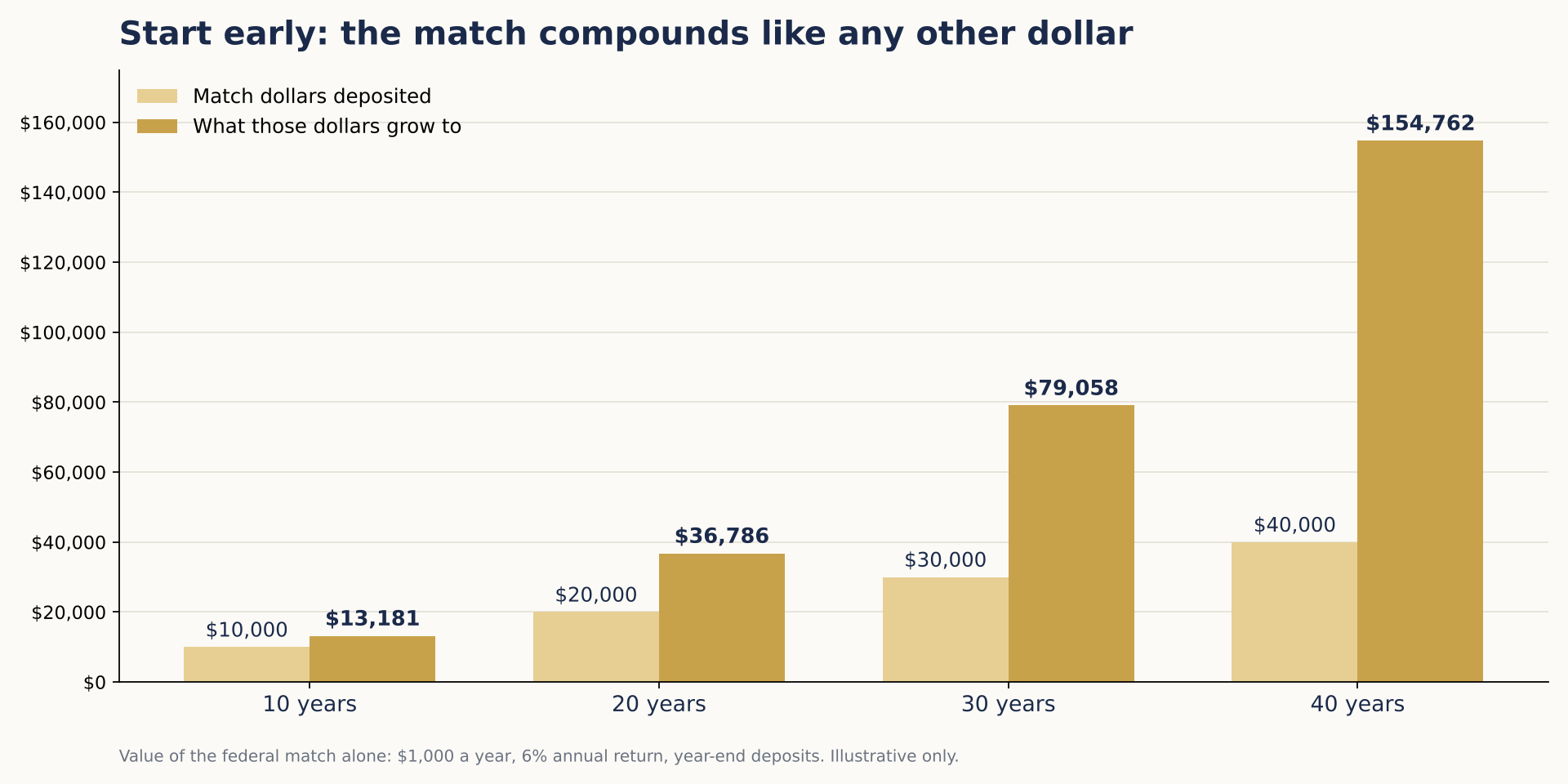
Then it compounds. A worker who saves $2,000 a year and collects the full match for 30 years puts in $60,000 of their own money and receives $30,000 from Treasury. At a 6% return, the account reaches about $237,000. Without the match, it would be about $158,000. That $30,000 of federal money grew into roughly $79,000.
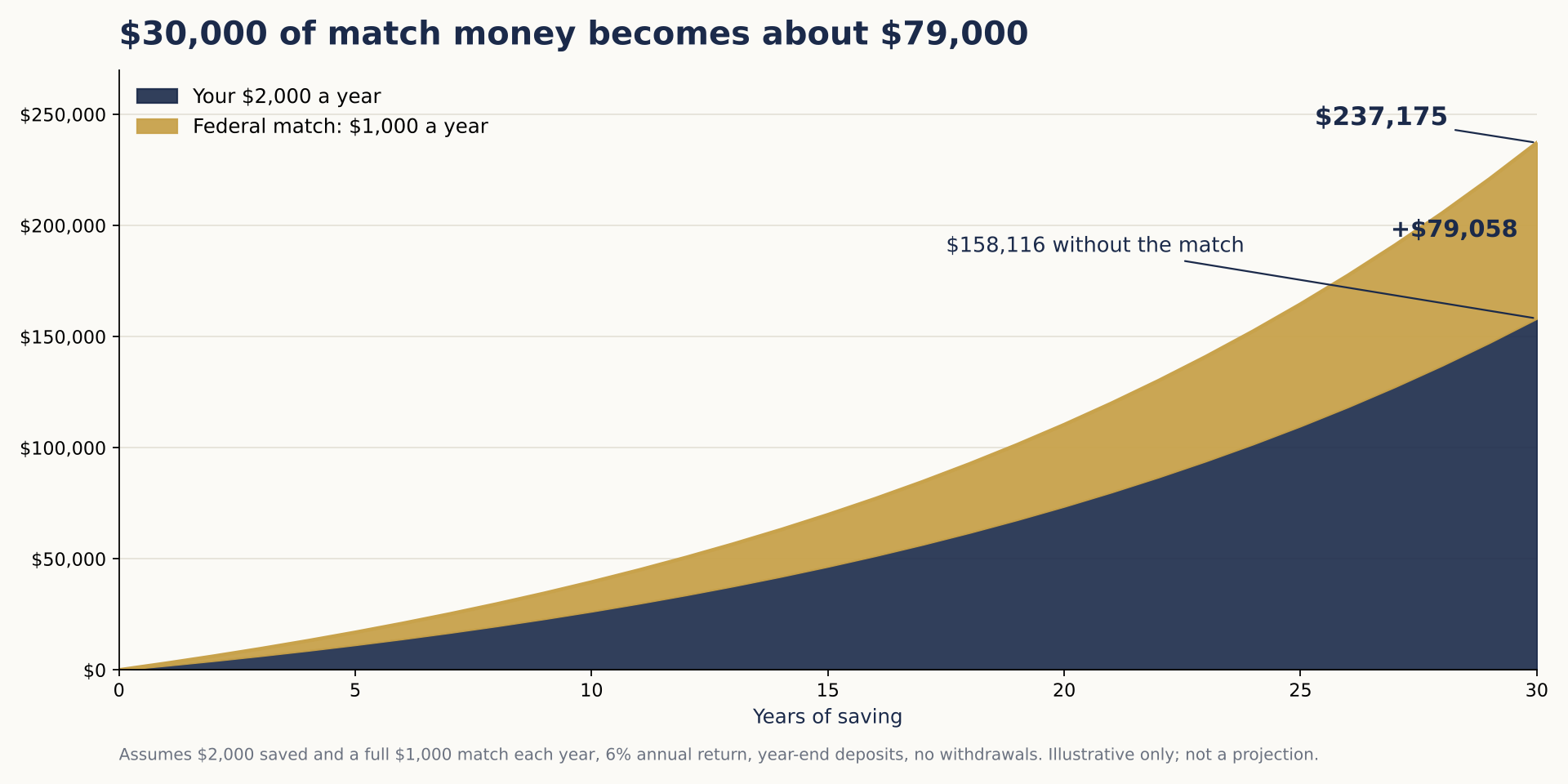
Time does most of the work. Ten years of matches ($10,000) grows to about $13,000. Forty years ($40,000) grows to more than $154,000. For a 25-year-old in a lean stretch, this is worth starting now.
The fine print that can cost you
Don't pull money out. Withdrawals from retirement accounts in the current year, the two prior years, or before your filing deadline reduce the contributions that count. Take $900 out in 2026 and $500 in 2027, and only $600 of a $2,000 contribution is matched.
Early withdrawals of the match itself can trigger the 10% penalty plus a separate "recovery tax" that claws back the federal money.
Nothing happens without a return. No Form 8880-A, no match. People who normally don't file because they owe nothing need to file anyway.
Mind the 2026/2027 overlap. An IRA contribution made between January 1 and April 15, 2027 can be designated for 2026 (the old credit) or 2027 (the new match). For anyone who owes little or no tax, 2027 is usually the better choice.
What this means for business owners
Most of my clients will earn too much to receive the match themselves. Their workers often won't. If you run a small business without a retirement plan, TrumpIRA.gov gives your part-time staff and contractors a no-minimum account and a real reason to use it. It's a meaningful benefit you can point people to at no cost to the business.
It's not a replacement for a plan of your own, though. If you want to shelter real money — the $24,500 401(k) deferral, or the larger limits in a solo 401(k) or safe-harbor plan — that's still a separate conversation, and one worth having before year-end.
The bottom line
The Saver's Match turns the old Saver's Credit from a tax break most low earners couldn't use into actual money in an account. Treasury puts in 50 cents for every dollar up to $2,000, phased out by income, deposited even if you owe no tax. TrumpIRA.gov is the front door that helps people find a low-cost IRA to receive it.
If you, a family member, or someone on your payroll fits the income ranges, the steps are simple: open an eligible IRA in 2027, put in up to $2,000, leave it alone, and file a return in 2028. If you're unsure whether the numbers work in your situation — especially the income add-backs — that's a short conversation worth having before the first deposit.
This article is provided for general educational purposes and is not tax, legal, or investment advice. Rules, rates, and thresholds change, Treasury has not yet issued final regulations or Form 8880-A, and the right answer depends on your specific facts. Please reach out before acting on anything here.
Sources: IRC §6433 (SECURE 2.0 Act §103); IRS Notice 2026-48 (Saver's Match anticipated regulations); Executive Order 14403, Promoting Retirement-Savings Access for American Workers by Establishing TrumpIRA.gov (April 30, 2026) and White House fact sheet; IRS Notice 2025-67 (2026 retirement plan limits); IRS and Treasury guidance on Trump Accounts (IRC §530A).
