If no one withholds tax from your income, the IRS expects you to pay as you go. Here is how to do it, how much is enough, and what it costs to skip it.
Every year I meet business owners, freelancers, landlords and retirees who did everything right except one thing: they waited until April to pay. They filed on time and paid the full balance, and the IRS still added a penalty. The reason is simple. The federal income tax is a pay-as-you-go system, and if tax isn't withheld from your income, you're expected to send it in during the year through estimated tax payments.
The good news is that the rules include a "safe harbor," a fixed target that protects you from the penalty even if you still owe money when you file. With the January 15 payment coming up and only a few weeks left in 2026, now is a good time to check where you stand.
Who needs to make estimated payments
You generally need to pay estimated tax if you expect to owe at least $1,000 for 2026 after subtracting withholding and refundable credits. That usually means people with income that has no withholding:
Self-employed people and 1099 contractors
S corporation owners whose distributions or K-1 income go beyond their W-2 salary
Landlords with rental income
Investors with large capital gains, dividends or interest
Retirees whose pension or IRA withdrawals have little or no withholding
There's one clean exemption: if you were a U.S. citizen or resident for all of 2025 and had zero tax liability for that full year, you don't have to make 2026 estimated payments.
The calendar: the "quarters" aren't equal
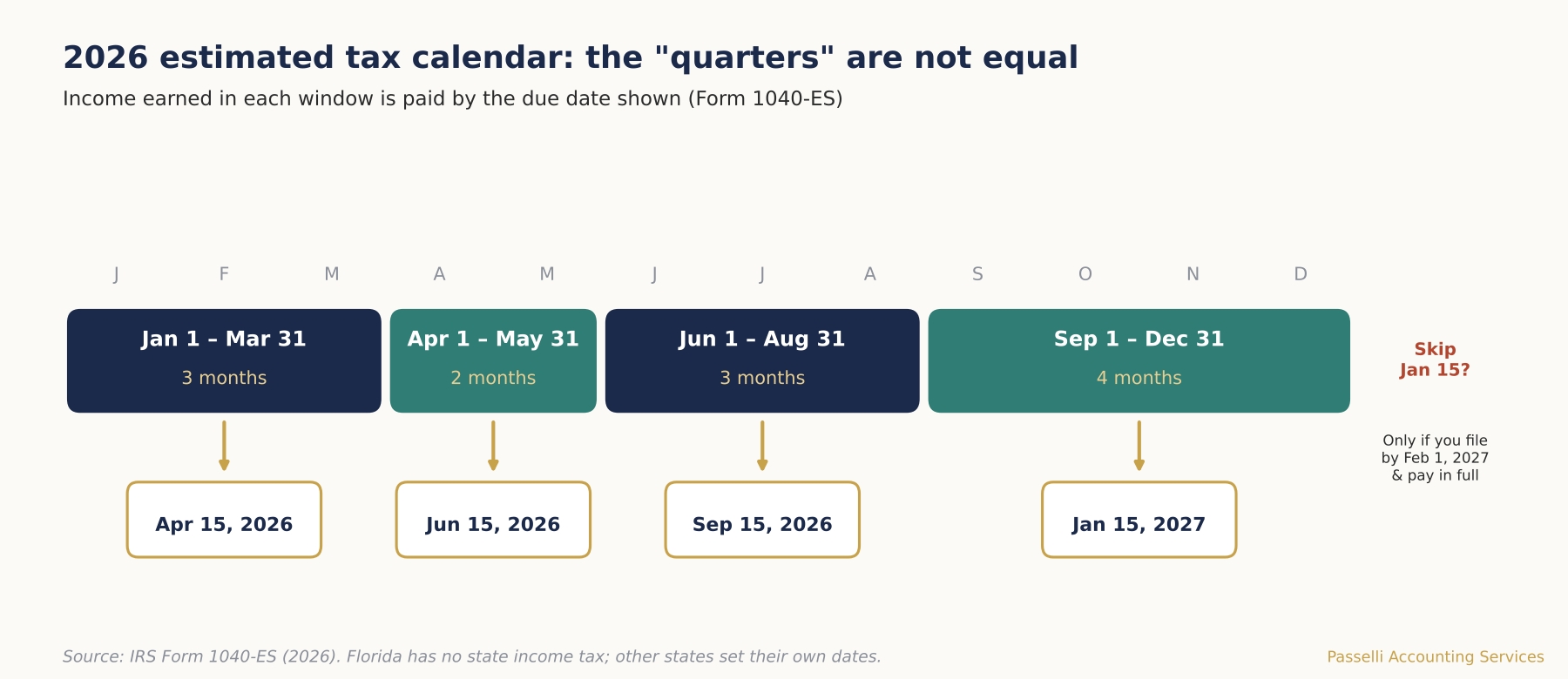
The IRS calls them quarterly payments, but the periods don't match calendar quarters. For 2026, payments are due April 15, June 15 and September 15, 2026, and January 15, 2027. The second window covers only two months (April and May), and the last one covers four (September through December).
One useful shortcut: you can skip the January 15, 2027 payment if you file your 2026 return by February 1, 2027 and pay the whole balance with it. That works well for people whose documents arrive early.
Florida has no state income tax, so Florida residents only have to think about the federal schedule. If you have income in another state, that state may have its own dates and rules.
The safe harbor: the number that protects you
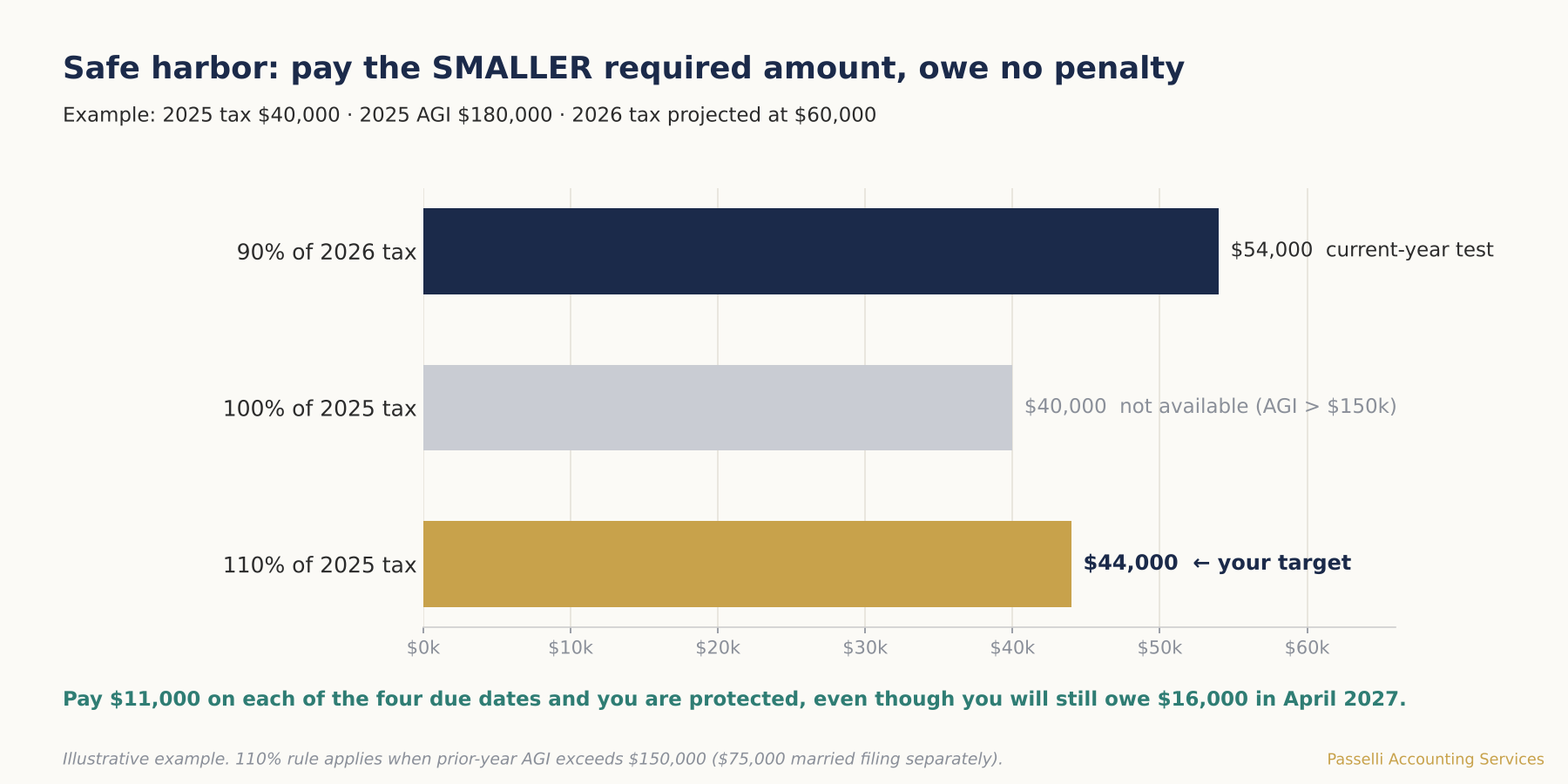
You avoid the underpayment penalty if your withholding plus on-time estimated payments add up to the smaller of:
90% of your 2026 tax, or
100% of your 2025 tax (the tax shown on last year's return)
If your 2025 adjusted gross income was more than $150,000 ($75,000 if married filing separately), the prior-year test rises to 110%.
Here's how that works in practice. Say Maria runs a consulting business. Her 2025 tax was $40,000 on AGI of $180,000, and her business is growing, so her 2026 tax will be about $60,000. Ninety percent of this year's tax is $54,000. Because her AGI was over $150,000, her prior-year test is 110% of $40,000, or $44,000. The smaller number wins, so her safe-harbor target is $44,000, or $11,000 on each of the four due dates.
Maria will still owe about $16,000 when she files in April 2027, but she won't owe a penalty on it. That's the real value of the prior-year safe harbor: you get a fixed number at the start of the year, and you keep the extra cash in your business until the return is due.
What it costs to skip the payments
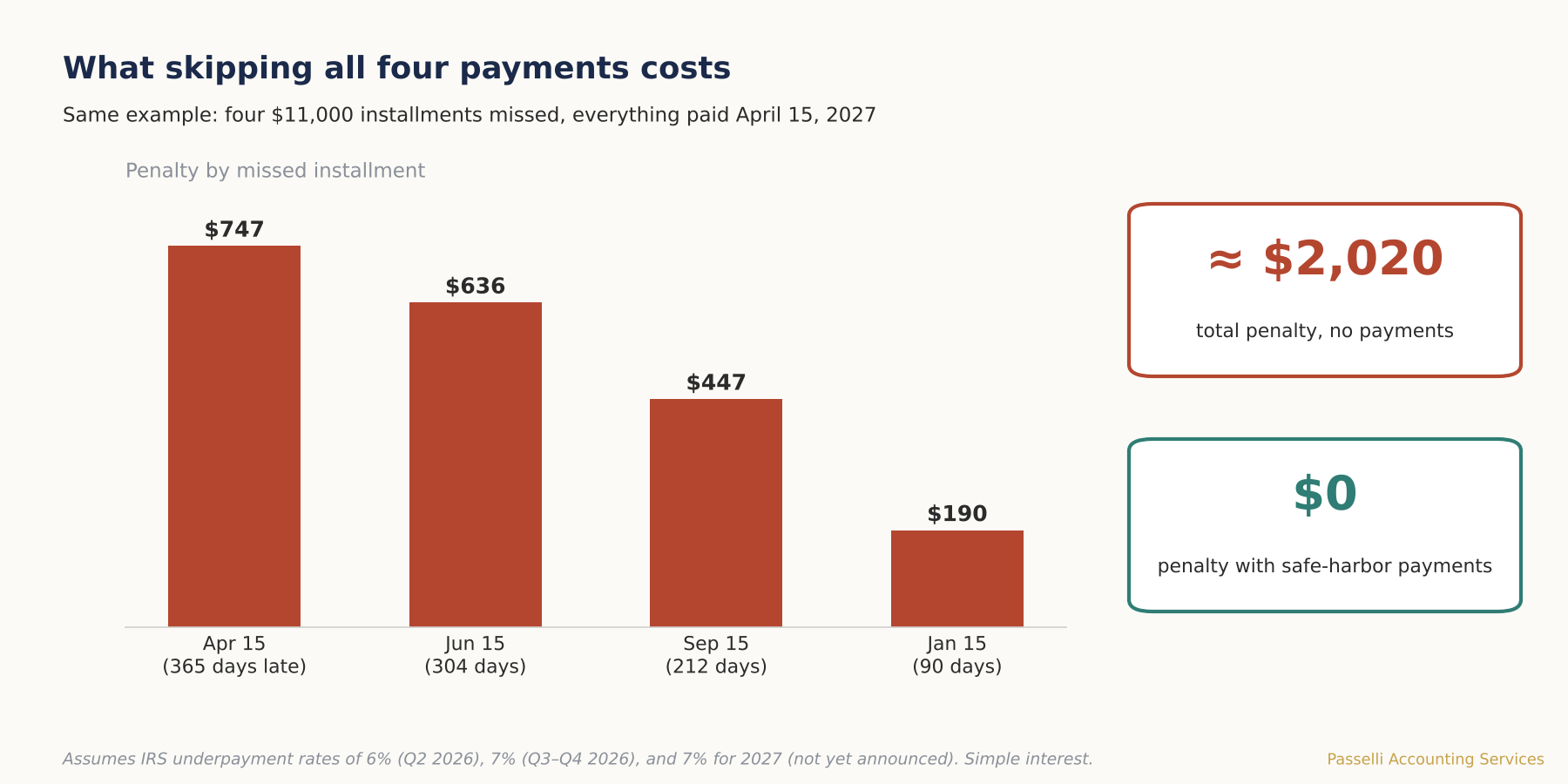
The penalty works like interest. It's charged on each missed installment from the date it was due until the date it's paid, at the IRS underpayment rate. That rate was 7% for most of 2026 (6% in the second quarter). And here's the part that surprises people: you can owe the penalty even if you end up getting a refund, because it's based on when you paid, not just how much.
If Maria made no estimated payments and paid everything on April 15, 2027, her penalty would be roughly $2,020. The April installment alone costs about $747 because it sat unpaid for a full year. Making the four $11,000 payments on time brings that to $0.
Two thousand dollars may not sound huge, but it's money spent for nothing. It isn't deductible and it doesn't reduce your tax. It also grows quickly with income: a client with a $40,000-a-quarter requirement would face more than $7,000 in penalty under the same facts.
Four ways to stay penalty-free
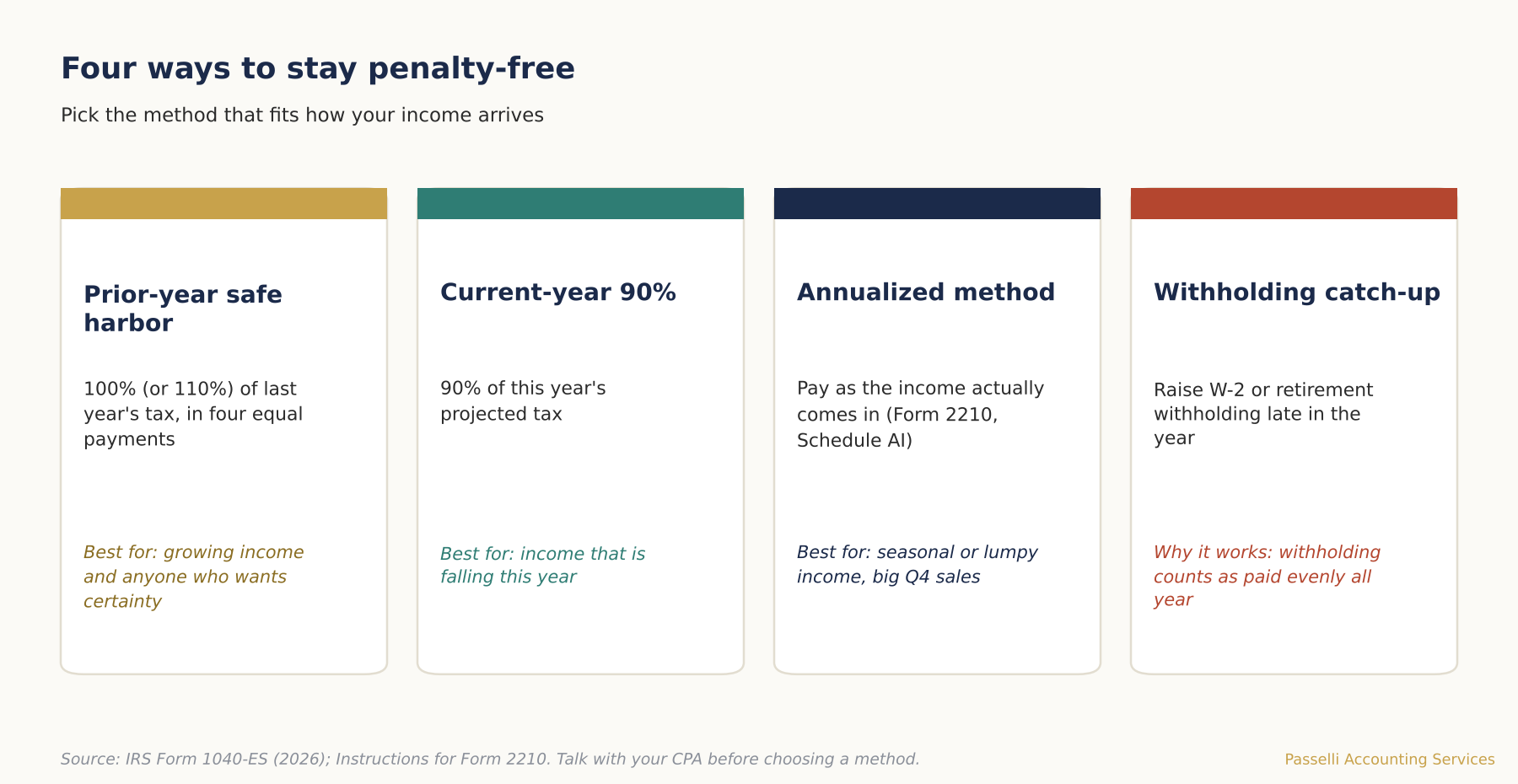
1. Prior-year safe harbor. Pay 100% (or 110%) of last year's tax in four equal payments. This is my default recommendation for most clients, especially when income is growing, because the target is known on day one.
2. Current-year 90%. If your income is dropping this year, 90% of this year's tax may be the smaller number. The catch is that you need a good projection, and if you guess low, you lose the protection.
3. The annualized income method. If your income comes in unevenly (a seasonal business, a big fourth-quarter sale, a large capital gain in November), you don't have to pretend it arrived evenly. Form 2210, Schedule AI lets you match each required payment to the income actually earned through that period, which can reduce or eliminate the penalty.
4. The withholding catch-up. This is the most useful year-end move. The IRS treats federal income tax withheld from wages as if it were paid in four equal parts on the four due dates, unless you choose otherwise. So if you or your spouse has a W-2 job, or you take IRA distributions, increasing withholding in December can fix an underpayment from earlier in the year. S corporation owners can do the same thing through their own payroll. An estimated payment sent in December can't do that, because it only counts from the date you send it.
Making the payments
Paying is simple. IRS Direct Pay, EFTPS and your IRS Online Account all accept estimated payments for free. Just choose "Estimated Tax" and the correct tax year. My earlier article on paying the IRS online walks through each option step by step. Keep the confirmation numbers, because we'll need the dates and amounts when we prepare your return.
The bottom line
Estimated taxes aren't extra tax. They're the same tax paid earlier. Using the safe harbor turns an uncertain bill into a fixed schedule: hit 100% (or 110%) of last year's tax across four on-time payments and the penalty goes away, even if you owe a balance in April. If your income is uneven or you're already behind for 2026, the annualized method and a year-end withholding increase can still limit the damage. The best time to set this up is before the January 15 payment, so reach out if you'd like us to calculate your 2027 schedule.
This article is for general educational purposes only and is not tax advice. Your situation may differ, so please reach out before acting on anything here.
Sources: IRS Form 1040-ES (2026); IRS Topic No. 306, Penalty for Underpayment of Estimated Tax; Instructions for Form 2210; IRS quarterly interest rates (IR-2026-98, Rev. Rul. 2026-5); Kiplinger and Instead.com analyses of 2026 estimated tax rules.
