A Short History of the United States and Its Taxes

Quick question: what’s the first thing that comes to mind when you think of the founding of America? For a lot of us, it’s a bunch of colonists throwing tea into a harbor. And here’s the thing - that wasn’t a party about tea. It was a fight about taxes. The United States was, in a very real sense, born out of an argument over who gets to tax whom - and we’ve been having that argument ever since.
So let’s take a quick walk through it. The story of American taxation is really the story of the country itself: its wars, its boom years, its crises, and its endless tug-of-war over who pays and how much. Stick with me - by the end you’ll never look at your paycheck the same way.
It Started With a Tea Party
Before there was a United States, there were colonists who were furious about being taxed by a Parliament an ocean away. “No taxation without representation” wasn’t just a slogan - it was the emotional engine of a revolution. The Stamp Act, the Townshend duties, and finally the tax on tea pushed them past their limit. In December 1773, a group of Bostonians dumped 342 chests of British tea into the harbor.
Here’s the irony you can already see coming: the new nation would soon have to figure out how to tax its own citizens. Turns out that’s a lot harder than complaining about someone else doing it.
The Awkward Early Years
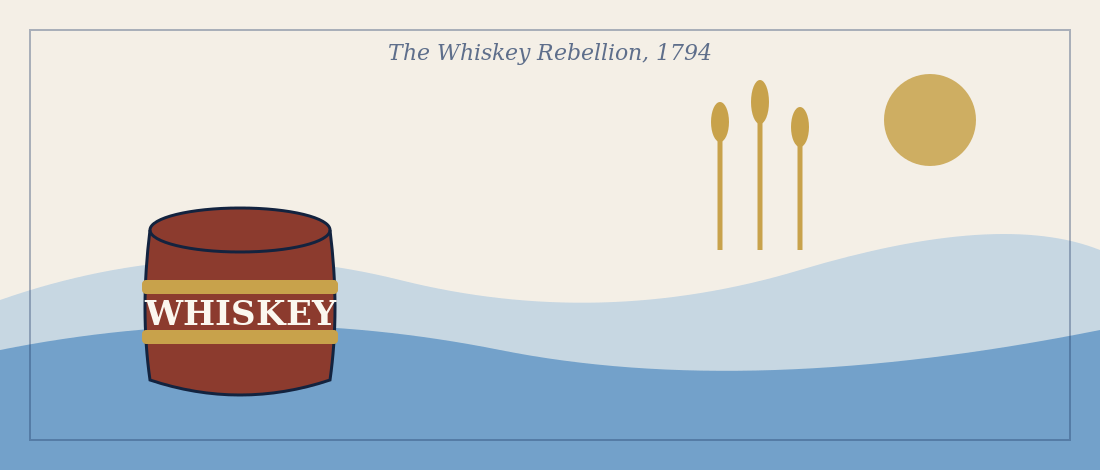
Independence came with bills to pay. The young republic was buried in Revolutionary War debt, and in 1791 Treasury Secretary Alexander Hamilton pushed through the first tax on a domestic product: an excise tax on whiskey. Frontier farmers - who turned their grain into spirits to make it worth hauling to market - were not amused. The Whiskey Rebellion of 1794 got violent enough that President George Washington personally rode out at the head of a 13,000-man militia to shut it down. The message? The federal government could, and would, collect its taxes.
For most of the 1800s, though, Washington funded itself in a way that would astonish you today - mostly through tariffs on imported goods. No income tax. No payroll tax. No IRS. But tariffs were political dynamite. The “Tariff of Abominations” of 1828 enraged the South and nearly triggered a constitutional crisis when South Carolina threatened to nullify federal law. Even then, taxes were never just about money. They were about region, power, and identity.
War Invents the Income Tax
It took a catastrophe to create the income tax. To finance the Civil War, President Abraham Lincoln signed the Revenue Act of 1862, which levied the nation’s first real income tax and created the office of the Commissioner of Internal Revenue - the direct ancestor of today’s IRS. It was progressive (higher earners paid higher rates), and it worked. But Americans treated it as an emergency measure, and once the war ended, they let it expire in 1872.
The idea didn’t die, though. Reformers kept pushing for a permanent income tax as a fairer alternative to tariffs that hit ordinary consumers hardest. Congress passed one in 1894 - and the Supreme Court promptly struck it down the next year as unconstitutional. Which set up the plot twist.
1913: The Year Everything Changed
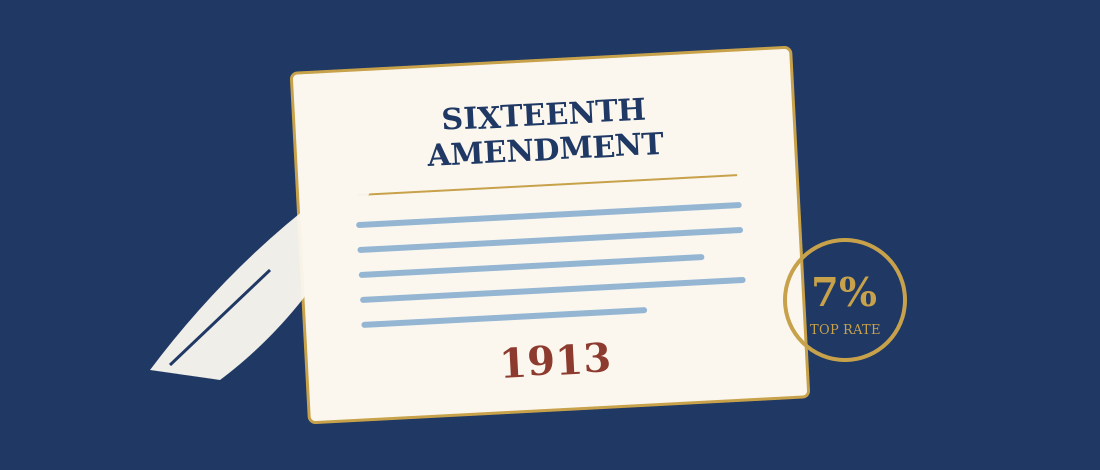
To get around the Court, supporters of the income tax did something bold: they amended the Constitution. The Sixteenth Amendment, ratified on February 3, 1913, gave Congress the explicit power to tax incomes. The modern income tax was born later that year - and by today’s standards it was almost adorable. The top rate was just 7 percent, it only applied to income above $500,000 (a fortune at the time), and fewer than one percent of Americans paid it at all.
Imagine this: the entire federal income tax once topped out at 7%, and almost nobody had to pay it. Hold onto that number - because it’s about to move fast.
Wars, Rates, and the Tax Everybody Pays
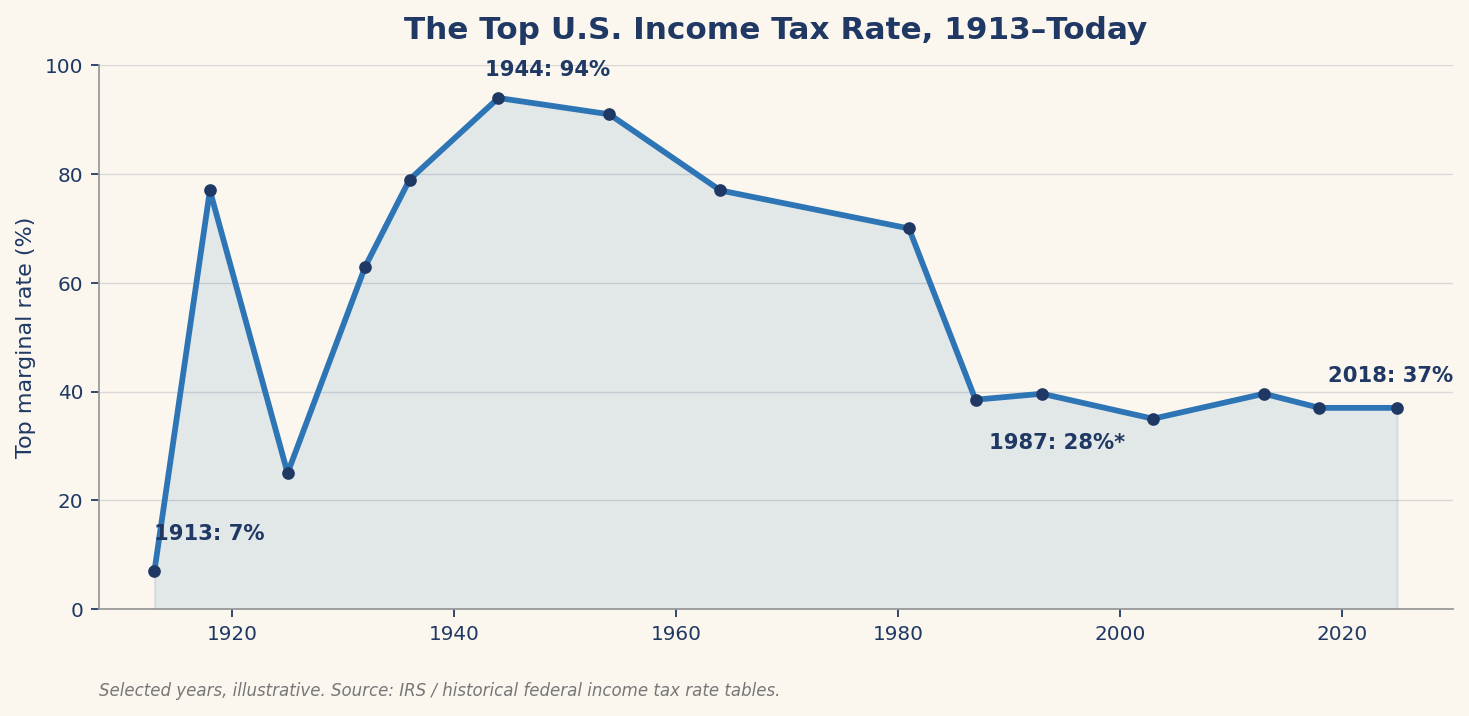
Once the machinery existed, the rates could rise - and did they ever. World War I sent the top rate past 70 percent. It fell in the roaring ‘20s, then climbed again during the Depression and the New Deal. The Social Security Act of 1935 added the payroll tax, creating the dedicated funding stream that still powers Social Security today.
Then came World War II, which transformed the income tax from a levy on the rich into something nearly every working American paid. The top marginal rate hit a jaw-dropping 94 percent in 1944 and 1945, and stayed above 90 percent for nearly two decades. Just as important, 1943 introduced payroll withholding - the system that quietly skims taxes from your paycheck before you ever see the money. Ever wonder why your take-home pay is smaller than your salary? You can thank a wartime accountant.
The Age of Cuts and Complexity
The second half of the twentieth century became one long argument over how high those rates should stay. By the 1980s the pendulum swung hard toward cutting them. Ronald Reagan’s 1981 and 1986 reforms slashed the top rate from 70 percent to 28 percent - a bet that lower rates would fuel growth. The decades since have been a back-and-forth: the Clinton-era increases, the Bush cuts of the early 2000s, the Tax Cuts and Jobs Act of 2017.
Through all of it, the code only got more tangled. What started as a few pages in 1913 is now a labyrinth of brackets, credits, deductions, and carve-outs - one big enough to support an entire profession of accountants and tax attorneys.
Why This History Matters to You
Look closely and a pattern jumps out. American taxes have almost always been driven by crisis - a revolution, a civil war, two world wars, a depression. Each emergency expanded what the government taxed and how, and most of those expansions never fully went away once the crisis passed.
That tension - between the deep American suspicion of taxes and the equally American appetite for an ambitious government - isn’t a bug in the story. It is the story. More than two centuries after Boston, the argument is still going strong. So next time you grumble at a withholding line on your pay stub, remember: you’re part of a debate older than the country itself.
What do you think - has the pendulum swung too far in either direction? Drop a comment and let me know.
