When or when not to become an S Corporation
An S Corporation (S Corp) is a tax election (via IRS Form 2553) available to eligible corporations or LLCs. It provides pass-through taxation—profits and losses flow directly to shareholders’ personal tax returns—while maintaining corporate limited liability protection.
This avoids the double taxation of a traditional C Corporation (corporate-level tax + shareholder dividends tax) but comes with strict eligibility rules and compliance requirements. Key Eligibility Requirements to qualify for S Corp status:
Domestic U.S. corporation (or LLC electing corporate taxation).
No more than 100 shareholders (family members can sometimes count as one).
Shareholders limited to U.S. citizens/resident aliens, certain trusts, or estates (no partnerships, corporations, or non-resident aliens).
Only one class of stock (voting rights can differ, but economic rights must be identical).
Not an ineligible entity (e.g., certain banks, insurance companies).
Deadline: Generally file Form 2553 within 2 months and 15 days of the start of the tax year for it to apply to that year. Late elections may qualify for relief in some cases.
When to Consider Becoming (or Electing) an S Corp. S Corp status often makes sense for profitable, owner-operated small businesses where tax savings outweigh added costs
Net profits are high enough for meaningful self-employment tax savings: Typically when annual net income exceeds ~$40,000–$80,000+ (varies by situation; some cite $50k–$100k gross revenue). You pay yourself a reasonable salary (subject to payroll taxes) and take remaining profits as distributions (not subject to self-employment/Social Security/Medicare taxes, currently ~15.3% on the first ~$168k in 2026).
Example: $100k profit as sole proprietor → $15k+ self-employment tax. As S Corp with $60k reasonable salary → payroll taxes only on salary ($9k), saving thousands.
You actively work in the business and can justify/document a reasonable salary (based on industry, role, location, experience).
You want limited liability + pass-through taxation without C Corp complexities.
Business is growing steadily but not yet needing venture capital or many shareholders.
Owners plan to sell/transfer the business (easier than some structures in some cases).
You value QBI (Qualified Business Income) deduction eligibility (up to 20% on pass-through income).
Bottom line: Ideal for consistent-profit service/professional businesses (consulting, tech, professional services) run by owner-operators who want to minimize self-employment taxes while staying small/domestic.
When NOT to Become an S Corp:
Low or inconsistent profits — Below ~$40k–$50k net, administrative/payroll costs often exceed tax savings. Early-stage or side-hustle businesses may prefer default LLC/sole prop taxation.
You need flexibility in ownership — More than 100 shareholders, non-U.S. owners, corporations/partnerships as owners, or multiple stock classes (e.g., for investors or complex equity).
High growth/VC plans — C Corps are often better for raising capital, stock options, or going public.
You prefer simplicity — S Corps require more paperwork: payroll (W-2 for owners), reasonable compensation documentation, annual meetings, separate tax filings (Form 1120-S), state compliance, and potential franchise taxes.
Real estate or businesses with high losses you want to deduct flexibly (passive loss rules or other limits may apply).
You’re risk-averse to IRS scrutiny — “Reasonable salary” is a common audit trigger. Too-low salary + high distributions can lead to reclassification, back taxes, penalties, and interest.
State tax issues — Some states don’t recognize S Corp status or impose extra taxes/fees.
One-time or short-term venture — Extra compliance isn’t worth it if the business isn’t long-term.
Other drawbacks: Potential reduction in retirement contribution base (tied to salary), restrictions on deducting certain losses, and higher formation/ongoing costs vs. a plain LLC.
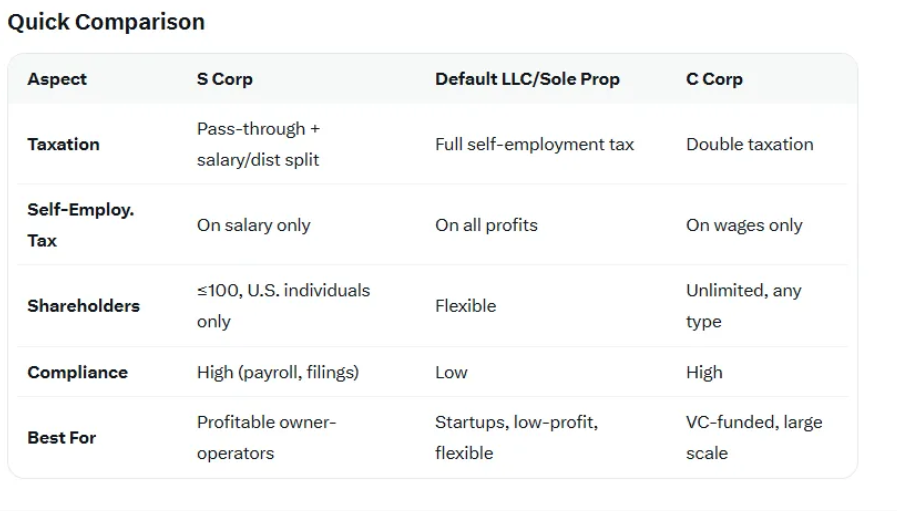
Financial Analysis: $100k Net Profit Entity (S Corp vs. Default LLC/Sole Prop):
$100,000 net business profit (after operating expenses, before owner compensation).
Reasonable S Corp salary: $60,000 (common benchmark for ~$100k profit businesses; 50–60% of profits; document with industry data to defend vs. IRS). Distributions: $40,000.
Standard deduction: ~$16,100 (single).
QBI deduction: 20% eligible (assumed full for both; S Corp applies only to distributions).
Self-employment/SE tax rate: 15.3% (12.4% SS up to $184,500 + 2.9% Medicare).
Half of SE/payroll taxes deductible.
No additional 0.9% Medicare tax (income under thresholds).
1. Employment Taxes (Biggest Difference)Default LLC (Sole Prop taxation):
Self-employment tax on full $100k: **$14,130** (after 92.35% adjustment).
You pay this on all profits.
S Corp:
Payroll taxes (FICA) only on $60k salary: ~$9,180 total (employer + employee shares; business deducts employer portion).
Savings: ~$4,950 on employment taxes alone vs. LLC.
Distributions ($40k) are not subject to SE/payroll taxes.
2. Rough Federal Income Tax + QBI (Approximate)Default LLC:
Business profit: $100k.
Deduct half SE tax (~$7,065) + standard deduction.
QBI: ~20% of $100k = $20k deduction.
Taxable income: Roughly in 22–24% brackets.
Estimated total federal tax (income + SE): ~$22,000–$26,000 (varies with exact deductions).
S Corp:
W-2 salary: $60k (subject to income tax).
Distributions: $40k (QBI-eligible).
Payroll taxes deductible (employer share).
QBI: 20% of $40k distributions (~$8k).
Estimated total federal tax (income + payroll): ~$18,000–$22,000.
Net savings: Often $3,000–$6,000+ vs. LLC at this level, mostly from SE tax reduction.
